Forte San Procolo: An Austrian-Era Detached Fort in Verona


Site at a Glance
- Rating
- 4.2
- Popularity
- Very Low
- Country
- Italy
- Primary era
- Modern
- External website
- Open
- Eras represented
- Modern
- Civilizations
- Austrian Empire, Habsburg
- Site type
- Military
- Remains
- Fort
On this page10 sections
History
Forte San Procolo is a nineteenth-century fortification in Verona, Italy, built under the Austrian-ruled Kingdom of Lombardy–Venetia between 1840 and 1841. Originally called Vorwerk San Procolo, meaning an advanced fort outside a city’s main fortified perimeter, it formed part of the defensive system developed around Verona between 1837 and 1843.
Planning and construction
The fortification project was designed under Franz von Scholl, a German major general who directed Verona’s Imperial-Royal Fortification Office. Scholl intended to complete the defenses on the right bank of the Adige and to give indirect protection to the Santa Lucia–San Massimo plain and escarpment. The plan also related to the later advanced strongpoints at Santa Caterina and Porta Nuova.
Scholl’s proposal was not carried out before his death in 1838. Johann von Hlavaty, a major general and military engineer who became the new director of the fortification works, subsequently directed the construction of Forte San Procolo. Work took place during the wider expansion of Verona’s hill forts and advanced plain forts.
Defensive role
The fort occupied a depression at the foot of the San Massimo escarpment, toward the San Procolo bastion. This ground was considered favorable to an attacking force. The depression threatened sorties from the city because artillery within the defenses could engage it only at a steep downward angle, while batteries on the opposite bank of the Adige could also bring fire into the area.
Forte San Procolo was positioned to overcome these tactical disadvantages and to connect the forward defenses with Verona’s main fortified perimeter. Its wartime garrison comprised 230 infantrymen and 30 artillerymen, with an emergency strength of 438 men. The fort remained part of Verona’s defenses under the Kingdom of Lombardy–Venetia and was later used by the Kingdom of Italy.
Remains
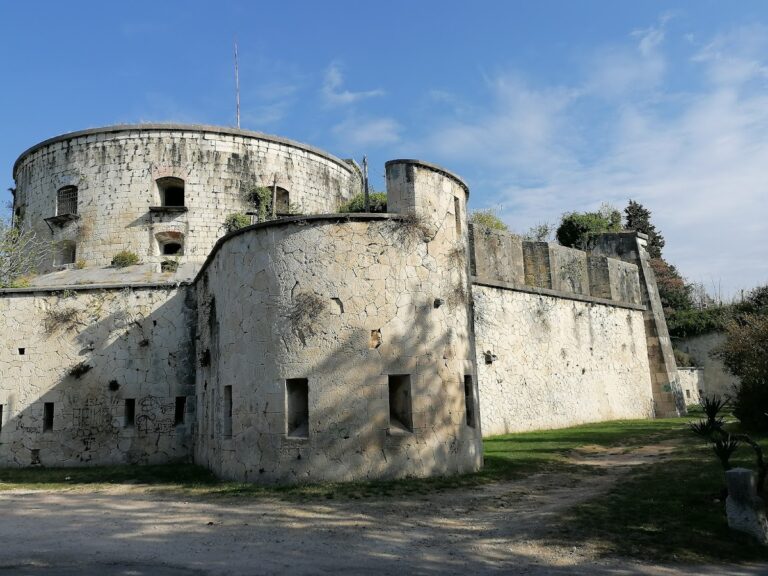
Forte San Procolo survives as a large, asymmetrical heptagonal fortification beside the right bank of the Adige, in front of the San Procolo–Spagna bastioned front. Its principal work is an earthen enclosure with a raised parapet, open artillery positions, naturally sloping outer faces, and a dry ditch extending around the perimeter. A covered slope, or glacis, surrounded the ditch and exposed attackers to fire from the fort.
Outer defenses
Earthwork and ditch
The parapet carried artillery positions arranged to engage the entire horizon, helping the fort counter the restricted firing angles created by the surrounding depression and the batteries across the river. Four casemated caponiers, covered defensive works projecting into or alongside a ditch, were arranged for riflemen and flanked the perimeter. Two adjoining wings of revetment wall reinforced the earthwork at the caponiers, while a simple palisade protected its foot within the ditch.
Central redoubt
At the center stands a two-storey casemated redoubt on a square plan, enclosing the inner courtyard. A casemate is a fortified enclosed position for personnel or artillery. Small caponiers resembling bastions alternate at the redoubt’s corners, and a riflemen’s gallery running around the entire perimeter provided access to them.
Interior defenses and access
Traverses and magazines
Four large casemated traverses divide the inner parade ground. These raised or strengthened barriers were integrated into the earthwork, and each contained a powder magazine. Their passages led to posterns, concealed secondary passages through a fortification, which connected the interior with the four caponiers flanking the ditch.
Entrance and armament
The entrance was placed on the southeast side of the heptagon, facing the main fortified perimeter, and was protected by a riflemen’s gallery. A postern rose from ditch level to the inner parade ground, where a drawbridge crossed the ditch to the central redoubt.
The fort’s artillery consisted of two 9.5-centimeter guns with rifled barrels and muzzle-loading systems. Four powder magazines held the ammunition reserves, each with a capacity of 1,790 kilograms. Forte San Procolo is preserved in its current condition.
Nearby sites