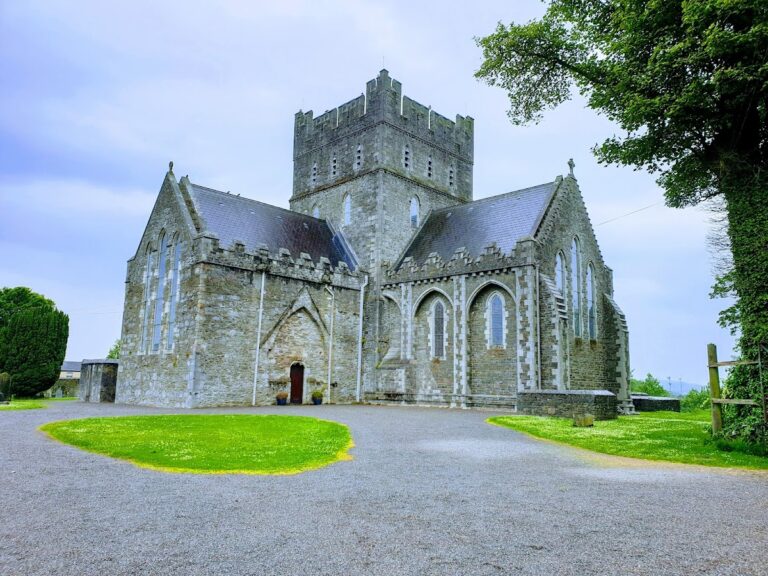
Blundell Castle: A Ruined Hilltop Fortress in Ireland


Site at a Glance
- Rating
- 4.1
- Popularity
- Very Low
- Country
- Ireland
- Primary era
- Early Modern
- Eras represented
- Medieval, Early Modern
- Civilizations
- English, Norman
- Site type
- Military
- Remains
- Castle
On this page9 sections
History
Blundell Castle is a ruined fifteenth-century hilltop fortress in Ireland, standing above Edenderry in County Offaly and built by the de Bermingham feudal lords. Its name is translated as “castle on the hilltop of oaks.” The site belonged to a contested frontier shaped by the Anglo-Norman conquest of Ireland, which began in 1171 and brought English and Norman lords, settlements, and fortified sites into territories previously controlled by Gaelic dynasties and clans.
Gaelic and Anglo-Norman frontier
Before the conquest, the surrounding lands were held by the Ui Failghe clan, which was dependent on the O’Connors. Anglo-Norman colonization displaced Irish communities and led to prolonged conflict between the settlers and Gaelic clans. The castle later became associated with the struggle between the de Berminghams and the O’Connors. In 1305, the baron Pierce de Bermingham invited 28 members of the O’Connor clan to a festival, surrounded them, and killed them.
An earlier fortification may have stood on the hill, but that possibility remains uncertain. A record from 1427 describes John de Grey, Lord Deputy of Ireland, the chief representative of the English crown in Ireland, attacking and destroying Edenderry Castle. It is possible that this reference concerns Blundell Castle, although the identification is not certain.
O’Connor Faly control
By the fifteenth century, de Bermingham control in the area had effectively ended, and the O’Connor clan had taken control. The O’Connor Faly clan was a Gaelic ruling lineage based in the central Irish region associated with Ui Failghe. Its principal residence was Croghan Castle, within direct sight of Blundell Castle, and the clan used Croghan during its wars against English authority.
The O’Connors defeated English forces at Gishill in 1406 and Lucan in 1414. They also defeated and captured Thomas, Earl of Desmond. During the fifteenth and sixteenth centuries, the O’Connor Faly clan expanded its territory and recognized no authority other than that of its own chiefs.
Internal disputes later weakened the clan. In 1511, its leader, Cahir O’Connor Faly, was killed by members of his own clan, the brothers Taig and John Ballagh O’Connor of Monasteroris. England exploited these divisions. Although the lands of Ui Failghe, or Teffia, were described as strong Irish territories in 1521, England conquered them a few years later.
Colley ownership and English authority
The Colley family acquired the castle around 1556, after the English conquest of the area. Edenderry was then known as Coolestown or Colleytown. Henry Colley probably rebuilt the castle around 1560. A 1550 survey by Walter Colley called it Edanderry Castle, while a map made that year by Andrews and Loeber appears to mark the site.
George Colley, the Colley heir, inherited the castle in 1581 and worked to establish English authority and law in the area. During the Nine Years’ War in Ireland, a late-sixteenth-century conflict between forces representing English rule and a coalition of Irish leaders, he drove away livestock to prevent Irish clans from seizing it.
Sir George Colley defended Blundell Castle against an attack by the O’Neills in 1599. The castle withstood the siege. Nicholas Herbert may have controlled it on behalf of the English government in 1658, although it is uncertain whether he was the owner or the castellan, the official responsible for administering or defending a castle.
Blundell ownership and destruction
The Colley family held the castle until 1650, when George Blundell married Sarah Colley and received it as her dowry. It thereafter became known as Blundell Castle. The Irish rebellion that began in 1641 caused widespread destruction, but no fighting around Blundell Castle during that conflict is recorded.
In 1674, the state confiscated the castle after Sarah and George Blundell’s three sons, Francis, William, and Winwood, were accused of murdering Thomas Preston, the Catholic son of Lord Tara. King Charles II later acquitted them. Charles II ruled England, Scotland, and Ireland from 1660 to 1685.
During the Williamite or Jacobite wars, conflicts connected with the struggle between supporters of James II and William III, troops loyal to the Catholic King James II attacked the castle in 1691 and severely damaged it. The Blundells supported the Williamites, destroyed Ballybrittain Castle, destroyed Edenderry on 13 February 1691, and fought the Catholic forces led by the O’Connors.
Blundell Castle was abandoned after the attack and gradually became a ruin. Sarah Blundell died in 1701 and Francis Blundell in 1707. In the nineteenth century, the castle became associated with Lord Downshire, an Irish peer, while local residents dismantled parts of the ruins for building materials.
Later traditions
Local tradition says that the ghost of Sarah Blundell, also called Lady Blundell, has appeared among the ruins. The castle is mentioned in older songs and poems, including Dermot and the Earl of Maurice Regan, which concerns Dermot MacMurrough, the twelfth-century king of Leinster whose actions were connected with the beginning of the Anglo-Norman intervention in Ireland.
Another tradition claims that a tunnel links Blundell Castle with Carbury Castle, about 8 kilometres away. Its proposed history varies. One interpretation attributes it to the de Berminghams as a wartime communication route, while another says that Lord Downshire’s wife used it to meet a lover at Carbury Castle. According to that story, Lord Downshire discovered the affair and killed her. The full connection remains unverified.
Remains
Hilltop fortress
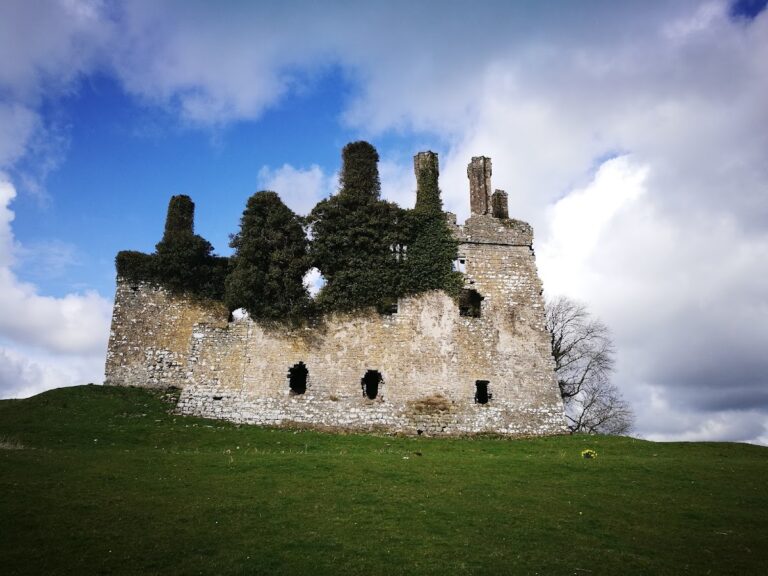
Blundell Castle is a rubble-stone fortress on a hill approximately 108 metres above sea level. Its towers once provided views over Edenderry. Carbury Castle, identified as the principal residence of the de Berminghams, and Croghan Castle, the principal residence of the O’Connors, were both within direct line of sight of the site.
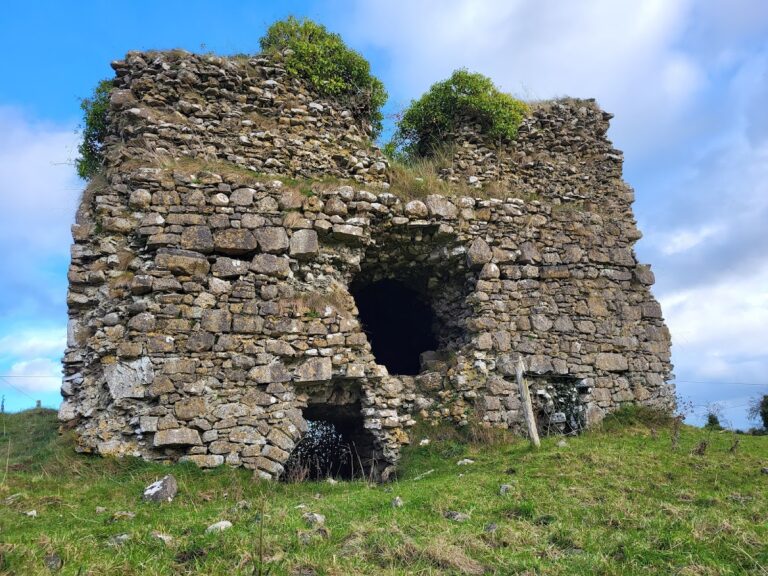
The surviving structure is a ruin shaped by the severe damage inflicted in 1691 and by abandonment thereafter. Parts of the castle were later dismantled for building materials during the nineteenth century. The remaining fabric continues to deteriorate, and the ruins have been regarded as at risk of eventual disappearance.
Water tower and tunnel entrance
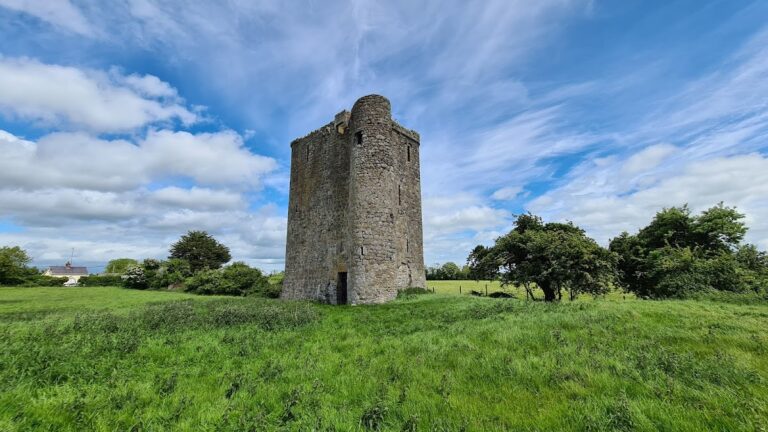
A water tower stands beside the castle. Near the ruins, a tunnel entrance is also reported. The entrance’s alleged route toward Carbury Castle, its construction, and its historical use remain uncertain.
Nearby sites