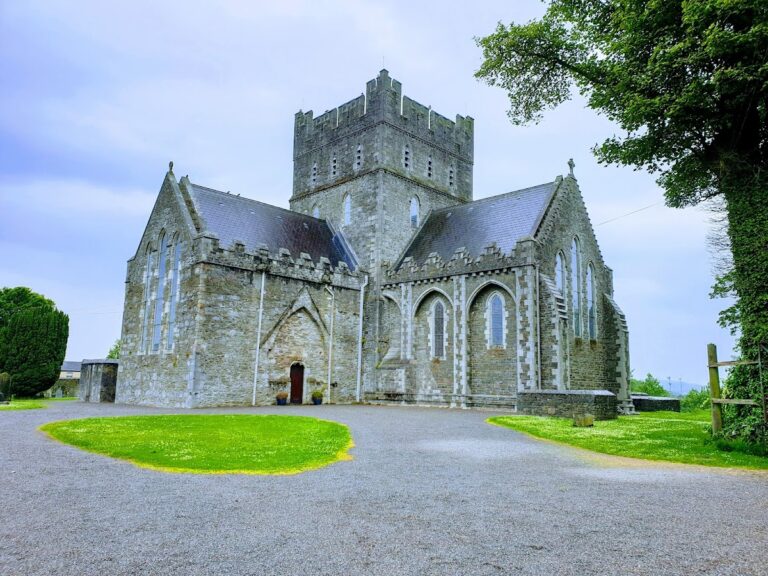
Carbury Castle: A Medieval Castle in County Kildare


Site at a Glance
- Rating
- 4.7
- Popularity
- Low
- Country
- Ireland
- Primary era
- Early Modern
- External website
- Open
- Eras represented
- Medieval, Early Modern
- Civilizations
- English, Norman
- Site type
- Military
- Remains
- Castle
On this page8 sections
History
Carbury Castle is a medieval castle in Ireland, located near Carbury in County Kildare. Its earliest development followed the Anglo-Norman conquest of Ireland around 1171, while the castle is dated to 1220. Built on an artificial mound, it became associated with successive Anglo-Norman and Irish landholding families before being transformed into a fortified house by the Colleys.
Anglo-Norman foundations
The castle’s beginnings lay in a motte-and-bailey, a raised earth mound carrying a defensive structure beside an enclosed courtyard. Meiler FitzHenry, an Anglo-Norman feudal lord, is credited with building the original wooden fortification on the mound after Strongbow, the commonly used name of Richard de Clare, granted him the land.
Carbury Hill was also connected with the Irish clan Cairbre Uí Chiardha, a sept, or branch, of the southern O’Neills. The clan’s chiefs appear in the Annals of the Four Masters, a major Irish historical chronicle compiled from earlier records, from 952 onward. The clan’s name was later anglicized as Carey.
Stone castle and Irish control
In the fourteenth century, the De Bermingham family, whose origins were Norman, acquired the estate and built the oldest surviving part of the stone castle. The property later passed to the Preston family, whose head held the title Baron Gormanston.
Irish clans repeatedly attacked Carbury Castle in attempts to recover their traditional lands. By the fourteenth century, or during the period after 1400, the castle had come under Irish control. Around 1446, an Irish leader made peace with John Talbot, 1st Earl of Shrewsbury, an English nobleman and military and political figure, and retained the castle. Talbot is also credited with rebuilding it after 1447.
The Colley estate
On 23 October 1554, Sir Henry Colley leased the estate for 21 years. The Colley family had secured full ownership by 1562 and expanded the castle. The family later became the paternal ancestors of the Dukes of Wellington.
During the seventeenth century, the Colleys developed a large fortified house on the summit of Carbury Hill. They also added a church and a family mausoleum south of the castle. Early in the same century, the building received four large chimneys and new large windows, reflecting its development beyond its earlier defensive role.
Destruction in 1798
During the Irish rebellion of 1798, insurgents used Carbury Castle as a base. Fighting during the rebellion severely damaged the castle and left it in ruins.
Remains
Carbury Castle occupies an artificial mound on Carbury Hill, also known as Fairy Hill, at an elevation of about 134 metres. Fairy Hill is an English folkloric name for a hill associated in Irish tradition with fairies or other supernatural beings. The mound probably began as an Anglo-Norman motte and supported the earlier wooden fortification before the stone castle was built. The hill stands near the sources of the River Boyne and forms a prominent feature in the surrounding landscape.
Hilltop castle and fortified house
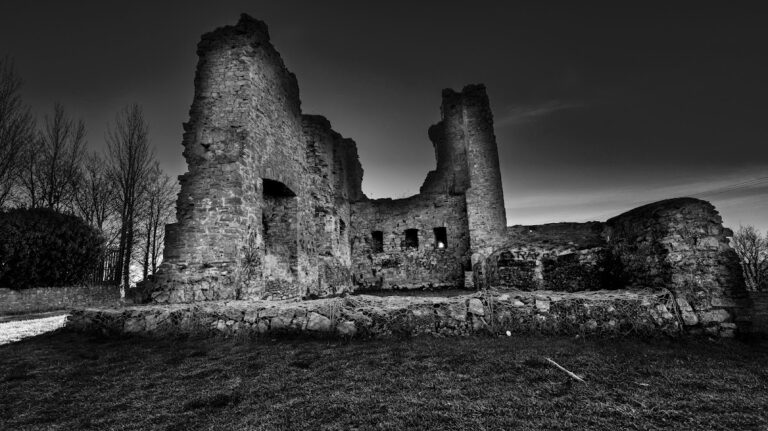
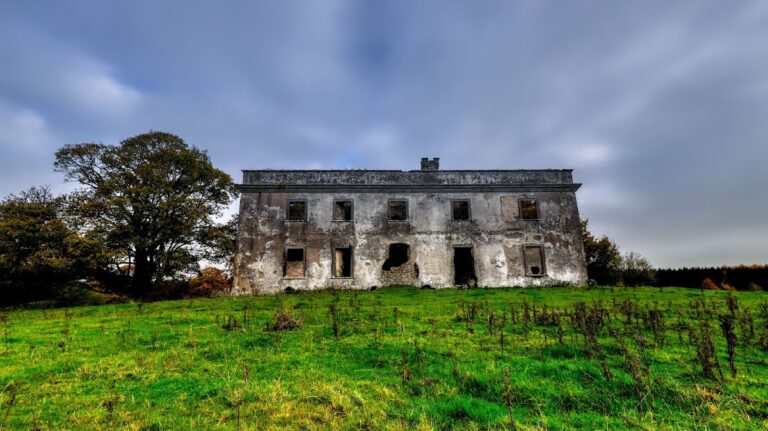
The surviving complex is a ruin built mainly of rubble stone. Its principal visible remains are the large fortified house developed by the Colleys on the hilltop. Four large chimneys and large windows added early in the seventeenth century remain part of the building’s architectural history, while the ruined structure preserves the form of the later fortified residence on the mound.
Church and burial remains
Near the castle ruins are an ancient church, an older manor house, a cemetery, and a mausoleum. The church and family mausoleum built by the Colleys lie south of the castle, forming part of the surviving group of structures associated with the estate.
Two Bronze Age round barrows are associated with the hill. They were erected after approximately 3000 BC and provide evidence of activity at the site long before the Anglo-Norman fortification and medieval castle.
Nearby sites