Fort de l’Ève: A Coastal Artillery Battery at Saint-Nazaire

Site at a Glance
- Rating
- 4.5
- Popularity
- Very Low
- Country
- France
- Primary era
- Modern
- Eras represented
- Modern
- Civilizations
- French, German
- Site type
- Military
- Remains
- Fort
On this page15 sections
History
Fort de l’Ève is a coastal defensive site in Saint-Nazaire, France, established by the French for the protection of the Loire estuary and the nearby port. Its principal battery was built between 1891 and 1895 as a late nineteenth-century coastal-artillery position, and the site later became part of the German defenses of Saint-Nazaire during the Second World War.
Origins and French construction
The first planned defense at the Ève promontory dates from 1859. A model tower was proposed to protect the nearby beach, but the project was abandoned before the tower was built. A substantial earthwork forming a parapet was completed instead. The French Navy acquired the site and marked its boundaries on 20 September 1859 in preparation for a larger coastal-artillery battery.
The French position took shape in stages. An underground magazine was built in 1890, followed by the main battery between 1891 and 1895. Barracks were added in 1899 and 1900, and a rear range-finding and fire-control post was constructed in 1901 and 1902. A rangefinder measures the distance to a target, while a fire-control installation uses observations and measurements to direct artillery fire.
French naval defense before 1940
During the First World War, the French Navy operated a battery complex intended to control the entrance to the Loire and protect Saint-Nazaire’s port infrastructure. The defenses included batteries at Fort de l’Ève and Fort du Pointeau. Each had four 240 mm Guerre Model 1884 guns firing over the parapet and four 95 mm Lahitolle Model 1888 guns. A separate battery of two 75 mm Model 1897 guns stood at Ville-Es-Martin.
The weapons at the two main batteries did not remain unchanged. After the First World War, the Ève battery retained three 240 mm guns whose chambers had been enlarged. The corresponding guns at Pointeau had been sent to the Verdun front in 1916. Two 95 mm Lahitolle guns at Ève were dismantled in 1920.
Modernization before the Second World War
Modernization began in 1931 with a command and range-finding post equipped with offset observation posts, a large rangefinder on the upper roof surface, and an Aster-type generating set. In 1932, four concrete positions with adjoining ammunition chambers were under construction for 194 mm Model 1902 guns. The terraces of the four magazines were waterproofed in 1940.
By the eve of the Second World War, all four 194 mm guns had been installed and were ready for action. Two rangefinders directed the battery’s fire. These works replaced much of the earlier artillery arrangement while preserving the site’s function as a position controlling the seaward approach to the estuary.
German occupation and Operation Chariot
The Kriegsmarine, the German navy during the National Socialist period and the Second World War, took control of the battery in July 1940. Before surrendering, the French crews sabotaged the equipment to varying degrees, including the optics of a searchlight. In 1941, German personnel dismantled the obsolete French coastal guns and installed their own 17 cm coastal-artillery equipment.
The German naval coastal-artillery detachment remained at the former French battery until 11 May 1945. The position was renamed MKB “Bencke,” operated by the 3./MAA 280, and identified as Nz 305 within the Saint-Nazaire fortress system. MAA was short for Marine-Artillerie-Abteilung, a German naval coastal-artillery detachment. The local commander was Oberleutnant MA d.R. Heinrich Meyer. The unit had 151 personnel, including one officer, 29 non-commissioned officers, and 121 sailors.
The MAA 280 was distributed on both sides of the Loire estuary and was subordinate to the German maritime-defense commander for the Loire. Its first commander was Kapitänleutnant MA Edo-Friedrich Dieckmann, based at Pointe de Chemoulin on the north bank. Korvettenkapitän MA Werner Sommerfeld succeeded him in March 1943, followed by Korvettenkapitän MA Hans Luther in April 1943.
Fort de l’Ève took part in the fighting during Operation Chariot, the British raid on the Saint-Nazaire dock and lock facilities on 28 March 1942. The battery fired on the attacking flotilla, which included motor launches, MGB 314, MTB 74, and HMS Campbeltown. German forces had been on general alert since 11:30 p.m., while 35 Whitley and 27 Wellington bombers circled above Saint-Nazaire.
The flotilla was detected at 1:22 a.m. in the middle of the estuary, between Pointe de Villes-Martin and the Pointeau promontory. Fighting began at about 1:28 a.m. The Ève battery’s 17 cm SKL/40 guns and the Pointeau battery’s 7.5 cm C/97 guns fired heavily. The total number of shells directed at the flotilla was at least 1,500, although the exact figure remains uncertain. Seven launches were destroyed during the outward passage and two during the return passage, under fire from the Pointeau 7.5 cm guns and the Ève 17 cm guns.
Final destruction and later change
By the liberation, only two of the four German 17 cm guns remained at the site, identified as guns 3 and 4. Guns 1 and 2 had been removed from their casemates and sent to the land front near Lesnais. During the winter of 1945, wooden dummy guns were placed in the two western casemates. The embrasures of the two eastern casemates were enlarged with jackhammers so that the remaining guns could cover a wider firing sector against a possible Allied landing.
On 8 May 1945, as surrender approached, German sailors destroyed the battery’s firing and range-finding equipment. The German naval unit remained at the former French battery until 11 May. Later changes reduced the surviving military installation: part of the site was replaced by the Fort de l’Ève campsite, an equipped beach with a seasonal lifeguard station, and a large parking area.
Remains
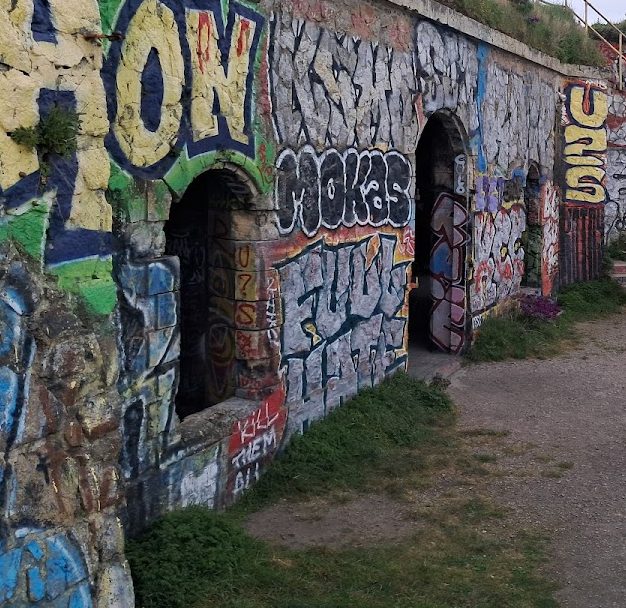
Fort de l’Ève occupies the Ève promontory at the entrance to the Loire estuary, near a beach in Saint-Nazaire. The surviving complex combines the earthwork of the nineteenth-century defense, underground and surface artillery installations, barracks, magazines, and later concrete positions. Its remains are incomplete because sections of the former military area later disappeared or were replaced by beach facilities, a campsite, and parking.
French battery and support works
Earthwork and firing platforms
The earliest surviving defensive feature is the substantial earth embankment that formed a parapet. It represents the 1859 work carried out after the planned model tower was abandoned. The later French battery used artillery firing platforms for guns mounted behind or above the parapet, a barbette arrangement that allowed them to fire over the earthwork.
Magazine and barracks
An underground magazine dating from 1890 formed part of the French battery’s ammunition infrastructure. Four magazines also belonged to the later position, while barracks built in 1899 and 1900 provided its accommodation. Their terraces were waterproofed in 1940, an alteration made shortly before the German occupation.
Range-finding post
Behind the position stands the range-finding and fire-control installation built in 1901 and 1902. The modernization of 1931 added a command and range-finding post with offset observation posts, a large rangefinder on the upper roof surface, and an Aster-type generating set. By the eve of the Second World War, two rangefinders directed the four 194 mm guns.
Concrete gun positions
194 mm gun emplacements
The 1930s modernization produced four concrete gun positions for 194 mm Model 1902 guns. Each position had an adjoining ammunition chamber. All four guns were installed and ready for action before the Second World War, creating the principal late French armament of the battery.
German casemates and altered embrasures
The German replacement armament included four 17 cm guns, installed after the older French coastal guns were dismantled in 1941. A casemate is a protected chamber or gun emplacement, and an embrasure is the opening through which a gun fires. By 1945, guns 1 and 2 had been removed and sent to the land front near Lesnais. Wooden dummy guns were then installed in the two western casemates, while the embrasures of the two eastern casemates were enlarged to extend the firing sector of guns 3 and 4.
German equipment and surviving military fabric
The German battery also had four 7.5 cm guns, a 5 cm antitank gun, three 2 cm Oerlikon anti-aircraft guns, two searchlights, and machine guns of German, Polish, and French origin. Its listed equipment included a 150 cm searchlight, two German light machine guns, four Polish light machine guns, one French light machine gun, and two French heavy machine guns. Individual equipment included 125 Gewehr rifles, with 400 rounds issued per man.
The firing and range-finding installations were destroyed by German personnel on 8 May 1945. The remaining structures therefore preserve an incomplete defensive complex, combining French earthworks and concrete artillery works with alterations made during German occupation and the physical changes that followed the site’s military use.
Nearby sites