Grenchen Castle Ruins: An 11th-Century Hill Castle in Switzerland


Site at a Glance
- Rating
- 4.7
- Popularity
- Very Low
- Country
- Switzerland
- Primary era
- Medieval
- External website
- Open
- Eras represented
- Medieval
- Civilizations
- Holy Roman Empire
- Site type
- Military
- Remains
- Castle
On this page6 sections
History
Grenchen castle ruins, also known as Bettleschloss, are the remains of a medieval hill castle in Switzerland above the municipalities of Grenchen and Bettlach. Founded around AD 1000, the castle belonged to the early clearing castles of the Jura Mountains, fortified settlements established alongside the clearing and development of wooded land.
Foundation and stone rebuilding
The first fortification consisted of a wooden castle and a rampart. Around 1150, the Barons of Grenchen, a medieval noble family, rebuilt the site in stone. The new castle included a tower house, a fortified residence organized around a substantial tower, together with several outbuildings.
By around 1200, the outbuildings had been enlarged and an oven had been added to the complex. The castle remained inhabited until the early fourteenth century.
Destruction, investigation, and conservation
In 1583, the Council of Solothurn authorized the use of the castle ruins as a stone quarry for constructing a prison tower in Grenchen. The later history of the site also produced important archaeological evidence. In 1930, Germann Leimer of Bettlach found a fourteenth-century hoard in the castle area containing 300 silver planchets, prepared pieces of silver intended to be struck into coins, several coins, a small silver bar, and an iron bar.
The Grenchen Museum Society began archaeological investigations in 1959 and 1961. After the excavations, the surviving ruin masonry was restored and conserved. The excavation finds and a model of the castle were subsequently exhibited at the Historical-Cultural Museum of Grenchen. In 2011, the Bettlach Historical Association and the Grenchen Museum Society organized further work at the ruins, removing overgrown vegetation, repairing the walls, and renewing the castle entrance.
Remains
Hilltop castle layout
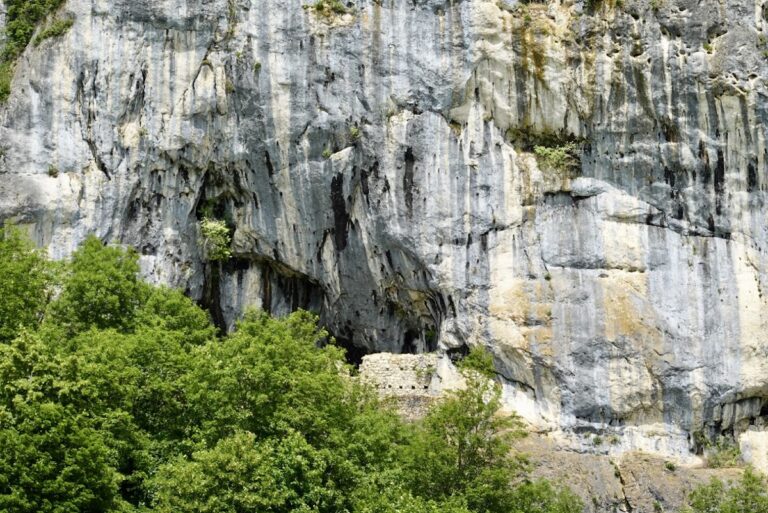
The ruins form a hill castle at approximately 950 metres above sea level, positioned above Grenchen and Bettlach. The main castle stood on Schlossfluh, while a lower castle occupied Hofacherfluh. The original wooden fortification and rampart were later replaced by a stone complex consisting of a tower house and several outbuildings. Enlargement of the outbuildings around 1200 and the incorporation of an oven reflect the development of the occupied castle complex.
Surviving masonry
The castle survives in a ruined state. Its remaining masonry was restored and conserved after the archaeological excavations, and later work cleared vegetation and repaired the walls. The renewed entrance and the preserved wall sections form part of the surviving physical evidence of the medieval castle.