Château de la Roche: A Medieval Hilltop Fortress in France


Site at a Glance
- Rating
- 4.3
- Popularity
- Very Low
- Country
- France
- Primary era
- Medieval
- Eras represented
- Medieval
- Civilizations
- Holy Roman Empire
- Site type
- Military
- Remains
- Castle
On this page11 sections
History
Château de la Roche is a ruined medieval hilltop fortress in France, above the village of Bellefosse in the Ban de la Roche. Built probably in the second half of the thirteenth century by a knight of the Rathsamhausen family, it served a defensive purpose within an imperial fief, a territory held directly from the emperor or the Holy Roman Empire in return for allegiance and recognized obligations.
Origins and Rathsamhausen Lordship
The castle’s origins are uncertain. It was traditionally said to have been built in the eleventh century and destroyed in 1099, while a castellanus de Rupe, meaning a castle administrator or commander, appears in a document from 1178. The present fortress is considered later. The earlier identification of its founders with the de Lapide or de Rupe family is regarded as mistaken, since those imperial knights were based at Dreistein near the Abbey of Hohenbourg-Saint-Odile.
The present castle was probably established in the late thirteenth century by a member of the Rathsamhausen family, who served the Staufers. The Staufers were a major medieval imperial dynasty whose rulers held the German kingship and the Holy Roman Empire. Rudolf and Hartmann von Racenhusen were involved in a territorial dispute with the nobles of Andlau in 1284 and may already have controlled the lordship at that time.
The first documentary reference to the castle dates from 1398, when it was called “die purgk zum Stein” during an arbitration over a forest dispute between the Rathsamhausens and the city of Obernai. The lordship of Ban de la Roche, also known as Steintal, included eight villages and remained an imperial fief of the Rathsamhausen family until it passed to Count Georg Johann of Veldenz in 1584.
Conflict and Destruction
Ulrich of Rathsamhausen pledged the castle to the Duke of Lorraine in 1430 for 400 gold florins. In 1445, the fortress provided the setting for a reconciliation between Obernai and the Count of Salm.
The castle’s decisive crisis began on 19 April 1469. From 1467, occupants associated with Jerothe of Rathsamhausen and Wecker of Leiningen had attacked merchant convoys from Lübeck, Göttingen, and Mulhouse and held merchants for ransom. The Duke of Lorraine and the Bishop of Strasbourg joined forces to end these raids.
After the roads were made passable, artillery was brought from the arsenal of Nancy, while infantry surrounded the castle. Its defenders consisted of 22 men, 16 squires, peasants, and two women. Bombardment forced the garrison to surrender on 23 April 1469, and the fortress was dismantled immediately.
An effort to rebuild the castle in 1472 was blocked by the Count of Salm and the Bishop of Strasbourg, so it was never reconstructed. The younger Jerothe of Rathsamhausen’s part in the ransom-taking remains uncertain. He was buried in the small church at Fouday rather than with his family at Baldenheim. A tombstone records his death in 1492, and the church frescoes probably show him and his wife as donors. The ruins are listed in the French heritage inventory.
Remains
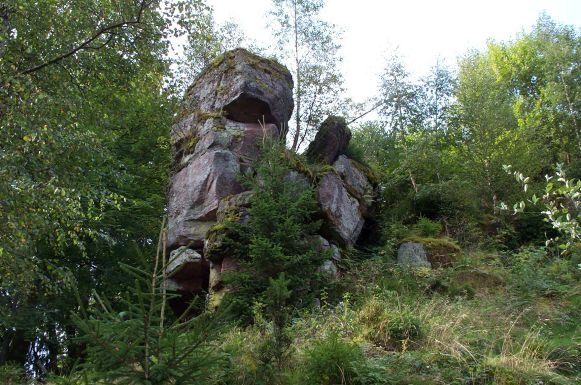
Château de la Roche occupies a rocky dolerite outcrop 820 metres above the Chirgoutte valley and Bellefosse, in a side valley of the Bruche near the northern edge of the Vosges and the Champ du Feu massif. A deep neck ditch, more than 50 metres long, separates the rock from the mountain. The summit is narrow and allowed little space for construction, producing a compact defensive layout.
Fortified Rock and Main Buildings
Keep
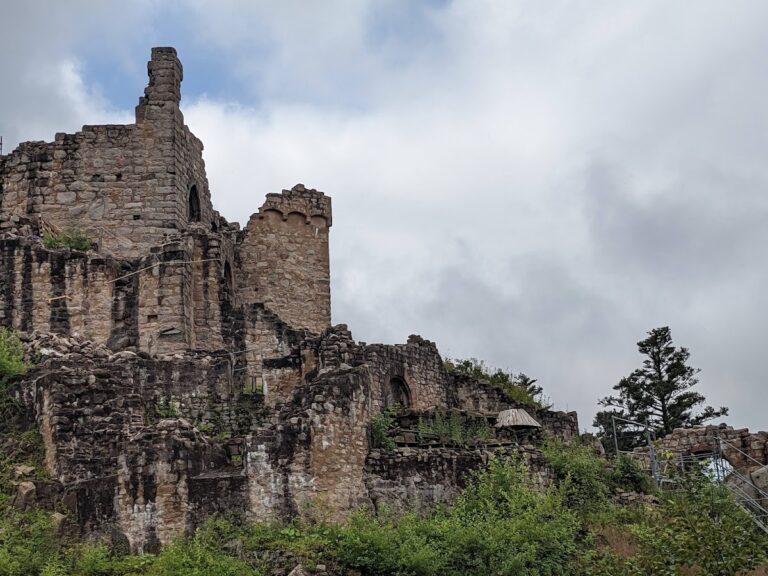
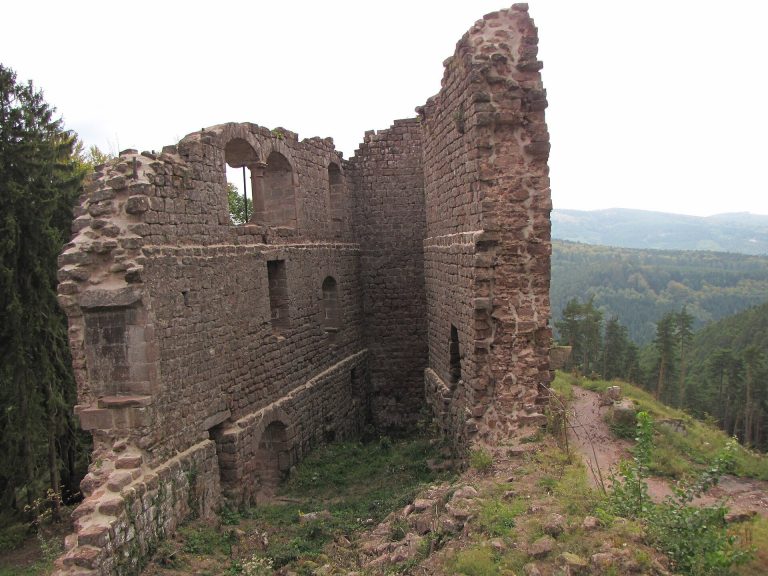
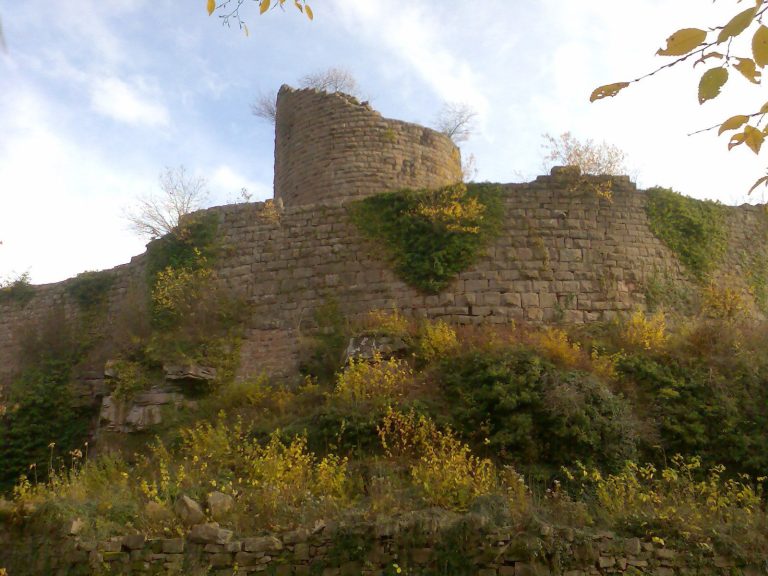
The massive bergfried, or principal defensive tower, stands on the exposed side of the rock facing the likely direction of attack. Its irregular plan follows the shape of the outcrop and measures approximately 8 by 5 metres. The tower is built from Vosges sandstone quarried at Tanrupt rather than granite. Its small bossed blocks suggest construction in the late thirteenth or early fourteenth century, while the keep itself is generally dated to the late thirteenth century.
The keep was relatively low because the rock already supplied considerable elevation. Its form indicates that it was intended for habitation as well as defence. The surviving masonry is heavily ruined.
Lower Ward
A lower ward, or bailey, extended behind the rock. This area appears to have held an inhabited settlement within the fortress. A proposed reconstruction places a roughly rectangular enclosure there with two service or economic buildings, of which only slight traces of walls survive.
Residential Building
A palas, the castle’s principal residential building, probably stood against the northern side of the rock. Only limited masonry remains of this structure.
Access and Rock-Cut Features
Former Arch
A masonry arch once bridged a fissure in the rock. The arch has not survived, but it appears in a depiction by Oberlin and formed part of the fortress’s former construction across the irregular outcrop.
Present Stairways
The rock is currently reached by two steep iron stairways. They provide access to the elevated remains above the valley and the village of Bellefosse.