Château de Dortan: A Historic Manor and Former Fortress in France


Site at a Glance
- Rating
- 3
- Popularity
- Very Low
- Country
- France
- Primary era
- Medieval
- External website
- Open
- Eras represented
- Medieval, Early Modern, Modern
- Civilizations
- Duchy of Savoy, French
- Site type
- Domestic
- Remains
- Castle
On this page10 sections
History
Château de Dortan is a historic manor in France, developed in the fifteenth and sixteenth centuries and later altered in the eighteenth century and restored in the nineteenth. It became the center of the lordship of Dortan, succeeding an earlier fortified castle probably built in the twelfth century. Its position in Bugey placed it on the route between Lyon and Saint-Claude and near the frontier with the County of Burgundy.
The Dortan Lords and the Medieval Fortress
The Dortan family held the site for more than 530 years. Members of the family appear in evidence from 1180 and 1200, when the lords of Dortan held their fief from the abbot of Saint-Claude. A fief was a holding governed by a feudal relationship that required obligations such as homage and service. The earliest known members included Lambert de Dortan, a knight, and his brother Geoffroy, who gave property to the Carthusian monastery of Portes.
In 1320, Renaud, son of Humbert and lord of Dortan, built the castle’s large tower. Humbert V, lord of Thoire-Villars, contested the work because he held high, middle, and low justice over the castle, meaning different levels of judicial authority. He argued that Renaud needed his permission to build or strengthen the fortress. Renaud instead maintained that he held the castle from the abbot and lord of Saint-Claude.
Guillaume I de Sure, archbishop and count of Lyon, settled the dispute at Pierre Scize Castle in Lyon in 1339. His decision upheld Renaud’s right to construct and raise the tower, dig moats around the residence, and use the fortification against his enemies. The decision confirmed the castle’s place within the competing layers of feudal authority that shaped medieval Bugey.
Seventeenth-Century Conflicts and Ownership
The castle’s strategic position brought repeated attacks. During the Franche-Comté wars in 1637, Louis de Dortan and his son Philippe-François supported the Comtois, forces and inhabitants associated with Franche-Comté, against the troops of King Louis XIII. An order confiscated their lands and demanded the destruction of the family castle, followed by ploughing and the sowing of salt across its site. Both men were sentenced to be hanged, although the sentence was carried out only in effigy the following year.
On 6 February 1637, Louis XIII cancelled the order and granted the castle and its lands to Sieur de Reydellet, a light cavalryman in the royal guard, as a reward for his service. Two months later, Reydellet transferred his rights back to the former owners in return for payment. In 1658, Jean-Philibert de Dortan bought back the castle and lordship for another branch of the family, the lords of Marteray and La Barre in Dauphiné.
Further conflict followed in 1696, when François de Dortan, son of Gaspard de Dortan, lord of Dortan and Marterey, was condemned by the Parliament of Dijon. After committing offenses at Oyonnax while leading an armed group, he was ordered to demolish the castle and sow salt on his lands.
From the Eighteenth Century to the Second World War
The estate remained with the Dortan family until 2 September 1720, when Jean-François de Dortan, grand cantor and canon-count of Lyon, sold it to Pierre Gaulthier. Gaulthier was a squire, lord of Pusignan, former alderman of Lyon, and counselor and secretary to the king. His son inherited the estate and kept it until his death in 1787.
Known as Monsieur d’Uffelle, Gaulthier’s son was a friend of Voltaire, the eighteenth-century French writer and philosopher. Voltaire visited Dortan, where his plays were performed at the château. He reportedly attended the first performance there of his tragedy Tancrède.
The château passed by inheritance from Monsieur d’Uffelle to Claret de Fleurieu, a French naval administrator who served as minister of the navy. After his death in 1810, his brother sold the property in 1822 to several owners. In 1858, the Lyon industrialist Noël Le Mire acquired it, rebuilt the south tower, created a new chapel, and restored the building. His heirs sold the château to the Richoux family in 1898, after which it passed to the Roux family.
During the Dortan massacre of 1944, German troops used the château as their headquarters after being stationed in the village from 12 July. Local inhabitants were detained, tortured, and executed there. In 1973, Marius Rollet bought the property and moved into it after the château had stood unoccupied for eighteen years.
By an order dated 12 December 1997, the château, its underground areas, western esplanade, southern-terrace garden, park and enclosing wall, outbuilding, and pump mill were entered on France’s register of historic monuments.
Remains
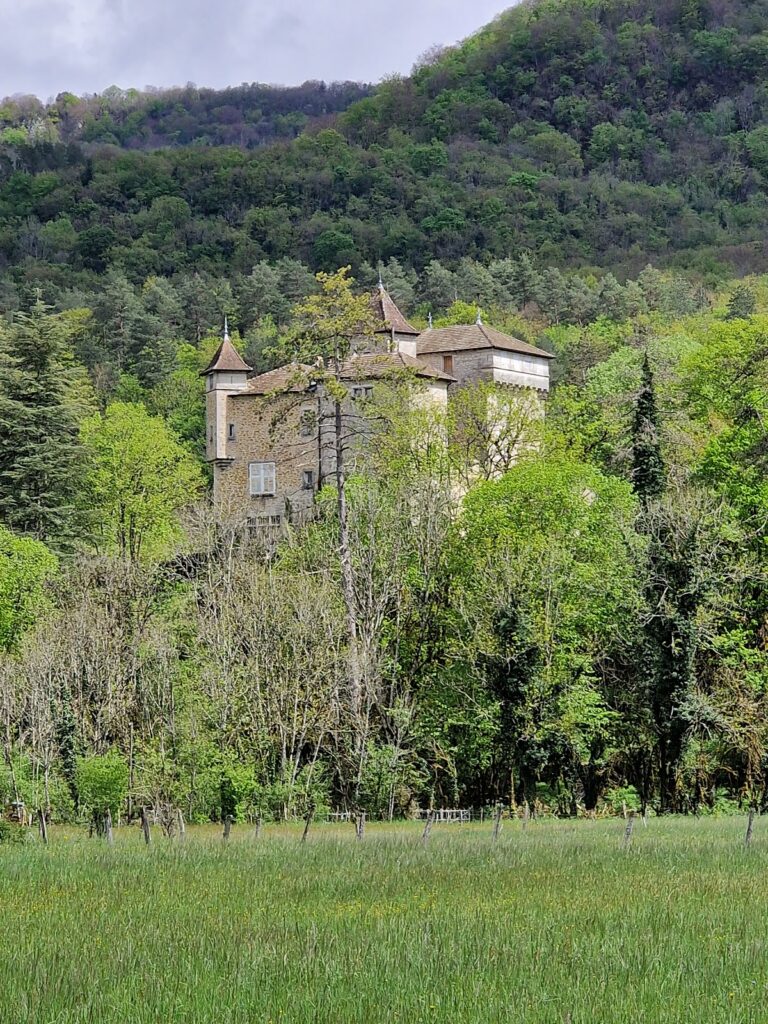
The surviving complex retains the character of a fortress adapted into a residential manor. Two large square towers stand to the south and north, enclosing an interior courtyard between two principal residential wings. The upper parts of those wings date from the nineteenth century, while the kitchen building dates from the fourteenth century.
Towers and Residential Buildings
South Tower
The south tower rises on a rocky outcrop and began as the medieval keep, the principal fortified tower of a castle. Its original structure was destroyed in 1637, and the tower was rebuilt in the nineteenth century. The upper floor is flanked by small projecting defensive turrets called échauguettes. It contains a chapel built by Louis Sainte-Marie Perrin in 1864 in the Neo-Gothic style.
North Tower and Residential Wings
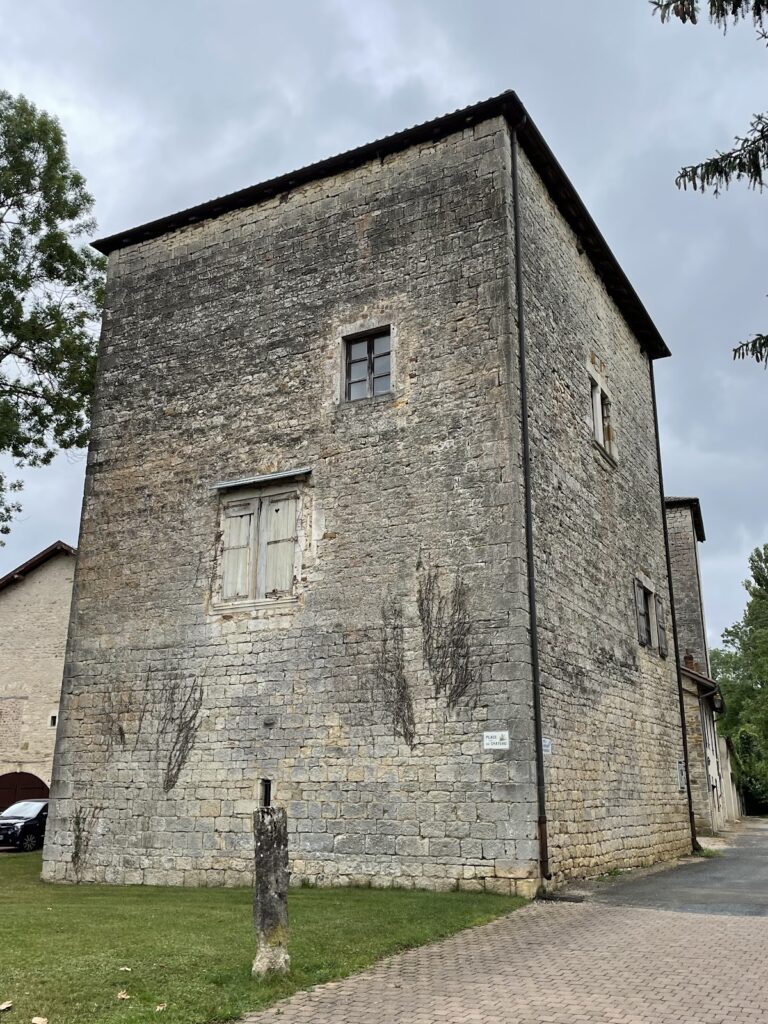
The north tower dates from the fifteenth or sixteenth century. Together with the south tower, it bounds the courtyard between the two main residential wings. Their upper sections belong to the nineteenth-century rebuilding and restoration of the château, while the fourteenth-century kitchen building preserves an earlier phase of the complex.
Interior Features
Inside the château, an armory contains a Gothic fireplace. The feature forms part of the building’s surviving interior, alongside the chapel and the residential spaces arranged around the courtyard.
Gardens, Park, and Underground Features
Outside the buildings are a French formal garden and a large park enclosed by a wall. The protected grounds also include the western esplanade, a garden on the southern terrace, an outbuilding, and a pump mill. A Vauclusian spring, known as the Blue Spring, rises within the park from a deep underground water system. It has been explored for 1,030 meters to a depth of 99 meters below the surface and remains the subject of speleological exploration, the scientific study of caves and other underground environments. The château complex also includes underground areas associated with the protected estate.
Nearby sites