Camp des Rouëts: An Early Medieval Military Camp in France


Site at a Glance
- Rating
- 3.3
- Popularity
- Very Low
- Country
- France
- Primary era
- Medieval
- External website
- Open
- Eras represented
- Medieval
- Civilizations
- Duchy of Brittany
- Site type
- Military
- Remains
- Castle
On this page7 sections
History
Camp des Rouëts is an early medieval archaeological site and former military camp at Mohon in Brittany, France. Built during the early Middle Ages, probably in the tenth century but possibly in the eighth or ninth, it may have incorporated remains from the Gallo-Roman period, the era of Roman Gaul and the society that followed Roman rule.
The early medieval settlement
The site developed around a central castle mound, or motte, where the lord of Bodieu established a tower. Around it, an enclosed lower court provided refuge for villagers. This settlement supported a range of activities and contained a well, barns, a forge, a pottery, and habitations.
Bodieu and the later history of the site
A neighboring priory was established in the twelfth century and became the nucleus of the future village of Bodieu. Camp des Rouëts therefore formed part of a changing local landscape in which the earlier fortified settlement and the later religious foundation occupied distinct historical roles.
Protection and preservation
The Departmental Council of Morbihan purchased Camp des Rouëts in the 1970s at the request of Jacques Mercier, a local advocate for its preservation. An order dated 22 July 1975 entered the site on the register of French historic monuments, providing legal heritage protection. A decree of 22 September 1975 also classified it as a natural site because of its scenic or picturesque interest. Les Amis du camp des Rouëts was founded in 1980 on Mercier’s initiative to protect and promote the site.
Remains
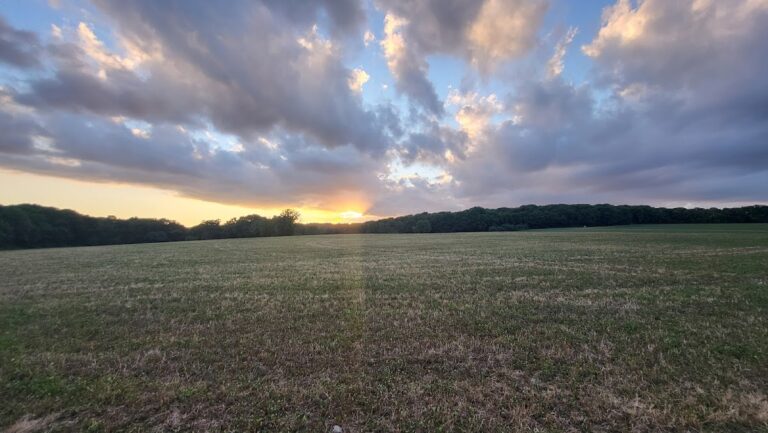
Camp des Rouëts survives as a group of earthworks spread across approximately 5 hectares. Its layout follows the motte-and-bailey form, with a raised mound carrying a fortified residence or tower and an adjoining enclosed lower court for settlement and supporting activities.
Central motte and enclosing ditches
The central motte rises about 8 metres above the surrounding ground. It carried the tower established for the lord of Bodieu. Ditches encircle the site, measuring approximately 10 metres deep and 15 metres wide. Together, the mound and ditches define the defensive structure of the former camp and separate the raised central position from the lower court.
Lower court
The enclosed lower court lay at the foot of the motte and accommodated the settlement associated with it. Its recorded features include a well, barns, a forge, a pottery, and habitations, showing how domestic life and craft activity were organized within the protected area.
Nearby sites