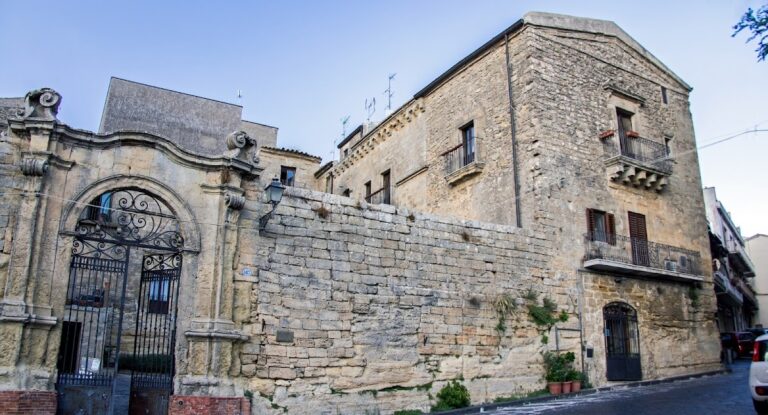
Palazzo Bongiorno: An Eighteenth-Century Palace and Academy at Gangi


Site at a Glance
- Rating
- 4.8
- Popularity
- Very Low
- Country
- Italy
- Primary era
- Early Modern
- Eras represented
- Early Modern
- Civilizations
- Kingdom of Sicily
- Site type
- Domestic
- Remains
- Elite Residence
On this page11 sections
History
Palazzo Bongiorno is an eighteenth-century palace in Gangi, Italy, built for Baron Francesco Benedetto Bongiorno beginning in the early 1740s. Later known as Palazzo Li Destri, it stands in the historic center between Corso Umberto and Salita Matrice, near Piazza del Popolo. Its history is closely connected with the Bongiorno family and with the intellectual life of eighteenth-century Sicily.
Foundation and the Accademia degli Industriosi
Francesco Benedetto Bongiorno initiated the construction of the palace in the early 1740s. During the second half of the eighteenth century, the building became the meeting place of the Accademia degli Industriosi di Gangi, also called the Accademia Enguina. Bongiorno founded the academy after the earlier Accademia degli Sprovveduti, between 1748 and 1758. Its public meetings probably began before 1758, when its first printed work appeared in Palermo.
The academy became a local branch, or colony, of Palermo’s Accademia del Buon Gusto in 1756 and affiliated with Arcadia in December 1771. Arcadia was a major Italian literary academy and movement that encouraged classical and pastoral ideals. The Accademia degli Industriosi continued publishing in Palermo, with its last known printed work appearing there in 1777.
Gandolfo Felice Bongiorno served as the academy’s prince, its leading officer, while Giuseppe Fedele Vitale was secretary. Public sessions were generally held in the palace on the first day of each month, apart from vacation periods and the summer residence. The academy also published an academic liturgical calendar in Rime degli Accademici Industriosi in 1769.
Religious and intellectual setting
The academy promoted a pro-Jansenist program. Jansenism was an Augustinian reform movement within early-modern Catholic thought that stressed divine grace, human inability to achieve salvation unaided, and rigorous religious discipline. At Gangi, the academy combined public activities open to citizens with an esoteric and self-formative ideal centered on moral elevation, reason, justice, peace, light, and the relationship between the macrocosm and microcosm.
Its intellectual environment also adopted themes associated with Freemasonry, a fraternal initiatory tradition whose symbolic language commonly includes moral improvement, light, architecture, and the Great Architect of the Universe. This pro-Masonic language does not by itself establish formal lodge membership for every person connected with the palace. The academy belonged to a broader Jansenist and partly pro-Masonic network active in Sicily from approximately 1750 to 1770.
Tommaso Moncada, archbishop of Messina and prince of Calvaruso, initially protected the academy. Later protection came from the Jansenist archbishop Gabriello Maria Di Blasi. Francesco Benedetto Bongiorno remained one of its protectors until his death in 1767. The palace’s decorative program reflects the shared outlook of Francesco Benedetto, Gandolfo Felice, and Cataldo Lucio Bongiorno. Cataldo Lucio was an abbot, but the cycle is understood through the family’s pro-Jansenist orientation rather than as an expression of a purely Catholic program.
Municipal ownership
The Municipality of Gangi acquired Palazzo Bongiorno in 1967. Restoration and consolidation were carried out in the early 1980s, followed by a later intervention on the north wing. The building now accommodates the Municipal Council and other municipal offices, continuing its role as a public building while preserving the setting associated with the Accademia degli Industriosi.
Remains
Palazzo Bongiorno occupies the central block between Corso Umberto to the north and Salita Matrice to the south. Its principal surviving decorative features are on the piano nobile, the main ceremonial floor of an Italian palace, where a cycle of wall paintings executed on plaster preserves the intellectual program developed by the Bongiorno family and the academy. Gaspare Fumagalli, a painter from Rome who worked in Palermo, produced the frescoes between 1756 and 1759 with the assistance of Pietro Martorana.
Allegorical fresco cycle
A contemporary notarial document records that Francesco Benedetto Bongiorno worked with Fumagalli to determine the subjects and imagery of the paintings. The cycle draws on Cesare Ripa’s Iconologia, an influential repertory explaining personifications and their symbolic attributes, as well as on Pietro Bellori’s discussion of Clemency and the printed works of the Accademia degli Industriosi.
Fides sine operibus – Mortua est
The fresco Fides sine operibus – Mortua est gives the religious ideas of the cycle a direct allegorical form. It represents the Divine Redeemer, Grace, Reason, Justice, and human corruption. Its pro-Jansenist interpretation places divine grace and moral conduct at the center of the image, in keeping with the religious orientation associated with the academy and the Bongiorno family.
Mesi e fasi del giorno
Mesi e fasi del giorno incorporates imagery drawn explicitly from Ripa’s Iconologia. The landscape passages were influenced, to a lesser extent, by compositions associated with Locatelli. The fresco therefore combines allegorical imagery from a major symbolic repertory with landscape elements shaped by a Roman artistic model.
Sic floret decoro decus
In Sic floret decoro decus, the allegory of Decorum, or proper and fitting conduct, is divided between two figures. A putto, a childlike winged figure used in European decorative art, displays a scroll bearing the motto “Sic floret decoro decus.” One figure is identified by a lion skin and a right leg wearing a cothurnus, a high-laced boot associated with elevated or heroic figures. The other wears a rich garment, an amaranth crown, and a shoe on the left foot.
The fresco presents conduct in social relationships as governed by Grace, Reason, and Justice. Its themes continue in the related image Iustitia et Pax osculatae sunt, where this conduct produces social peace through the heart. The imagery of Decorum is connected with Giovanni Zarantino Castellani’s universal figure of Decorum, Carlo Grandi’s engraving, later editions of Ripa’s Iconologia, and the statue of Decorum in the Sansevero Chapel in Naples.
Clementia Mundi: il VITRIOL
Clementia Mundi: il VITRIOL is understood as a copy of Carlo Maratta’s Allegory, Triumph, or Praise of Clemency in Palazzo Altieri. The upper part of the Bongiorno version departs substantially from that model. Instead of papal and curial symbols, including papal insignia and keys, it shows the upper structure of VITRIOL, an alchemical and esoteric acronym associated with an inward journey toward concealed knowledge. Here it functions as a symbolic framework, with the Sun and Moon converging in a Mercury chalice.
The treatment of Clementia Mundi reflects the academy’s pro-Jansenist, anti-curial, and pro-Masonic intellectual orientation. Its imagery brings together Roman artistic models and the symbolic language developed in the academy’s literary and philosophical environment. Carlo Maratta and Giuseppe Bartolomeo Chiari, both prominent Roman painters, provided models for parts of the decoration at Palazzo Altieri that informed the Bongiorno cycle.
Academy emblem
The Accademia degli Industriosi used a wheel clock bearing the motto Ex pondere motus as its emblem. The image expressed the idea that love is the weight giving motion to the soul, and that the universe is an ingenious, industrious machine moved by an eternal divine mind. This emblem belongs to the academy’s wider symbolic vocabulary, which also informs the moral and cosmological ideas associated with the palace’s frescoes.
Nearby sites