Cathedral Basilica of St. Nicholas of Bari: Nicosia’s Mother Church and Cathedral


Site at a Glance
- Rating
- 4.6
- Popularity
- Low
- Country
- Italy
- Primary era
- Medieval
- Eras represented
- Medieval, Early Modern, Modern
- Civilizations
- Crown of Aragon, Kingdom of Sicily
- Site type
- Religious
- Remains
- Cathedral
On this page21 sections
History
The Cathedral Basilica of St. Nicholas of Bari is the principal Catholic church of Nicosia, Sicily, Italy, and the seat of the Diocese of Nicosia. Dedicated to Saint Nicholas of Bari, the Christian bishop of Myra associated with charity and the protection of children, sailors, and the poor, it is a Gothic building whose history reaches back to the Byzantine and Saracen occupations of Sicily.
Early church and royal basilica
A predecessor known as San Nicolò il Piccolo, or Little Saint Nicholas, also called the Castle church, is traditionally associated with the site during the Byzantine and Saracen periods. Around 1302, under Frederick II of Aragon, a larger church dedicated to Saint Nicholas of Bari was erected or rebuilt over the earlier building. Frederick II was a medieval king of Sicily from the Aragonese ruling house.
The new church was functioning by 1340, although work was not yet complete. An inscription on the architrave of the Porta del Monte records that date. From its beginnings, the church served as Nicosia’s mother church and royal basilica during the reign of Peter II of Aragon, Frederick’s successor. In 1388, the archbishop of Messina formally recognized it as a parish.
Collegiate church and civic religious centre
Pope Leo X elevated San Nicolò to a collegiate church by a bull dated 15 June 1521. A collegiate church is served by a college of clergy, while a cathedral is the principal church of a diocese and the seat of its bishop. During the seventeenth and eighteenth centuries, San Nicolò competed with Santa Maria Maggiore for religious primacy in Nicosia.
Saint Nicholas of Bari was declared the city’s sole principal patron in 1748. After a landslide damaged Santa Maria Maggiore in 1757, that collegiate church was incorporated into San Nicolò, further concentrating Nicosia’s religious institutions around the church.
Cathedral of the Diocese of Nicosia
The creation of the Diocese of Nicosia followed population growth and a dispute over whether San Nicolò or Santa Maria Maggiore should become the episcopal seat. The assessment of the buildings and their artistic character involved the architects Domenico Marabitti, Michele Billone, and later Alessandro Emanuele Marvuglia. Raffaele Mormile, archbishop of Palermo, supervised the evaluation.
Pope Pius VII established Nicosia as a cathedral city by a bull dated 17 March 1817 and provided it with its own bishop. The new diocese included Alimena, Capizzi, Bronte, Cerami, Cesarò, Maletto, Gagliano Castelferrato, Gangi, San Mauro Castelverde, Castelbuono, Petralia Soprana, Petralia Sottana, Resuttana, Geraci Siculo, Sperlinga, San Todaro, Troina, Villadoro, and the hamlets of Marianopoli and Bompietro. An episcopal palace, clerical seminary, episcopal chancery, and canonical administration were established for the diocese.
The cathedral was solemnly consecrated on 15 June 1856 by Monsignor Camillo Milana. It was declared a national monument on 21 November 1940 and received the title of minor basilica on 19 June 1967.
Remains
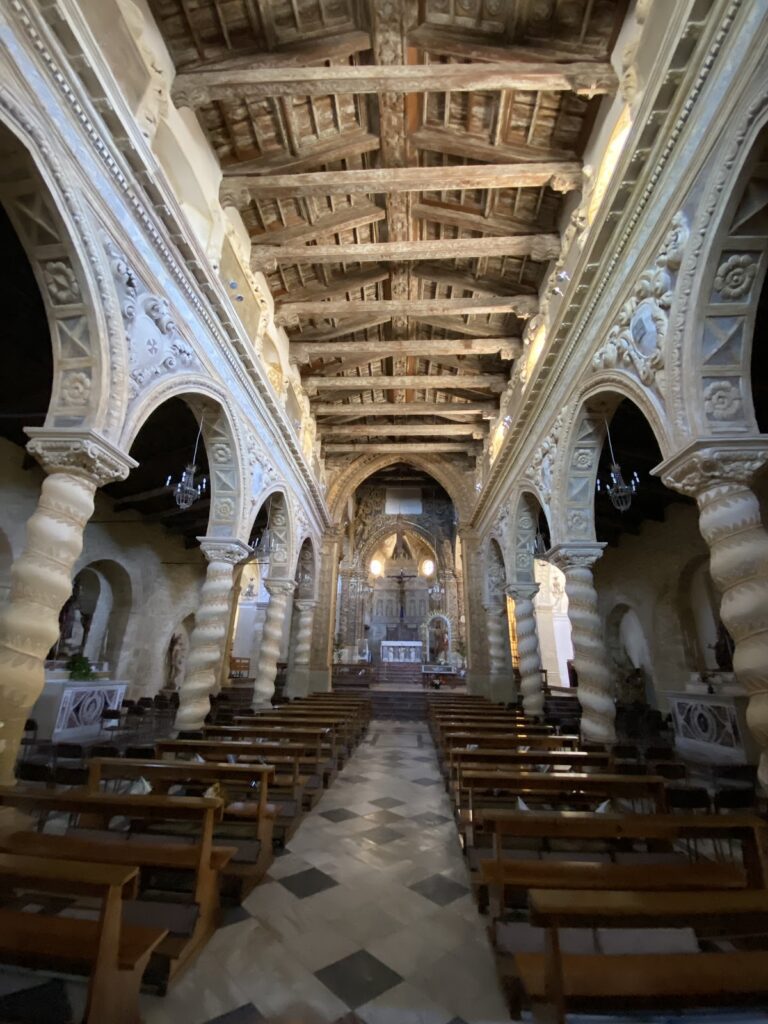
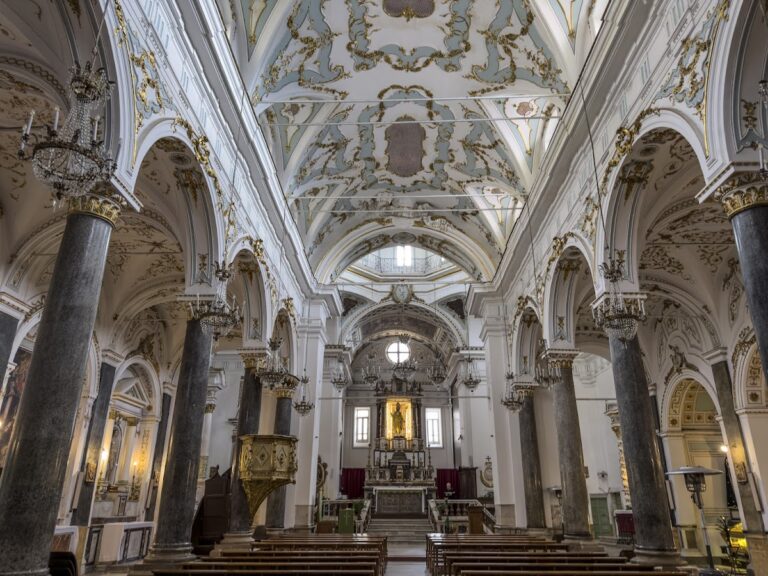
The cathedral is a Gothic complex organized around a principal church with a Gothic-Norman entrance, a north-facing portico, chapels along the interior, transepts, a raised high altar, a medieval bell tower, and associated ecclesiastical buildings. Its surviving fabric combines medieval construction with Renaissance marble, early modern woodcarving, later paintings, and nineteenth-century decoration.
Exterior and medieval structure
Gate of Paradise
The main portal, known as the Gate of Paradise, is richly decorated with Gothic foliage, particularly acanthus leaves. Its lower section originally carried four statues representing the cardinal virtues: Prudence, Fortitude, Justice, and Temperance. Three further statues stood above the tympanum, the enclosed area above a portal, representing the theological virtues of Faith, Hope, and Charity.
Portico and bell tower
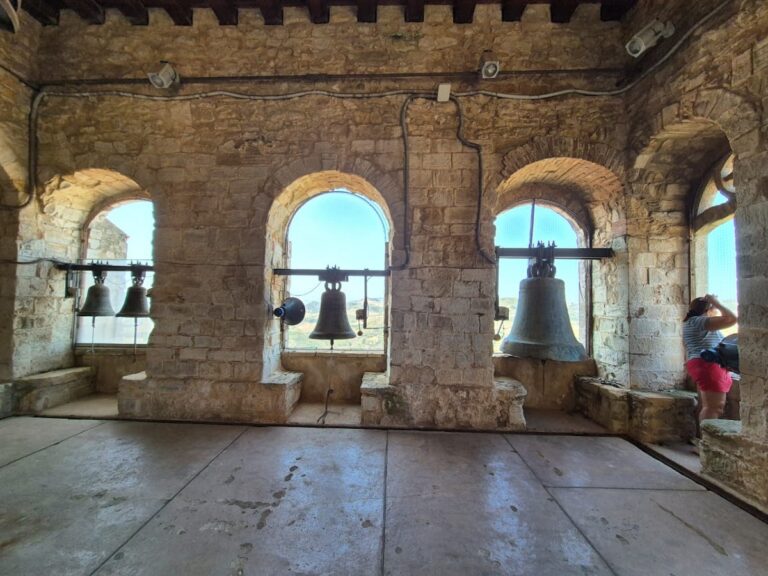
Facing north toward Piazza Garibaldi, the portico has a pitched roof and large pointed arches. The structure was made in 1489 and 1490 by the sculptors Gabriele di Battista and Andrea Mancino. The medieval bell tower is a large Gothic structure of three tiers, with broad pointed arches and three-light windows surmounted by rose windows.
Roof and interior painting
Painted timber roof
Above the present barrel vault survives a rare painted timber roof, regarded as a valuable example of fifteenth-century Sicilian painting. Its trusses carry sacred, figurative, animal, geometric, and heraldic motifs, including the coats of arms of the Ventimiglia, De Marchisio, and Sabia families.
Barrel vault
The barrel vault was frescoed in 1810 by the Palermo artists Antonio Manno and Vincenzo Manno. Their scenes from the Old and New Testaments were based on pre-existing cartoons and sketches, giving the upper interior a later painted layer beneath the older timber roof.
Chapels and sacred sculpture
Chapel of the Redeemer
The first chapel on the right is the Chapel of the Redeemer. It contains a marble triptych showing Christ as Judge between the Virgin Mary and Saint John the Baptist. The Confraternity of Santa Maria della Misericordia commissioned the work for its own church, and it is attributed to Antonello Gagini, a member of an important Sicilian family of Renaissance sculptors.
Chapel of Saint Placidus
The second chapel on the right contains a nineteenth-century altarpiece by Giuseppe Patania depicting the Martyrdom of Saint Placidus.
Baptistery
The first chapel on the left contains the baptistery and a marble font attributed to Antonello Gagini. Dated 1497 to 1499, the font has a relief of the Original Sin of Adam and Eve in Eden. The baptistery also contains a marble ciborium, an architectural canopy or covered sacred structure, attributed to Andrea Mancino and Antonio Vanella. Its reliefs show episodes from the Passion of Christ, prophets, angels, Saints Peter and Paul, and the Annunciation.
Transepts and high altar
Right transept
The right transept, the crosswise part of the church that intersects the nave, contains the Chapel of the Most Holy Crucifix. Its principal work is the wooden crucifix called the Father of Providence, which depicts the dying Christ. Once attributed to Fra Umile da Petralia, it is now attributed to the Palermo sculptor Gaspare De Miceli. The venerated crucifix is carried in processions during the devotional and penitential rites of Good Friday.
The same transept contains a marble Madonna della Vittoria attributed to the Gagini school. It was sculpted after 1571 to commemorate the Battle of Lepanto, when the Holy League defeated the Ottoman fleet in a major naval engagement.
Left transept
The left transept contains the Chapel of the Most Holy Sacrament, whose marble tabernacle was made by Andrea Mancino and Antonio Vanella. The nearby Chapel of Saint Nicholas contains a statue of Saint Nicholas of Bari by Filippo Quattrocchi of Gangi.
High altar and choir
The raised high altar area contains Giuseppe Velasco’s painting of the Resurrection. Velasco also painted the Adulteress. Seventeenth-century sculpture by the Nicosian Li Volsi family occupies the same area. Stefano Li Volsi carved the statue of Saint Nicholas, while he and his father and teacher, Giovambattista Li Volsi, made the finely carved walnut choir with thirty stalls.
The choir carvings include the Messianic Entry of Jesus into Jerusalem, the Martyrdom of Saint Bartholomew, the Assumption of the Virgin with Nicosia at her feet, Saint Nicholas assisting three poor girls, and King David with his harp. Giovambattista Li Volsi also made statues of Saint Bartholomew and Saint John. The cathedral has two organs, including a larger instrument made by Raffaello La Valle and Carlo Bonaiuto.
Other works and memorials
Among the other works in the cathedral are Pietro Novelli’s Madonna of Grace with Saints Rosalia and John the Baptist; Filippo Quattrocchi’s sculpture of the Assumption of the Virgin; Filippo Randazzo’s paintings of the Holy Family and the Immaculate Conception; and Antonio Filingelli’s paintings of the Resurrection and the Rosary.
An octagonal marble pulpit dated 1556 is attributed to Giandomenico Gagini. It rests on a shaft with a Corinthian capital, and its reliefs depict the risen Christ, Saints Peter, Paul, Nicholas of Bari, and John the Baptist, together with the coat of arms of Nicosia.
The cathedral also contains the 1753 mausoleum of Alessandro Testa by Ignazio Marabitti, the 1841 sarcophagus of Archpriest Avarna, and the 1902 monument to Bishop Bernardo Cozzucli by Gaetano Geraci. The Chapel of Saint Crispin served as the meeting place of the original Confraternity of Shoemakers.
Chapter Hall and associated buildings
The Chapter Hall contains Filippo Quattrocchi’s statue of Saint Nicholas; Johannes De Matta’s 1535 painting of Saint Eligius; Jusepe de Ribera’s Martyrdom of Saint Bartholomew; Pietro Novelli’s paintings of the Madonna and Child, Saint John, and Saint Rosalia; and Salvator Rosa’s Martyrdom of Saint Sebastian.
The cathedral complex is associated with the episcopal palace, the seminary, and the earlier Church of San Nicolò il Piccolo. Together, these buildings preserve the institutional setting that developed as the medieval church became Nicosia’s collegiate church, cathedral, and basilica.