Nevděk: A Gothic Castle and Strongpoint in Czechia


Site at a Glance
- Rating
- 4.1
- Popularity
- Very Low
- Country
- Czechia
- Primary era
- Medieval
- Eras represented
- Medieval
- Civilizations
- Holy Roman Empire, Kingdom of Bohemia
- Site type
- Military
- Remains
- Castle
On this page8 sections
History
Nevděk is a ruined Gothic castle in Czechia, located on a hill south of Žlutice. Founded before the middle of the fifteenth century, probably around 1446, by the Hussite commander and nobleman Jakoubek z Vřesovic, it served as both a residence and a supporting strongpoint. Its construction used material from a farmstead at Semtěš, which was demolished for the purpose.
Foundation and defensive role
The castle was originally known as Nový hrad, meaning “New Castle,” a name that distinguished it from Žlutice’s older town castle. The name Nevděk appears by the sixteenth century, although its origin is not explained. The Hussite Wars were religious and political conflicts in Bohemia during the early fifteenth century, and castles built in their aftermath could combine military protection with the residential needs of their owners.
Nevděk occupied a strategically favorable position above the Střela valley. It functioned as an advanced fortification guarding the southern communication routes leading toward Žlutice. The contemporary castle of Mazanec had a corresponding defensive role north of the town. A proposed identification of Nevděk with an older fortification conquered by Charles IV, the fourteenth-century King of Bohemia and Holy Roman Emperor, was rejected when the relevant references were found to concern another location.
Loss of function and abandonment
Nevděk lost its functions during the sixteenth century and was first recorded as deserted in 1568. It may have remained partly occupied until the seventeenth century, when its abandonment was apparently complete. The surviving ruins are protected as a cultural monument of the Czech Republic.
Remains
Approach and outer defenses
The castle stands at about 630 metres above sea level on the summit of Nevděk Hill, which rises above the Střela valley within the Teplá Highlands. Its position was practically impregnable to artillery, and Nevděk apparently lacked the active artillery defenses found at some contemporary sites. The outer rampart may nevertheless have offered space for heavy firearms, as well as additional defensive and communication elements.
Two advanced fortifications southwest and southeast of the castle core protected the approach. From them, the route entered the first section of the castle and continued westward along a connecting fortification. It then turned through almost 180 degrees before ascending an earth ramp to the top of the rampart around the core. A bridge crossed the moat, followed by another ramp leading to the castle’s fourth section.
Moat and gate
Entry into the core passed over a bridge across the moat and through a tower-like gate. The moat is approximately five to six metres deep. Rock blocks left at the crossing provided supports for the bridge structure, preserving evidence of how access to the defended center was organized.
Castle core
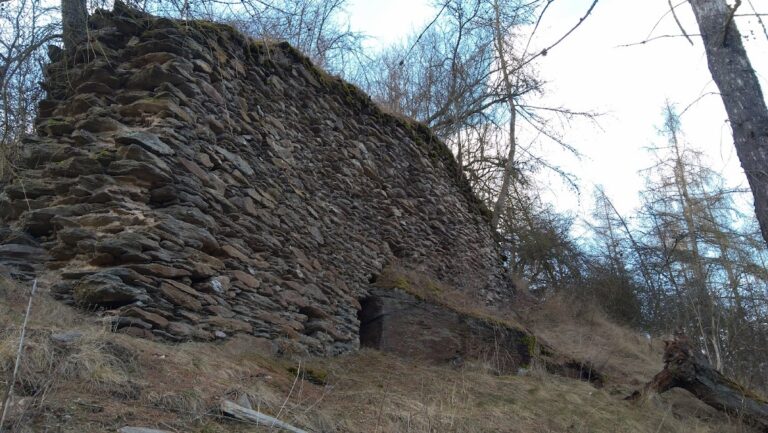
The core had an approximately trapezoidal plan dominated by a large palace. Its foundations, together with the circular stone-built feature interpreted as a well or cistern, are the principal identifiable masonry remains. A cistern is a reservoir used to collect or store water. The core apparently relied on a wall of dry-laid stones, fitted together without substantial mortar and possibly bonded with clay, rather than on a conventional enclosing wall.
Most of the surviving evidence consists of earthwork traces, including the fortifications, moat, and surrounding ramparts. Slight masonry fragments also remain, among them parts of the palace. The quality of the residential component appears notable in comparison with other castles built during the Hussite Wars. The castle historian and archaeologist Tomáš Durdík compared Nevděk with Jakoubek z Vřesovic’s earlier castle of Oltářík, although Oltářík had been founded mainly for military purposes rather than as a residence.
Summit and surrounding landscape
A large wooden cross stands on the summit. Dense woodland restricts the summit view mainly toward the north and Žlutice. Below the wooded summit, the landscape opens eastward and southward toward Vladař, Chlumská hora, Zbraslavský vrch, and other elevations of the Jeseník Uplands and the Teplá Highlands.
Nearby sites