Castell de Calonge de Segarra: Medieval Castle Ruins in Spain


Site at a Glance
- Rating
- 3.8
- Popularity
- Very Low
- Country
- Spain
- Primary era
- Medieval
- External website
- Open
- Eras represented
- Medieval
- Civilizations
- Crown of Aragon
- Site type
- Military
- Remains
- Castle
On this page8 sections
History
Castell de Calonge de Segarra is a medieval castle in Spain, first recorded in 1010 and associated for centuries with the viscounts of Cardona, a major Catalan noble family that held lordship over lands and fortresses. The site stands in the historical landscape of Calonge de Segarra and remained connected to the Cardona lineage through changes of inheritance, lordship, and administration.
Early connection with the Cardona family
The castle enters the historical record in 1010, when Arnulf, bishop of Vic and brother of the viscount of Osona-Cardona, died there from wounds received during the Catalan expedition against Muslim Córdoba. From that time, the fortress remained linked to the viscounts of Cardona.
In 1042, Eribau, bishop of Urgell and brother of the viscount Folc, left the castle in his will to his nephew Folc. Administration was entrusted to a castellan, the officer responsible for managing and defending a castle for its lord. The office was held by a lineage using the surname Calonge, which served as feudatories of the Cardona family. During the twelfth century, ownership continued to rest with the Cardona family.
Inheritance and changing lordship
In 1156, Ramon de Cardona held Castell de Calonge de Segarra and bequeathed it, together with the fortress of Fals, to his sister Dolça. By the end of the twelfth century, the castle had passed to the Torroja, also called Tarroja, family. It later returned to the Cardona patrimony when Agnès, granddaughter of Ramon de Torroja, married Ramon Folc.
In 1220, Bernat de Cardona granted Pere Puigferner one quarter of the castle and its tithe, a customary contribution often amounting to one tenth of produce or income. When the County of Cardona was created in 1375, the fortress became part of the county. Around 1391, Ramon de Fontanet held the office of castellan.
Heritage status
Castell de Calonge de Segarra is listed as a Cultural Asset of National Interest as a historic monument. It is also registered as a Spanish cultural-interest property, a designation dating from 1988, under heritage reference RI-51-0005229.
Remains
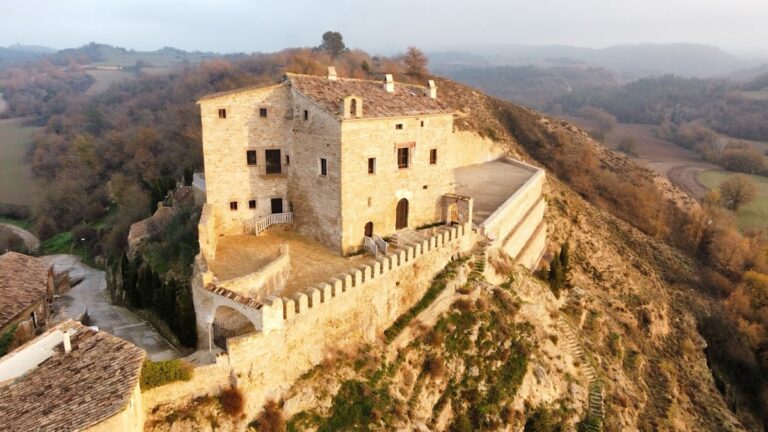
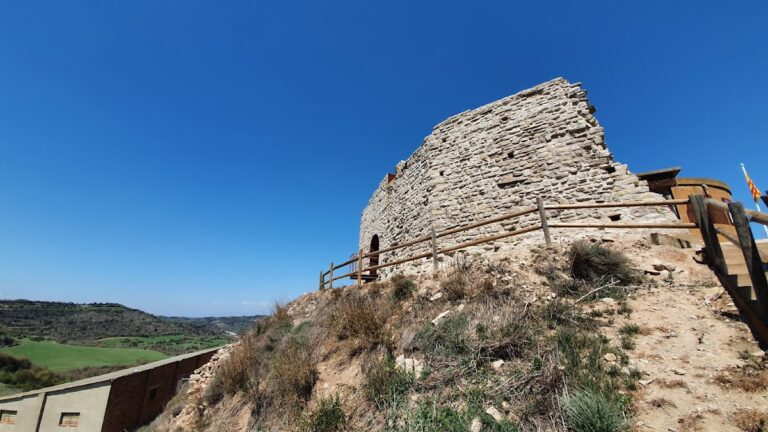
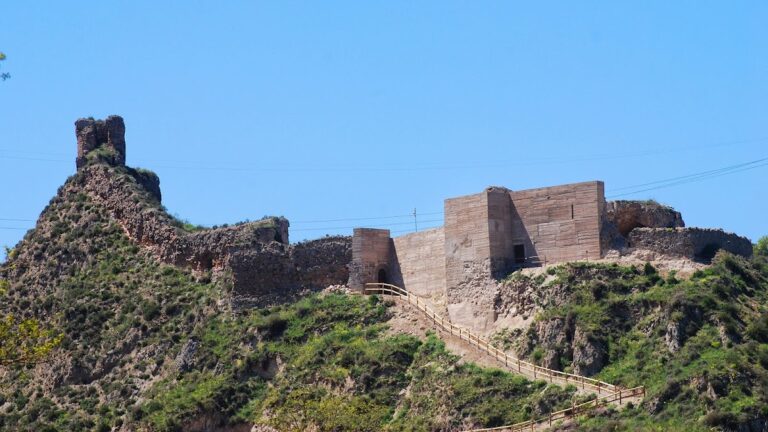
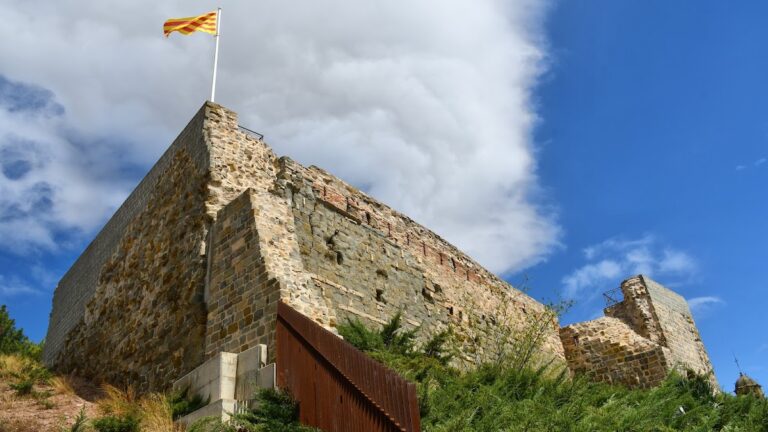
The ruins occupy a small hilltop at an elevation of 636 metres in Calonge de Segarra. The former parish church of Santa Fe de Calonge stands at the foot of the hill, within an area dominated by the Calaf plateau where it meets Bages. The surviving structures are damaged to varying degrees, and a relatively intact room stands beside a cistern or tank. Fragments of a circular tower remain in the western part of the site, where the tower appears to have organized the castle.
Medieval tower and hall
Circular tower
Only fragments of the circular tower’s first level survive, reaching the springing of its first roof. That roof was probably formed as a false dome. The tower’s masonry is made from uneven, poorly trimmed stone blocks arranged in roughly horizontal courses. It is probably the oldest element of the castle and may belong to an eleventh-century building.
Vaulted rectangular hall
The only feature still standing is a rectangular hall measuring 8 by 4 metres. Its complete semicircular barrel vault has a large arch opening toward the southeast. The hall is joined to side walls that rise from a slightly projecting low wall. Its exterior surfaces are generally plastered, while the interior masonry uses medium-sized, roughly trimmed stone blocks laid in orderly courses.
A doorway in the western wall is covered inside by a semicircular arch made of wedge-shaped stones and outside by a horizontal lintel. A second doorway in the northern corner has a covering of irregularly arranged slabs, and a badly damaged stairway descends beneath the ground from it. Two slit windows pierce the hall, each finished externally with a horizontally laid slab. The vaulted hall may have been built in the late twelfth or early thirteenth century, while other surviving parts probably reflect later remodeling.
Nearby sites