Bowden Battery: A Palmerston Fort Defending Plymouth
Site at a Glance
- Rating
- 4.3
- Popularity
- Very Low
- Country
- United Kingdom
- Primary era
- Modern
- Eras represented
- Modern
- Civilizations
- British
- Site type
- Military
- Remains
- Fort
On this page4 sections
History
Bowden Battery is a former nineteenth-century fortification in Plymouth, United Kingdom, built between 1863 and 1868 as part of the defence scheme created after the Royal Commission on National Defence of 1859. It formed part of the Palmerston Forts, a network of British defensive works intended to protect important naval and military installations from attack by land. Bowden Fort, as the work was also known, defended the north-eastern approaches to Plymouth and the Royal Naval Dockyard at Devonport.
Construction and military role
The fort was designed by Captain Edmund Frederick Du Cane, later Major General Du Cane. George Baker and Company undertook the construction, which was completed by the Royal Engineers, the British Army corps responsible for military engineering and fortification. A military road connected Bowden Fort with Crownhill Fort and Forder Battery, linking it to other defensive positions around Plymouth.
By the early 1900s, changes in military technology had made the fort obsolete as a defensive position, and it was disarmed. The War Office sold the site to Plymouth City Council in 1960. Bowden Battery received Grade II listed status in 1973, an English designation recognizing special architectural or historic interest.
Remains
Fortification and surviving structures
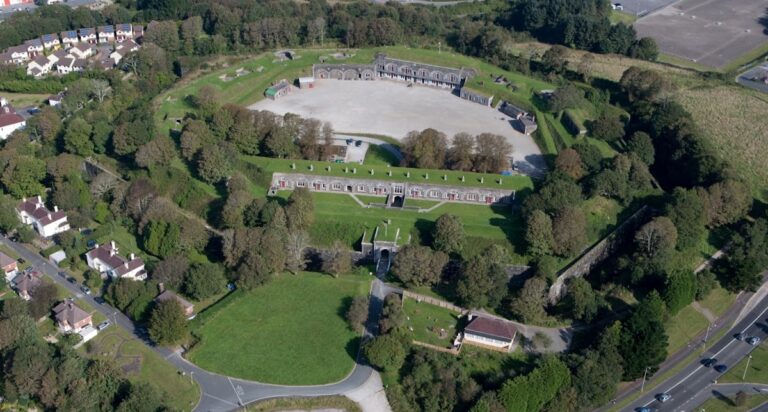
Bowden Battery is built from earth and masonry and was armed with 12 guns and three mortars. Mortars were artillery weapons designed to fire shells on a high trajectory, while guns generally fired on a flatter trajectory. A barrack block for 12 men stood within the rear section of the fort, providing accommodation for part of its garrison.
The fort remains largely intact, although it has been altered. Its rear gorge, the rear or open side of the fortification, has been filled in and now provides car parking. The surviving structure is currently used as a garden centre, preserving the physical remains within a later civilian use.
Nearby sites