Håøya Fort: A Coastal Artillery Fortress in Norway


Site at a Glance
- Rating
- 4.6
- Popularity
- Very Low
- Country
- Norway
- Primary era
- Modern
- External website
- Open
- Eras represented
- Modern
- Civilizations
- Norwegian
- Site type
- Military
- Remains
- Fort
On this page6 sections
History
Håøya Fort is a coastal artillery installation on Håøya Island in Norway, built between 1892 and 1894 to block the entrance to Vestfjord and help protect the Norwegian Navy port at Melsomvik. Its first armament exercise took place in 1897.
Construction and coastal defence
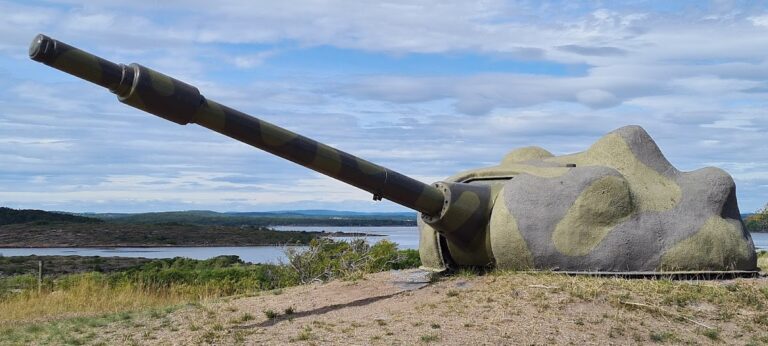
The fort formed part of a defensive arrangement with Sundås Battery on the mainland. Together, the two installations were intended to control access through Vestfjord and cover the naval port. In 1900, the fort received two 210 mm Armstrong M/00 guns, expanding its artillery capacity. Six 84 mm field guns and four Hotchkiss machine guns were also available for shared use with Sundås Battery.
Wartime use and later function
In May 1940, during the Second World War, the fort’s two 120 mm guns were dismantled and sent to Rørvik. Håøya Island was subsequently used as a convalescent camp, a recovery facility for wounded soldiers, and as the base of a flotilla, or group, of mini-submarines. The fort’s buildings are now used as holiday homes for personnel of the Norwegian Armed Forces.
Remains
Coastal artillery
Håøya Fort retains the character of a coastal artillery installation arranged for long-range fire across the sea approach. Its original armament consisted of two 120 mm Armstrong L/43.9 guns, each with a range of 9,000 metres, and four 65 mm Hotchkiss L/46.5 guns. The larger 210 mm Armstrong M/00 guns added in 1900 had a range of 10,000 metres. Six 84 mm field guns and four Hotchkiss machine guns were available jointly with Sundås Battery. Armstrong and Hotchkiss were manufacturers of artillery and firearms, while the L/43.9 and L/46.5 designations identify the respective gun types.
Fort buildings
The surviving buildings belong to the military installation established on Håøya Island in the 1890s. Their later use as holiday homes for Norwegian Armed Forces personnel has continued a connection between the structures and military life, while giving the buildings a function distinct from their original coastal-defence purpose.