Girsberg Castle (Château Girsberg): A Historic Estate in Switzerland


Site at a Glance
- Rating
- 4.5
- Popularity
- Very Low
- Country
- Switzerland
- Primary era
- Early Modern
- External website
- Open
- Eras represented
- Early Modern
- Civilizations
- Swiss
- Site type
- Domestic
- Remains
- Castle
On this page13 sections
History
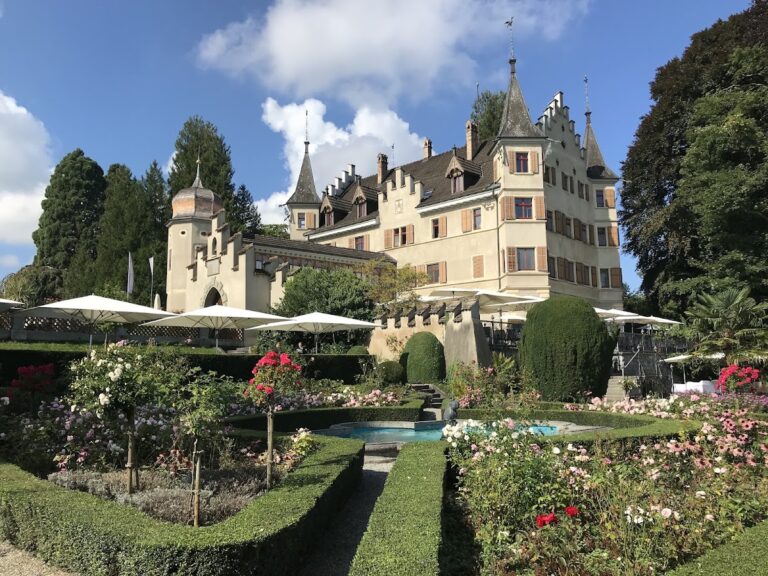
Girsberg Castle, also known as Mittel-Girsberg, is a historic estate in Switzerland, in the Kreuzlingen district of the canton of Thurgau. Its present castle dates from the rebuilding of 1790, when Zwiefalten Abbey replaced the older castle and made the property a governor’s residence. The estate’s history also reflects changing lordships, ecclesiastical ownership, and its later association with Ferdinand von Zeppelin.
Medieval estates and the emergence of Girsberg
After 1363, an additional estate was established above Alt-Girsberg, now Château Brunnegg, and was known as Ober-Gyrsberg. A still higher Ober-Girsberg later appeared, now Château Ebersberg, creating confusion between the names of the several properties. The site now called Girsberg is first recorded in 1473, when it belonged to Konrad Kupfermann.
The estate subsequently passed to Peter Breunli, Hans Lewenberg of Altiken, and Ulrich von Wengy of Constance. Nicolaus de Gall acquired it in 1539. A protocol of the Diet at Baden dated 26 August that year records his purchase and his request for jurisdiction over lower courts, an authority concerning minor local legal matters.
Ecclesiastical ownership and lordly status
Girsberg later belonged to Junker Hans Nythart. His widow sold it to Georg von Knöringen, whose widow transferred it to the monastery of Kreuzlingen. The monastery soon built a chapel at the estate. In 1567, it sold the property to the cathedral canon Sebastian von Herbstheim, who had owned Alt-Girsberg since 1565.
In 1582, the Swiss Confederates declared Mittel-Girsberg a Freisitz, an exempt residence whose lord enjoyed special freedom from ordinary local jurisdiction. Sebastian von Herbstheim’s heirs transferred the estate to the Mayer brothers of Stein am Rhein in 1588. They sold it in 1594 for 10,500 gulden to cathedral canon Paul Albert, who later became bishop of Breslau.
After Paul Albert’s death, the estate passed to the Bishopric of Breslau and was given to Rudolf II, the Habsburg Holy Roman Emperor. Rudolf authorized the Bishop of Constance, Johann Georg, and Maximilian Schenk von Staufenberg, the town commander of Constance, to sell it. The Reichsabtei Petershausen in Constance acquired Girsberg at auction.
From abbey property to private estate
Petershausen Abbey owned Girsberg for about fifty years before financial difficulties forced a sale to Junker Johann Anton Würz von Rudenz. His heirs sold the property in 1679 for 15,500 gulden to Zwiefalten Abbey, which retained it until 1803.
In 1790, Zwiefalten Abbey demolished the old castle and built a new one, converting the property into a governor’s residence. During secularization in 1803, the transfer or confiscation of ecclesiastical property by the state, Girsberg passed to the House of Württemberg as compensation for the loss of the county of Montbéliard. Friedrich II, later Württemberg’s first king, ordered the estate to be auctioned.
Jacques Louis Macaire de L’Or, a Geneva manufacturer and banker living in Constance, bought Girsberg for 26,000 gulden. He leased it the following year to Salomon Högger of Bischofszell. The property later passed by inheritance to Macaire’s son David. In 1840, David’s daughter Amélie gave Girsberg as a Christmas gift to her husband, Count Friedrich von Zeppelin.
The Zeppelin family and modern preservation
Amélie and Friedrich von Zeppelin lived at Girsberg with their children Eugenia, Eberhard, and their eldest son Ferdinand, later Count von Zeppelin. Ferdinand became the sole owner in 1870 and spent much of his time at the estate, particularly in summer. Ferdinand von Zeppelin was a German nobleman and pioneer of rigid airship development.
His seventieth birthday on 8 July 1908 was marked by a torchlight procession from almost the entire village to Girsberg and by fireworks produced by the local Alois Müller fireworks factory. After Ferdinand’s death, his daughter Helene, known as Hella, Countess von Brandenstein-Zeppelin, inherited the estate. She transferred it in 1960 to her daughter Alexandra, Baroness von Koenig-Warthausen, who lived at the castle until her death in 1997.
Alexandra von Koenig-Warthausen sold Girsberg to Kurt and Jolanda Schmid-Andrist in 1983 while retaining a lifelong right of residence. The new owners renovated the property between 1985 and 1987. In 2002 and 2003, the former farm barn was converted into a cultural barn. It later housed a doll museum and a memorial room for Ferdinand von Zeppelin, while rooms in the castle were used to display dolls and mechanical toys from the collection of Marguerite Stohler-Daeniker.
Remains
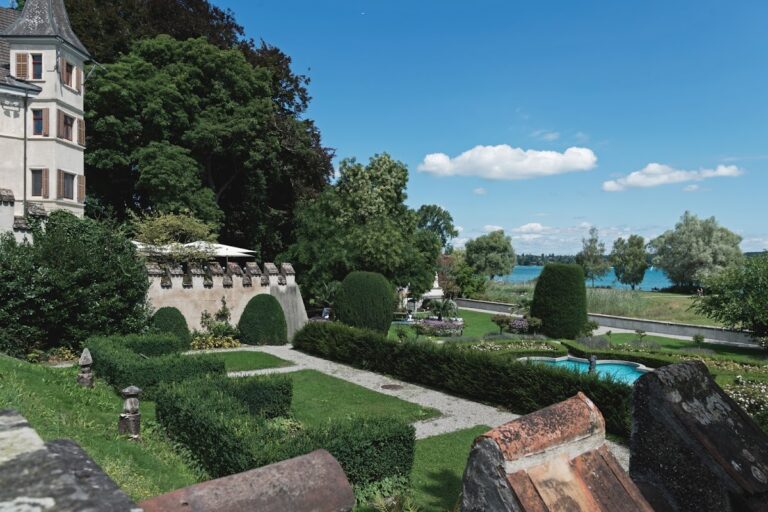
Girsberg’s surviving complex centers on the castle rebuilt in 1790 and the buildings that formed its associated estate. Earlier descriptions present the property as an enclosed lordly seat, with two principal dwellings inside a surrounding wall and agricultural buildings supporting the residence. Later changes preserved the estate’s domestic, religious, and agricultural components in altered forms.
Castle and enclosed estate
The 1790 castle
The present castle replaced the older building during Zwiefalten Abbey’s rebuilding of 1790. It was designed for use as a governor’s residence and represents the principal surviving form of the estate after the old castle was demolished.
The earlier lordly seat
An inventory from 1679 describes the lordly seat as two well-built dwellings enclosed by a surrounding wall with the other principal buildings. Together, the dwellings contained four living rooms, three kitchens, a small writing room, storerooms, eight chambers, three vaulted cellars, one non-vaulted cellar, and large storage casks that were described as almost new.
Agricultural buildings and land
The enclosed estate included a wine press with its equipment, a barn, double stabling, and substantial storage buildings. A bakehouse and a shed stood outside the enclosing wall. The associated land comprised ten Jucharten of vineyards, fifty Mahd of meadows, thirty-eight Jucharten of arable land, five Jucharten of woodland, and half an Emmishofer Schuppis. These were historical regional measures of agricultural land, while a Schuppis was a small agricultural holding.
Chapel and cultural barn
Chapel bell
A chapel stood east of the castle until its demolition around 1840. Its bell carried a Latin prayer asking the Lord for deliverance from lightning, hail, and violent weather, together with an appeal to Saint Blaise. A German inscription states that Leonhard Rosenlächer cast the bell in Constance in 1762 in honor of God. The bell is now installed in the castle’s present turret.
The cultural barn
The former agricultural barn was converted into a cultural barn in 2002 and 2003. Its contents included a doll museum and a memorial room dedicated to Ferdinand von Zeppelin. The doll museum was later expanded into rooms in the castle, where dolls and mechanical toys from Marguerite Stohler-Daeniker’s collection are displayed.
Nearby sites