Birtrange Castle: A Historic Estate in Luxembourg


Site at a Glance
- Rating
- 3.9
- Popularity
- Very Low
- Country
- Luxembourg
- Primary era
- Early Modern
- Eras represented
- Medieval, Early Modern
- Civilizations
- Duchy of Luxembourg, Habsburg, Holy Roman Empire
- Site type
- Domestic
- Remains
- Castle
On this page12 sections
History
Birtrange Castle is a historic estate in Luxembourg, near Schieren, whose origins date to the thirteenth century and whose present form was created around 1775 in the English Gothic tradition. The oldest parts were built by Gaspard-Florent de Breiderbach, giving the site a medieval foundation that was later transformed into an eighteenth-century residence.
From Medieval Origins to the Eighteenth Century
The castle’s earliest history reaches back to the thirteenth century. Its oldest surviving architectural component is a fourteenth-century round tower, while the residence that gives the castle its current form was built around 1775. English Gothic was a medieval architectural tradition that developed in England and is associated with pointed arches, ribbed vaults, large windows, and a strong emphasis on vertical lines.
The De Blochhausen Family
The De Blochhausen family acquired Birtrange Castle in 1813. Baron Félix de Blochhausen, who later served as prime minister of Luxembourg, was born at the castle in March 1834. He died there in November 1915, linking the estate to an important figure in Luxembourg’s political history.
The De Broqueville Family and the Second World War
Ownership passed to the family of Charles de Broqueville in 1935. Charles de Broqueville had previously served as prime minister of Belgium. During the Second World War, American troops were stationed in the castle, leaving inscriptions and graffiti on its walls.
Abandonment, Protection, and New Ownership
Birtrange Castle was abandoned in 2002. After Baroness Claudine de Broqueville died in January 2018, the estate was donated to the Luxembourg Red Cross. The castle was added to Luxembourg’s list of classified national monuments on 19 January 2018. This status represents the country’s highest level of statutory heritage protection for buildings and sites considered important for their cultural or historical value.
The castle’s poor condition made it difficult for the Red Cross to use and maintain. In accordance with Baroness Claudine de Broqueville’s wishes, the organization held a three-day music festival on the estate from 2 to 4 August 2019. About 2,500 people attended. Concerns about possible environmental and structural damage led to safeguards including guards, waste bins, a prohibition on chemical products, and limits on music. The organizers were held responsible for any damage.
The Red Cross subsequently offered the castle at auction with a minimum bid of EUR 5.2 million. The intended sale was to finance other Red Cross projects, with two-thirds of the proceeds assigned to the organization and one-third to Claudine de Broqueville’s legal heirs. The Luxembourg state declined to buy the property, and an attempted acquisition by Nordstad, an association of municipalities formed to pursue shared local projects and services, did not succeed.
Luxembourgish entrepreneur Jos Bourg acquired Birtrange Castle in March 2021. Renovation work began after the purchase, with assistance from Luxembourg’s national heritage authorities.
Remains
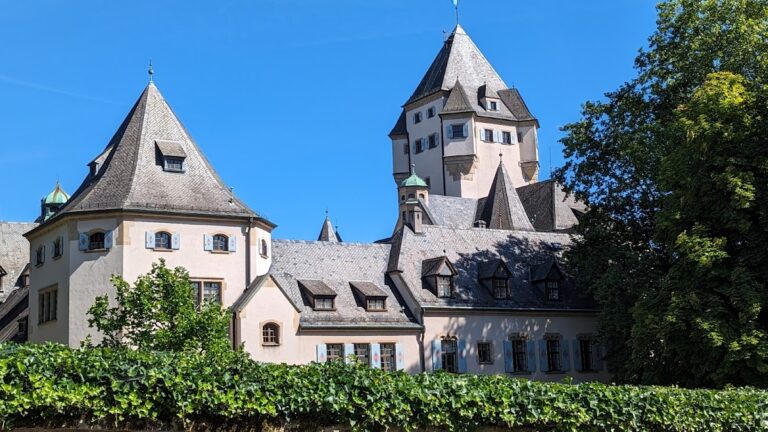
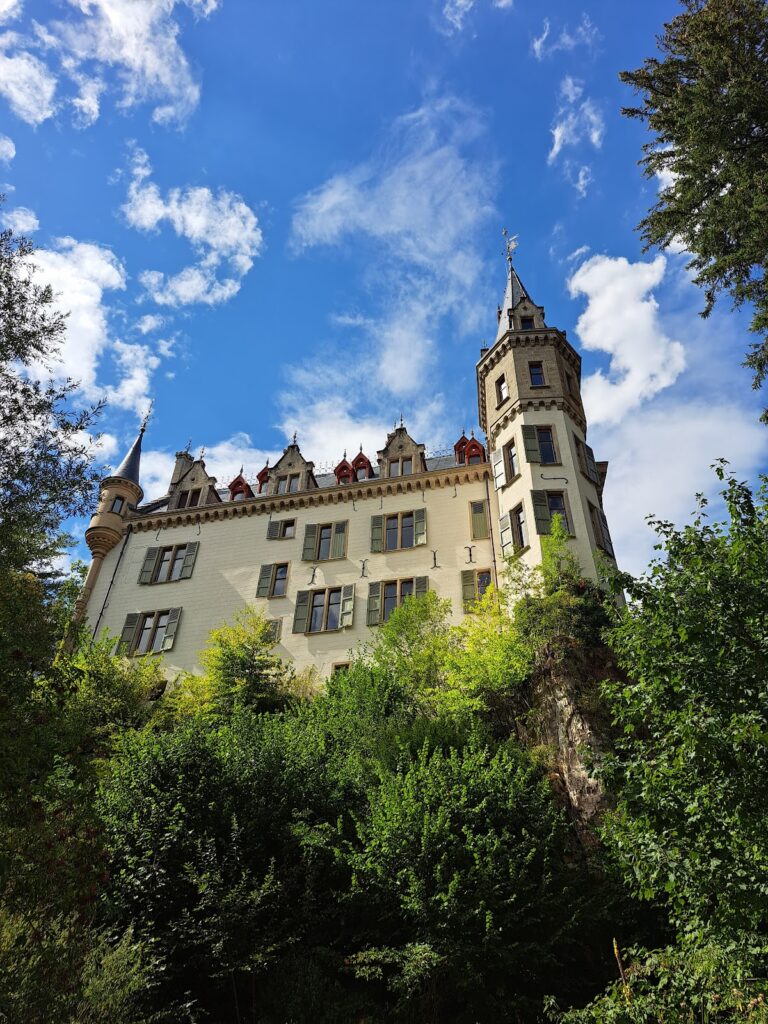
Birtrange Castle stands near Schieren in Birtrange, on the left bank of the Alzette River. The Alzette flows through central and southern Luxembourg. The estate combines the castle, an inner courtyard, service buildings, and landscaped grounds extending across approximately 90 hectares. Its architecture is described as English Gothic, while the surviving medieval tower provides a visible link to the site’s earlier phases.
Castle and Estate Buildings
Main Castle
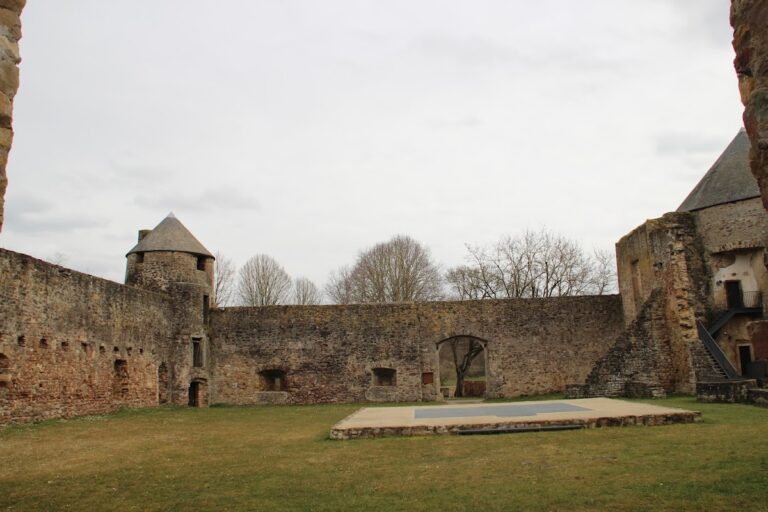
The castle’s present building dates from around 1775, and its oldest component is a tall round tower from the fourteenth century. A difficult staircase leads to the attic through the tower. The building is in poor and endangered condition, and renovation began after its acquisition by Jos Bourg in 2021 with support from the national heritage authorities.
Stables, Courtyard, and Russian House
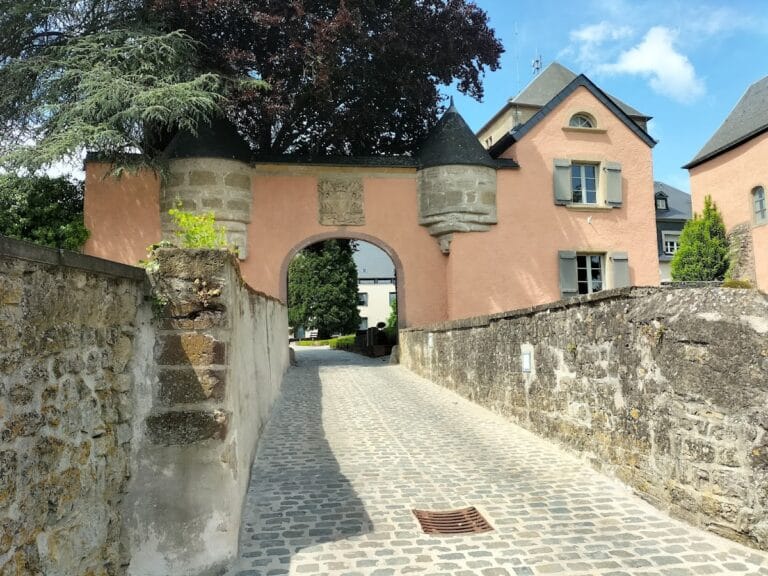
The estate includes stables and an inner courtyard containing a swimming pool. It also contains a wooden structure known as the Russian House. Together with the main castle, these buildings form part of the wider estate, whose grounds cover about 90 hectares and were formerly regarded as an excellent hunting area.
Approach and Wartime Traces
Former Avenue and Bridge
The former approach from Schieren ran along an avenue of red beeches and crossed the Alzette by a bridge. Built from red sandstone in 1844, the bridge was destroyed during the Second World War and was never rebuilt.
American Soldiers’ Inscriptions
Inscriptions and graffiti made by American soldiers during the Second World War remain visible on the castle walls. These marks preserve a physical trace of the building’s wartime occupation.
Nearby sites