Kozí hřbet Castle: A Gothic Castle Ruin in Czechia


Site at a Glance
- Rating
- 4.3
- Popularity
- Very Low
- Country
- Czechia
- Primary era
- Medieval
- Eras represented
- Medieval
- Civilizations
- Holy Roman Empire, Kingdom of Bohemia
- Site type
- Military
- Remains
- Castle
On this page7 sections
History
Kozí hřbet Castle is a Gothic castle ruin in Czechia near Radíč, with origins dating to the thirteenth century. Gothic architecture was the principal medieval European style from roughly the twelfth to the sixteenth century, characterized by masonry construction and strongly fortified or ecclesiastical forms. The castle was first mentioned in writing in 1369 under the name Hrádek.
Early lords and the Břekovec family
Volkéř of Hrádek held the castle from 1369 to 1375, after which it passed to Olbram of Hrádek. From 1392, its owner was Bohuslav Břekovec, who died in 1417 or shortly afterward. His sons Petr and Hašek Břekovec then inherited the property. Medieval noble bynames such as Břekovec identified families through their estates or places of origin.
The castle during the Hussite Wars
The Hussite Wars were the religious and political conflicts in Bohemia that followed the death of the reformer Jan Hus in 1415. Petr and Hašek Břekovec supported the Taborites, the radical Hussite faction. In 1430, they agreed to a truce with Oldřich of Rožmberk and the powerful Rožmberk family. When fighting resumed, Petr remained on the Taborite side. He concluded another eight-week truce with the Rožmberks on 24 February 1430, then signed the general provincial peace at Prague on 29 January 1440 and joined the moderate Calixtine movement.
The Taborites attempted to seize Kozí hřbet in 1441, but Petr Břekovec and the castle garrison repelled the attack. Petr was still alive in 1473, when he shared the castle with Bohuslav and Léva, the sons of his brother Hašek. By 1475, Petr was probably dead, and his share passed to his son Bohuslav.
Desertion and later protection
In the final years of his life, Petr stopped using the bynames “of Hrádek” and “of Kozí hřbet” and instead styled himself “of Ostromeč.” His descendants continued to use that name. The castle was sold shortly after 1475, possibly to the owners of Osečany. It then fell into decay. When Jindřich Osečanský of Osečany later sold it to Jan Voračický of Paběnice, the property was described as deserted. The ruins are now protected as a cultural monument of the Czech Republic.
Remains
Ridge setting and approach
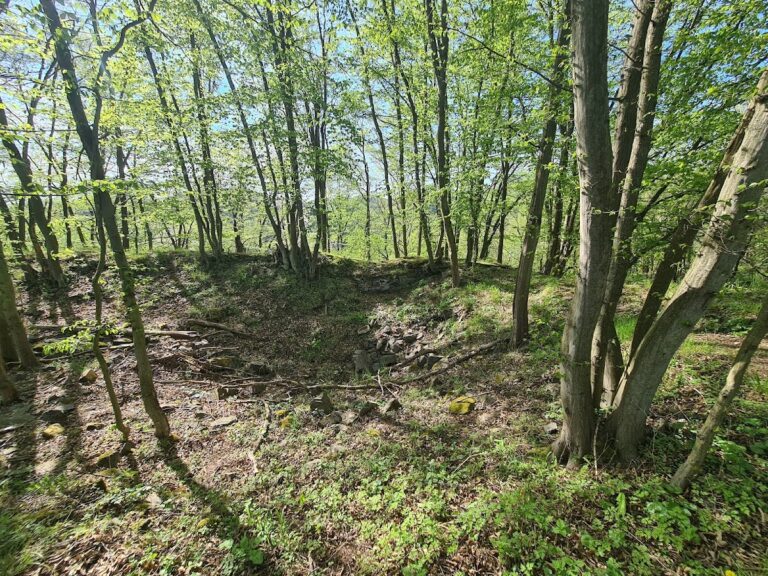
Kozí hřbet stood on a narrow rocky ridge at approximately 300 metres above sea level, in a forest near Radíč and above a meander of the Mastník stream, a right-bank tributary of the Vltava. The castle was divided into two parts. Beyond the first ditch lay a bailey containing buildings whose form is uncertain. From the bailey, the approach crossed a second ditch and entered the castle core through a gate set in a projecting tower.
A fragmentarily preserved square tower occupied the ridge’s highest point. Beyond its gate, a wall crossed the approach and contained a second entrance. A nineteenth-century plan also depicts a small round tower at this position. These defensive elements formed a sequence of ditches, gates, walls, and towers along the route into the castle.
Courtyard and surviving structures
The second gate opened into a rectangular courtyard. Buildings of uncertain form stood along its longer sides. On the eastern side, part of the outer-wall corner survives, including sockets that held ceiling beams. The western building is represented by terrain traces. A further ditch enclosed the castle behind the courtyard.
The surviving fabric includes fragments of the fortification walls, the square tower, both gates, and a palace. Together, these remains preserve the principal defensive sequence and the basic division between the outer bailey and the inner castle core.
Nearby sites