Vlčinec: A Short-Lived Gothic Castle in Czechia


Site at a Glance
- Rating
- 4
- Popularity
- Very Low
- Country
- Czechia
- Primary era
- Medieval
- Eras represented
- Medieval
- Civilizations
- Holy Roman Empire, Kingdom of Bohemia
- Site type
- Military
- Remains
- Castle
On this page8 sections
History
Vlčinec is a defunct Gothic castle in Czechia, situated south of Žďár nad Metují above the confluence of the Metuje and Dunajka near Petrovice. Archaeological finds indicate that it originated around the turn of the thirteenth and fourteenth centuries and had disappeared before the middle of the fourteenth century. Its remains are protected as a cultural monument of the Czech Republic.
Foundation and monastic rule
Vlčinec may have been founded by Bavor, abbot of Břevnov Monastery, a Benedictine monastery in Prague. As head of the monastery, the abbot may have established the castle to guard a remote Břevnov estate. Archaeologist Antonín Hejna placed its foundation during Bavor’s abbacy, between 1290 and 1332. The castle probably served as a strongpoint within the distant monastic domain.
In 1341, the monks enlarged this domain by purchasing Petrovice, Petrovičky, half of Hodkovice, and Dřevíč from the nobleman Hynek of Dubá. The archaeological finds from Vlčinec, however, belong to the first third of the fourteenth century and support the interpretation of a short-lived castle that had already vanished before this purchase.
Later records and competing interpretations
Historian August Sedláček associated Vlčinec with the administration of nearby villages during the later fourteenth century. In his reconstruction, Abbot Oldřich II of Břevnov leased Petrovice, Petrovičky, Maršov menší, and Dřevíč to Jan Kdulinec and his wife Bonuše between 1366 and 1378. Sedláček considered the person holding these villages in pledge to have lived at Vlčinec. In 1390, Petr, provost of Police, and his brother Kuneš of Pravětice received permission to redeem the villages from Jan Kdulinec and use them for the rest of their lives.
An entry from 1406 mentions a deserted mountain leased to Strádal of Vysoká Srbská for two groschen, a medieval silver coin used in Central Europe. Because the entry names only a mountain and gives a low rent, its connection with Vlčinec remains uncertain. The traditional story that the castle disappeared during a Hussite military action in 1422 was later included by the Czech writer Alois Jirásek in Old Czech Legends. Other interpretations, following Václav Vladivoj Tomek, placed the castle’s foundation at the beginning of the Hussite Wars, the religious and political conflicts in fifteenth-century Bohemia that began after Jan Hus’s death in 1415, and its disappearance around the middle of the fifteenth century. These later accounts conflict with the earlier date indicated by the archaeological finds.
Vlčinec lies within the Broumovsko Protected Landscape Area and is owned by the Czech Republic. Its surviving remains preserve evidence of a castle whose brief existence is clearer archaeologically than it is in the later documentary and literary tradition.
Remains
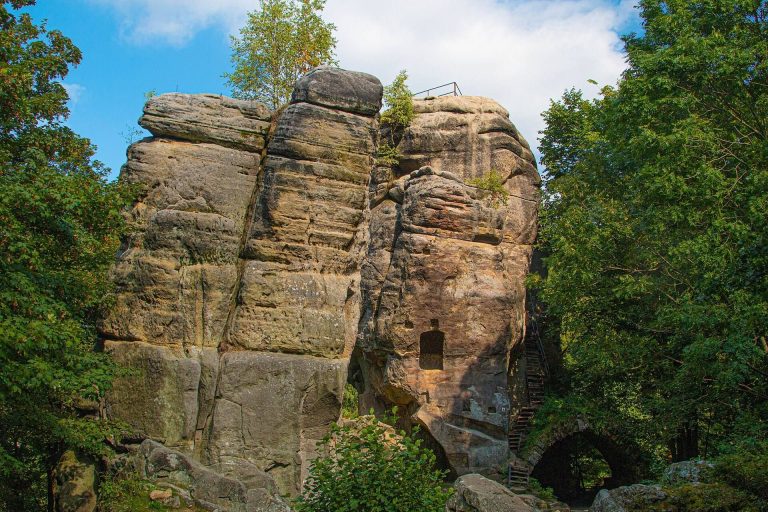
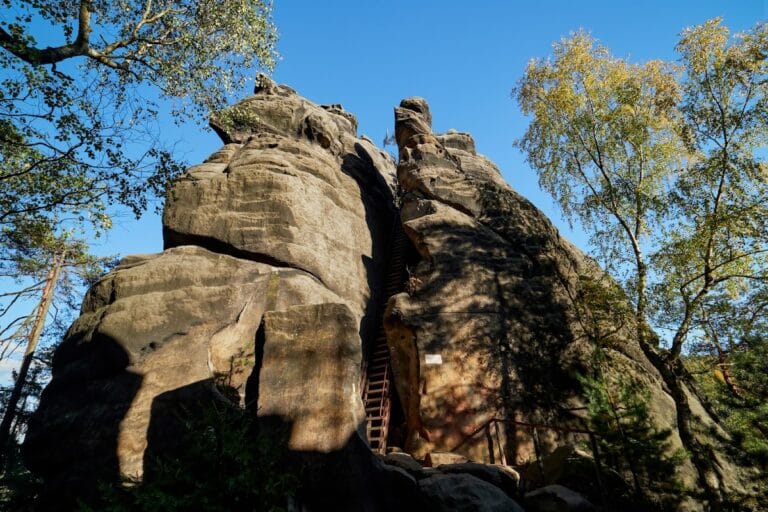
Vlčinec occupied an unusually long, narrow spur, meaning an elevated ridge projecting from higher ground, above the meeting of the Metuje and Dunajka. The landform determined the castle’s elongated shape. The site was divided into a castle core and a forecourt, while the descending end of the spur was protected by ditches and ramparts.
Castle core and forecourt
The castle core occupied the more enclosed part of the spur, with the forecourt extending from it along the narrow elevated landform. The forecourt forms part of the site’s planned division, while the core contains the only identified building remains.
Building and earthwork defenses
Rectangular building
Masonry from a rectangular building survives in the rear part of the castle core. It was exposed by improper excavation. Older plans place a round tower at the same location, so the original form of this part of Vlčinec remains uncertain.
Ditches and ramparts
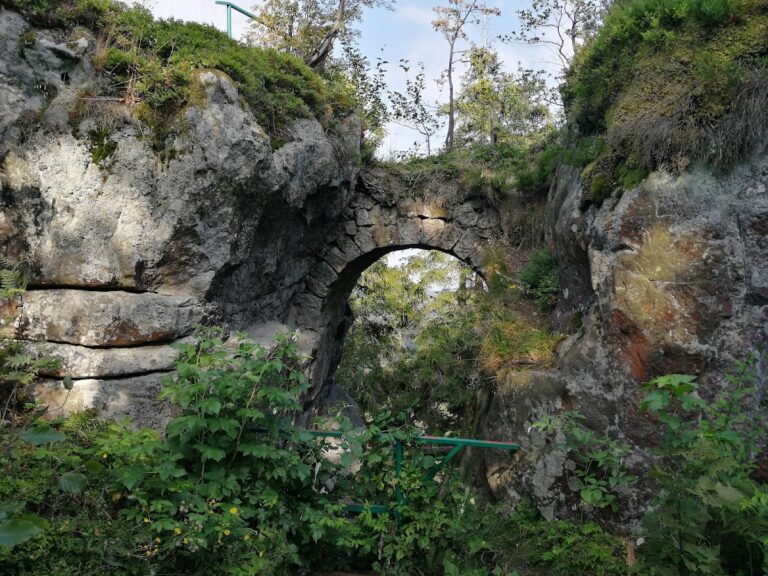
Ditches and ramparts defended the descending end of the spur. Their position used the natural shape of the elevated landform to strengthen the castle’s protection and complete the physical organization of the site.