Fort de Windt: A Coastal Artillery Battery on Sint Eustatius


Site at a Glance
- Rating
- 4.6
- Popularity
- Very Low
- Country
- Netherlands
- Primary era
- Early Modern
- Eras represented
- Early Modern
- Civilizations
- Dutch
- Site type
- Military
- Remains
- Fort
On this page7 sections
History
Fort de Windt, more accurately identified as Battery De Windt, is a coastal artillery battery on Sint Eustatius in the Netherlands, about 5 km south of Oranjestad. It was established in 1748 to defend the coast facing Saint Kitts and formed part of the island’s wider defensive system.
Establishment and rebuilding
The battery began as an earthen defensive work, but a hurricane destroyed it. Jan de Windt became commander of Sint Eustatius in 1752. A commandeur was the chief colonial official who administered the island. In 1756, the position was rebuilt in stone and named after De Windt.
The battery helped protect Oranjestad’s harbor within a network of coastal defenses. Sixteen defensive works were built for the harbor’s protection because favorable weather could allow an attack on Sint Eustatius from any direction. Nineteen batteries are also mentioned in connection with the island’s defenses.
Occupation and abandonment
During the British occupation of Sint Eustatius in 1781, the position was briefly renamed Lisburn’s Battery. The occupation was carried out by forces under Admiral George Brydges Rodney, a British naval commander. Battery De Windt was never used in practice and was abandoned in 1815.
The battery was restored in 1981, preserving the surviving stone structure and its remaining military features.
Remains
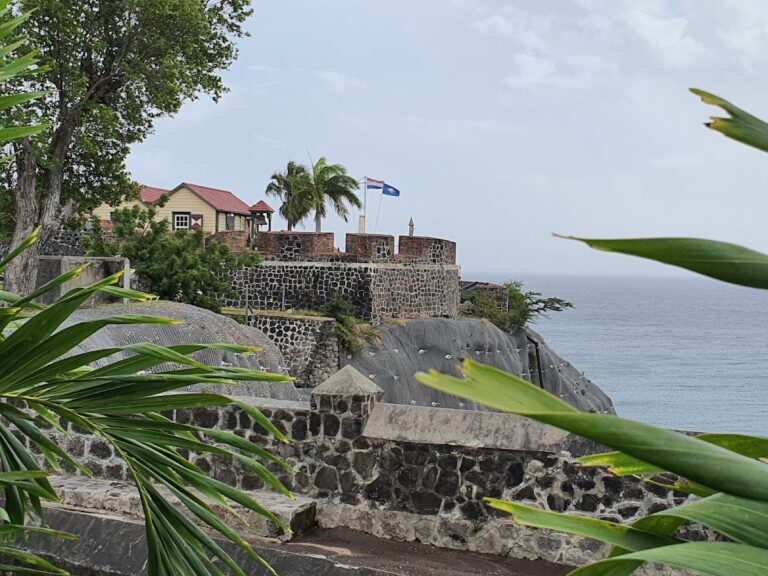
At Sugar Loaf, at the end of the road to White Wall, the surviving battery consists of a small stone work with a triangular plan. Its position at the southern tip of Sint Eustatius reflects its coastal defensive purpose and its orientation toward the coast facing Saint Kitts.
Surviving battery features
Triangular stone structure
The battery is built of stone and measures approximately 15 m in length. Its triangular layout forms the principal surviving feature of the restored position.
Cannons and inscription
Two old cannons remain at the battery on hardwood carriages. A stone set into the eastern wall carries the inscription “I.D.W. / AOR.” The initials “I.D.W.” probably refer to Iohannes, or Jan, de Windt, whose name was given to the rebuilt battery.