Castle Keppenbach: A Medieval Hill Castle in Germany


Site at a Glance
- Rating
- 4.4
- Popularity
- Very Low
- Country
- Germany
- Primary era
- Medieval
- External website
- Open
- Eras represented
- Medieval
- Civilizations
- Habsburg, Holy Roman Empire
- Site type
- Military
- Remains
- Castle
On this page7 sections
History
Castle Keppenbach is a ruined hill castle in Germany, above Freiamt, whose construction dates broadly from the twelfth to the thirteenth century. It became the ancestral seat of the Lords of Keppenbach and apparently helped protect silver mining in the Brettenbach Valley.
Origins and noble ownership
In 1161, Hartmut von Keppenbach was recorded as a ministerial, a medieval service official who performed military and administrative duties for a ruling lord. He served the Zähringer, a medieval ruling dynasty whose power extended across parts of southwestern Germany. Keppenbach appears in a 1251 arbitration document concerning Sigelau and Dannenbach, and again in a feudal charter of 1276.
By at least 1336, the castle was a Ganerbenburg, or jointly held castle, in which several noble families controlled defined shares. The Schnewlin family possessed one of those shares. The knight and baron Her Hummel von Keppenbach died on 9 July 1386 at the Battle of Sempach, a conflict in which the Swiss Confederacy defeated Duke Leopold III of Austria during the Habsburg-Swiss wars.
Destruction and rebuilding
The Lords of Keppenbach later became known as robber knights. In 1396, the Habsburgs ordered the castle destroyed as their territorial power expanded through the Breisgau and over Freiburg im Breisgau. The Lords, by then Habsburg vassals, rebuilt it in the early fifteenth century. The castle was destroyed again, this time definitively, during the German Peasants’ War in 1525, a widespread uprising in the German lands against seigneurial and political authority.
Rediscovery and interpretation
More than 350 years after the destruction of 1525, forestry workers rediscovered the ruins in the late nineteenth century. Finds from the castle are displayed at the local museum in Ottoschwanden and at the Badisches Landesmuseum.
Remains
Castle layout
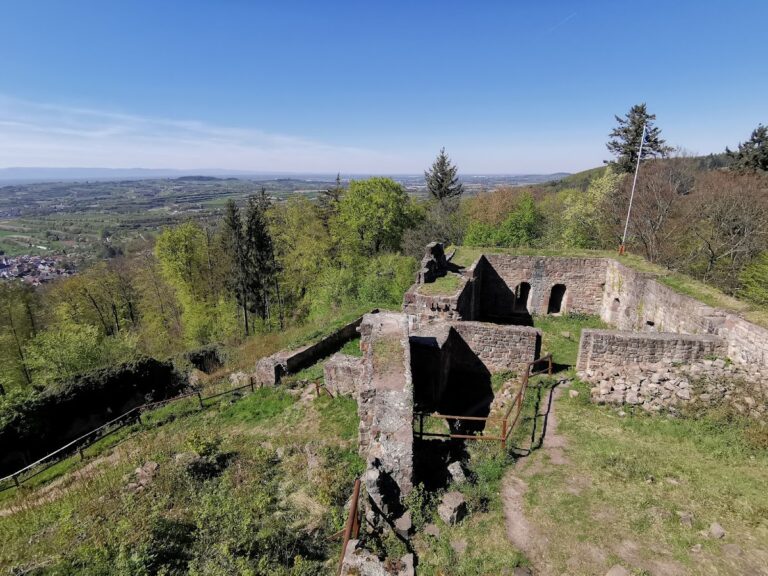
Castle Keppenbach stands at approximately 455.1 metres above sea level on a long spur of Schlossberg, above the hamlet of Sägplatz and the Reichenbach district of Freiamt. The compact complex had a triangular plan and was divided into an upper castle, middle castle, and lower castle. Its principal defense was a shield wall, a heavily fortified barrier protecting the most vulnerable approach. The wall bent twice, measured approximately 2.3 metres in thickness, and rose about 7.5 metres high. A neck ditch, cut across the spur as a defensive obstacle, surrounded the castle and was approximately 30 metres wide.
Outer defenses and surviving masonry
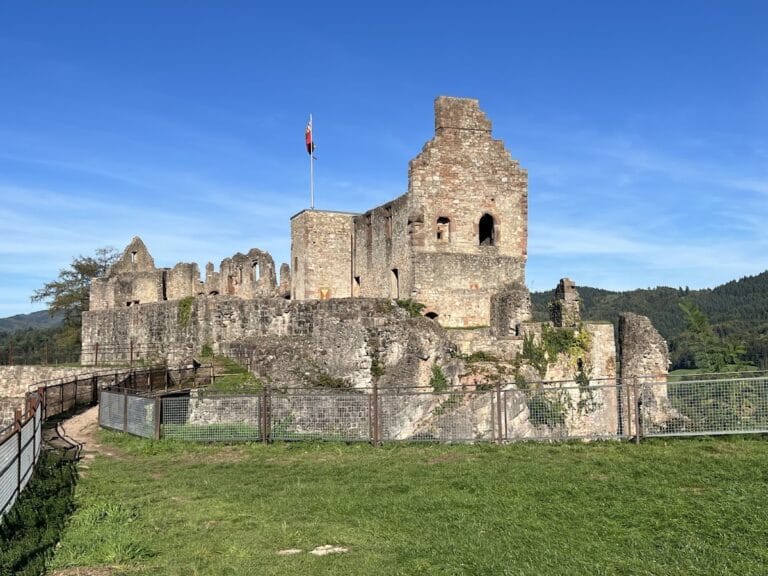
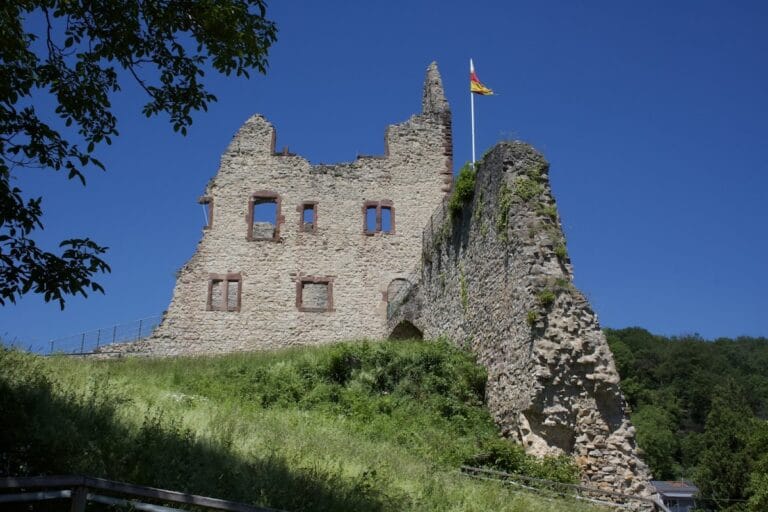
Considerable sections of the main castle’s masonry survive as ruins. A tower lies approximately 70 metres north of the castle and 38 metres lower on the slope. It is thought to have served as the keep and to have been connected with the outer bailey, a subsidiary fortified area beyond the main castle. The rocky base of the complex is registered by the State Office for Geology, Raw Materials and Mining as a geotope, a site recognized for geological interest.