Forte San Jachiddu: An Umbertine Battery Defending Messina


Site at a Glance
- Rating
- 4.6
- Popularity
- Low
- Country
- Italy
- Primary era
- Modern
- Eras represented
- Modern
- Civilizations
- Italian
- Site type
- Military
- Remains
- Fort
On this page7 sections
History
Forte San Jachiddu is an Italian military fort and battery in Messina, Italy, built by the Kingdom of Italy between 19 July 1889 and around 1910. It formed part of the six Umbertine batteries, a group of Italian defensive works constructed during the reign of King Umberto I, and was intended to control and defend the port and city while guarding the northern part of the Strait of Messina.
Military service and survival
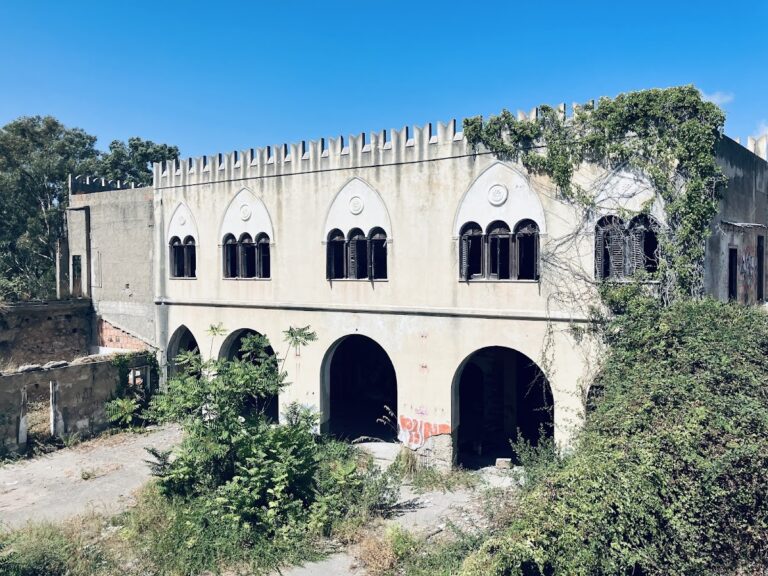
The fort was initially owned by the military and served the Kingdom of Italy, Nazi Germany, and Italy. Its strategic role continued until after the Second World War. Forte San Jachiddu survived the 1908 earthquake and both world wars in good condition, but it was abandoned after the war and later fell into serious disrepair.
Recovery and new use
Recovery began in 1997, when the Scirin Social Cooperative started restoring and upgrading the site in cooperation with public and private bodies, including the Pietro Castelli Botanical Garden of Messina. The work transformed the former military installation into an ecological park intended to provide the city with a natural and spiritual environment.
Since 2017, the renewed site has included educational trails, craft workshops, Mediterranean plant gardens, and contemporary-art installations. It also serves as the starting point for trekking paths through the Peloritani Mountains. Forte San Jachiddu is included in the protected architectural heritage list under DA 5070 of 20 January 1999 and is regarded as an important cultural and environmental heritage site of Messina.
Remains
Fortification and setting
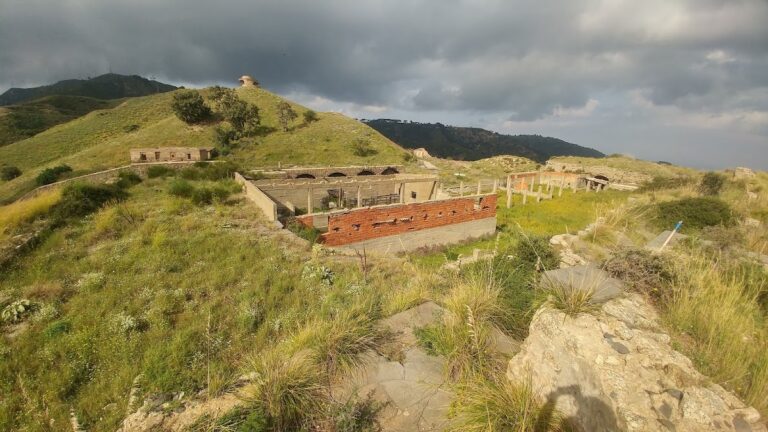
Forte San Jachiddu stands on an elevated promontory in north-central Messina, overlooking the Strait of Messina. A steep cliff descends below the fort toward Forte Ogliastri, which occupies a lower elevation. The structure was built with sedimentary rock, concrete, solid terracotta brick, and volcanic rock. Its design closely resembles other local defensive works, including Forte Serra La Croce, Forte Giulitta or Schiaffino, and Forte Monte Gallo or Cavalli, although Forte Monte Gallo was considerably larger.
Artillery platforms
Six circular platforms remain visible on the level earthwork area inside the fortification. These positions were designed for 280 mm howitzers, large artillery weapons with short barrels that fired heavy shells on high, curved trajectories. The platforms retain their original fastening pins, preserving evidence of how the guns were secured.
San Jachiddu Tunnel
The San Jachiddu Tunnel passes beneath the fort and connects the Giostra district with Annunziata Alta and the Annunziata university campus of the University of Messina. The restored fort is incorporated into a green ecological park containing educational paths, areas for craft workshops, Mediterranean planting, and contemporary-art installations.
Nearby sites