Forte Castellaccio (Messina): A Sixteenth-Century Fortress
Site at a Glance
- Rating
- 3.8
- Popularity
- Very Low
- Country
- Italy
- Primary era
- Early Modern
- Eras represented
- Early Modern, Modern
- Civilizations
- Kingdom of Sicily, Spanish
- Site type
- Military
- Remains
- Fort
On this page6 sections
History
Construction under Charles V
Forte Castellaccio (Messina) is a sixteenth-century fortress in Italy, built as part of Messina’s defensive system in the era of early modern military architecture. Formerly called Castel Reale, it was constructed between about 1547 and 1557 on the orders of Charles V of Habsburg, the Holy Roman Emperor whose territories included the Spanish monarchy and the Kingdom of Sicily.
Juan de Vega, the Viceroy of Sicily and the monarch’s chief representative and governor on the island, commissioned the project. Its designer was Antonio Ferramolino of Bergamo, an Italian military architect known for applying bastioned fortification designs to early modern defenses. Forte Castellaccio formed part of a wider scheme for protecting Messina, alongside Forte Gonzaga, another sixteenth-century fortress associated with de Vega and Ferramolino.
Revolts and later transformation
During the anti-Spanish revolt of 1674, the people of Messina stormed and seized the fortress. It was captured again in 1848, during the Messinese revolt against the Bourbon government. The 1908 Messina earthquake damaged the complex.
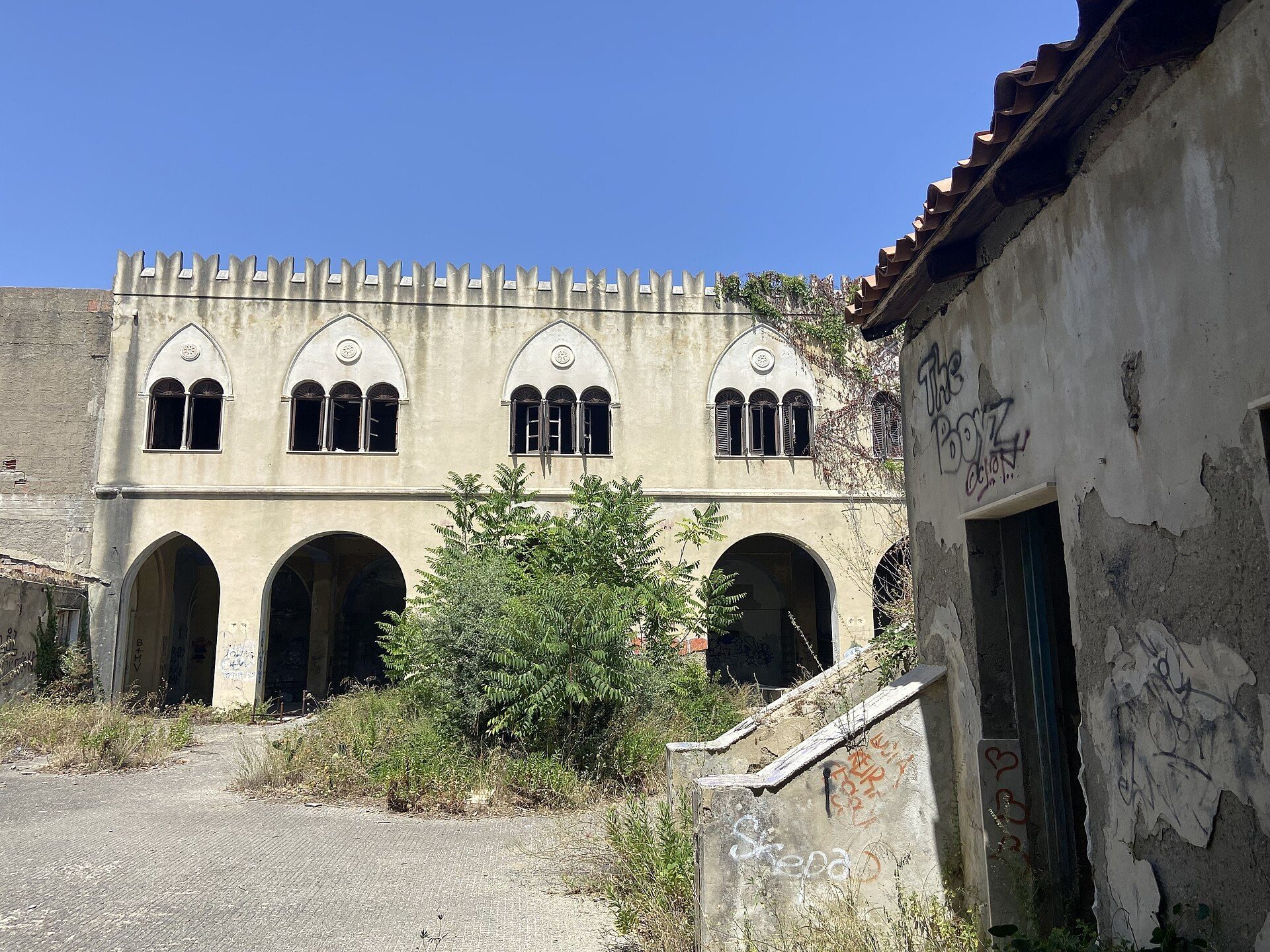
The fortress was rediscovered during the 1940s. After the Second World War, it was granted on concession to Città del Ragazzo, an organization caring for Messina’s orphans. Under Father Nino Trovato, the fort became Villa Pia, a colony for orphaned boys. The conversion added electricity and running water, but altered the original character of the site. Part of the bastioned defenses was dismantled for a chapel, while dormitories and a gymnasium were later built illegally behind the fortress.
After Father Nino Trovato died, the complex was abandoned. Several mayors later promised to regenerate it, but Forte Castellaccio remains derelict and is owned by the Municipality of Messina. Local tradition associates the abandoned complex with the ghosts of orphans and the apparition of a nun.
Remains
The original fortress
Forte Castellaccio stands on the summit of a hill in Messina’s Gravitelli area, between Gravitelli and Montepiselli, at approximately 145 metres above sea level. Its original plan was quadrangular, with bastioned fortifications arranged according to newer forms of early modern military design. A bastion is a projecting section of a fortified wall that allows defenders to cover adjacent walls with artillery and small-arms fire.
The fortress was built from limestone and tuff. Its original bastions were filled with sand, a measure intended to help absorb the impact of enemy artillery fire. The surviving fortifications are now in a derelict condition.
Postwar additions
Several later buildings were attached to the original fortress during and after its use as Villa Pia. These included the chapel that replaced part of the bastioned defenses, as well as dormitories and a gymnasium constructed behind the fort. The original structure and these annexes now form an abandoned complex whose later additions substantially changed the character of the sixteenth-century defense work.