Galileo’s House in Florence: A Galilei Family Residence


Site at a Glance
- Rating
- 4.2
- Popularity
- Low
- Country
- Italy
- Primary era
- Early Modern
- External website
- Open
- Eras represented
- Early Modern
- Civilizations
- Grand Duchy of Tuscany
- Site type
- Domestic
- Remains
- House
On this page12 sections
History
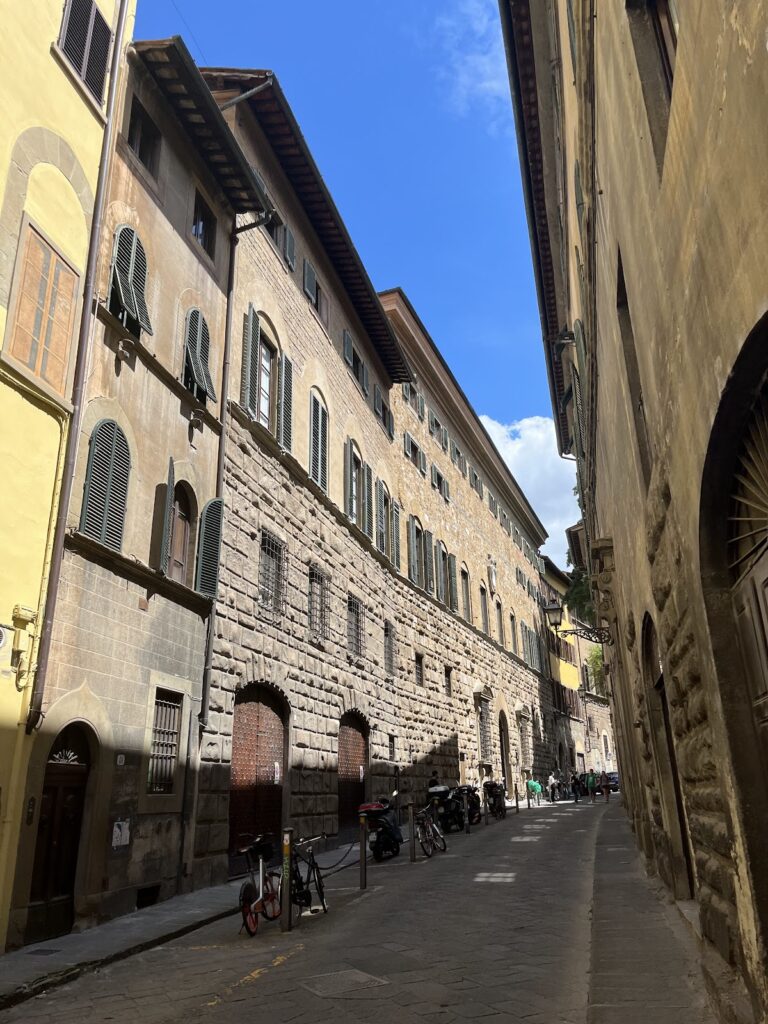
Galileo’s House is a historic residence on Costa San Giorgio in Florence, Italy, associated with Galileo Galilei, the Italian astronomer and natural philosopher whose telescopic observations and studies of motion helped shape early modern science. The property was assembled by his family between 1629 and 1634, and Galileo stayed there only briefly during the final years of his life.
Formation of the family residence
In December 1629, around the birth of their first son, also named Galileo, Vincenzio Galilei and his wife, Sestilia Bocchineri, acquired a house with a garden, water storage, and a courtyard. In 1634, Vincenzio bought the adjoining house in his father’s name. These purchases created a single residence corresponding to the present numbers 15, 17, 19, and 21.
Galileo moved to Costa San Giorgio in 1638 with permission from the Holy Office, the Catholic institution that investigated alleged religious and doctrinal violations, to receive care for his illnesses. Vincenzio and Sestilia assisted him during this period. In 1639, Galileo returned to Villa Il Gioiello at Arcetri, where restrictions imposed after his trial and recantation continued to affect his movements. Vincenzo Viviani first and Evangelista Torricelli later assisted him there until his death in 1642.
Family ownership and later memory
The property remained with the Galilei family into the nineteenth century. A cadastral plan from 1833 lists Alessandro and Leopoldo d’Antonio Galilei as owners, while documents from 1884 identify Enrichetta Galilei, Leopoldo’s daughter, as the owner.
A plaque at the entrance records a tradition that Grand Duke Ferdinando II de’ Medici visited Galileo at the house. Ferdinando II, the grand duke of Tuscany during Galileo’s later life, supported the scientist. The visit itself is not documented and is generally treated as a nineteenth-century Romantic legend. Galileo’s correspondence places him elsewhere during the plague of 1630, although it does not exclude an occasional stay at Costa San Giorgio during the 1630s.
The facade and its decorations were restored in 1998, and interior work followed in 2003. These interventions added to the understanding of the building’s earlier fabric and decoration. The house continues to be associated with Galileo’s memory, although the neighboring building at number 11 is often mistakenly identified as the Galilei property. That building was not owned by the Galilei family. Its tower was made available to Galileo for astronomical studies through an accommodation by the neighboring owner.
Remains
The property consists of a modest two-story principal building and adjoining parts that were once combined into a single family residence. Painted facade decoration, family heraldry, a fragmentary sundial, reused masonry, and a surviving painted frieze preserve different aspects of the building’s history. The adjoining structures on Costa San Giorgio form related but distinct elements of the historic setting.
The Galilei residence
Principal facade
The principal building has two floors and a restrained exterior. Painted panels cover the full height of the second-floor facade, where three medallions occupy the spaces between four windows. The central medallion contains a portrait of Galileo inspired by the well-known painting by Giusto Sustermans. Allegorical figures representing the sciences appear in the side medallions. Restoration in 1998 brought two previously covered female allegories back to view.
Family entrances and interior fabric
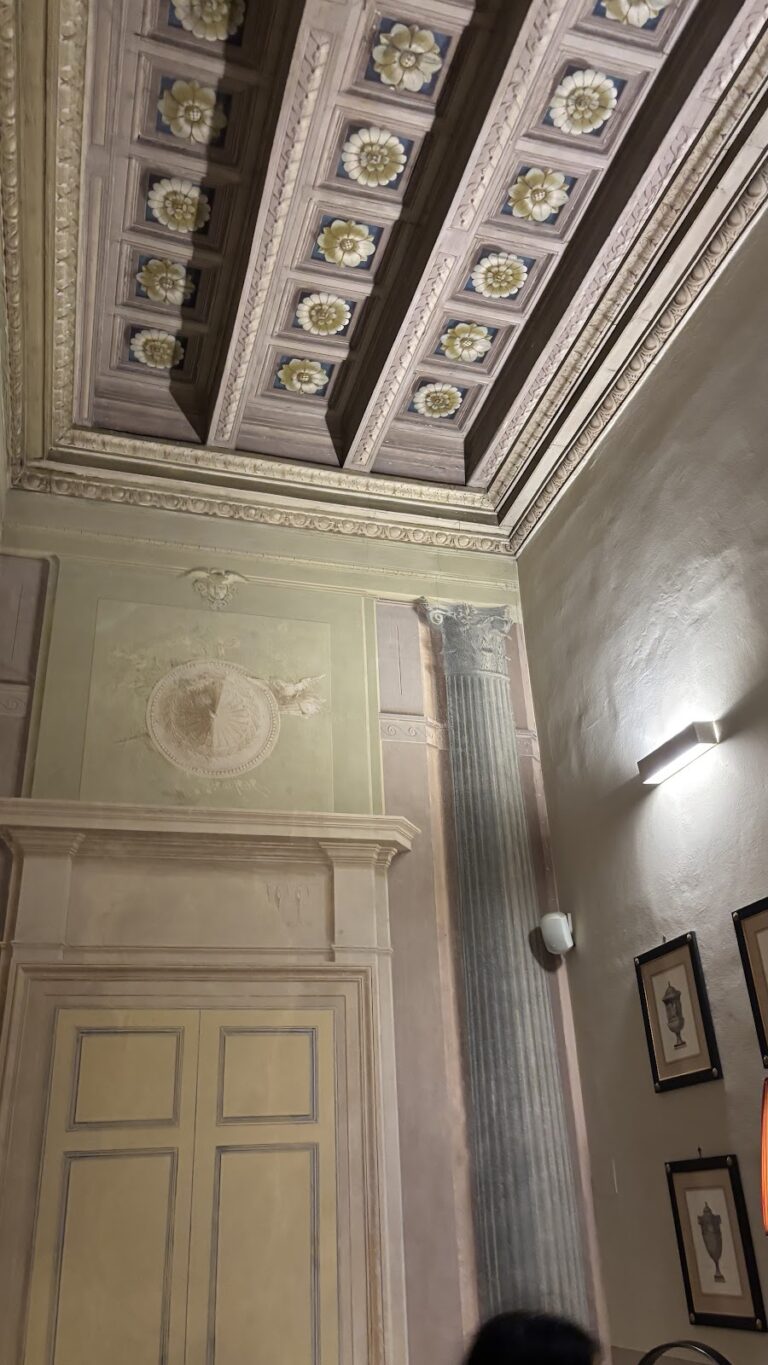
The two side entrances carry shields with the arms of the Galilei family, showing a red ladder with three rungs on a silver field. The family arms were usually represented on a gold field. Interior work in 2003 revealed dressed stones reused in the first-floor masonry and a fragment of a painted frieze decorated with flowers against a blue background.
Western facade and sundial
The western facade faces a green area enclosed by the wall along Vicolo della Cava. It retains the remains of a sundial dated 1620. Tradition has linked the sundial to Galileo or suggested that he commissioned it, but the fragmentary cartouche refers to a person named Bernardino.
House at number 15
The building at number 15 has a very simple facade arranged on two vertical axes across three floors. Its form is characteristic of a modest attached town house. The Galilei family probably restructured it to create one residential unit with the adjoining house, after which the combined property was subdivided again.
Neighboring astronomical tower
Tower and house at numbers 11 and 13
The neighboring building at number 11 has three stories arranged on two vertical axes, with a stone-framed doorway and windows in a sixteenth-century design. Its tower and the adjoining house at number 13 form a visually unified complex because of their similar noble forms, although their elements stand at different heights on the steep Costa San Giorgio.
Commemorative plaques
A plaque on the tower states that Galileo studied the motion of the stars there and inferred the motion of the Earth. A nearby marble plaque, installed by the municipality for the four-hundredth anniversary of the event, connects the tower with Galileo’s 1609 observations that led to his discovery of Jupiter’s four large moons, which he called the Medicean satellites in honor of the Medici family. Another plaque at number 9 bears the motto Nullius in verba, meaning “on the word of no one,” a statement of the principle that scientific claims should be tested through observation and experiment rather than accepted solely on authority.
Nearby sites