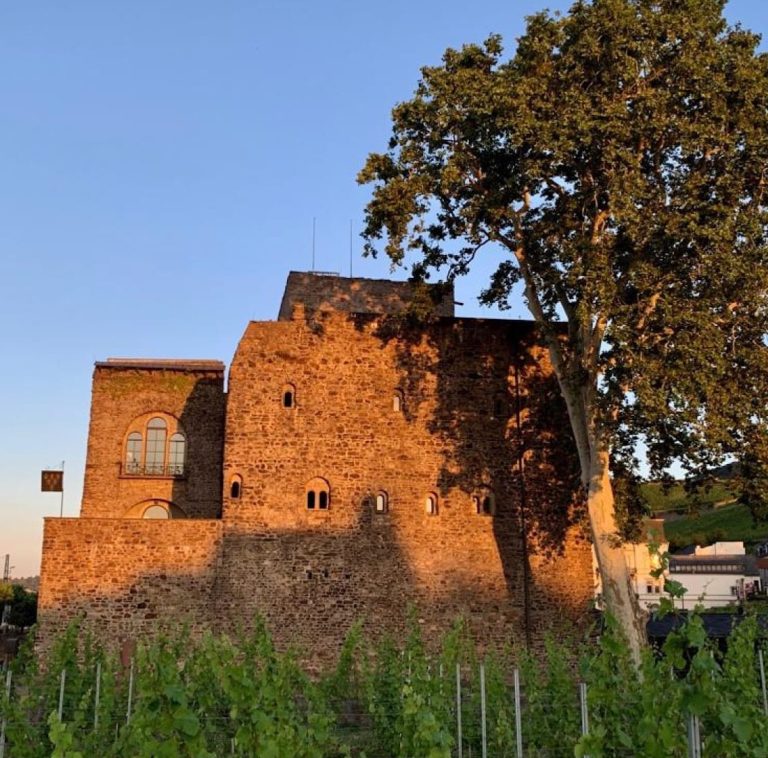
Schloss Johannisberg: A Historic Benedictine Winery and Baroque Palace in Germany


Site at a Glance
- Rating
- 4.8
- Popularity
- Low
- Country
- Germany
- Primary era
- Early Modern
- External website
- Open
- Eras represented
- Medieval, Early Modern, Modern
- Civilizations
- German, Habsburg, Holy Roman Empire
- Site type
- Domestic
- Remains
- Palace
On this page15 sections
History
Schloss Johannisberg is a historic winery and palace in Germany, a Baroque estate whose institutional history developed from a Benedictine monastery and monastic winery. Its documented antecedents reach back to the eighth century, while the present palace complex largely reflects an eighteenth-century transformation of the former religious estate.
Early holdings and the Benedictine foundation
A tradition links the first vineyard on Johannisberg with Charlemagne, the Frankish ruler crowned emperor in 800, who supposedly noticed that snow melted unusually early on the hill. The earliest documented landholding dates to 772, when property at Geisenheim was donated to Fulda Abbey. In 817, the monks exchanged it with Louis the Pious, Charlemagne’s son and successor, for land in the Wetterau. The agreement described a parcel beside the Elsterbach stream at the foot of Johannisberg.
By 983, Emperor Otto II had granted sovereignty over the western Rheingau to the Archbishops of Mainz. The vineyard was then known as Bischofsberg, meaning Bishop’s Mountain. Around 1100, Archbishop Ruthard of Mainz transferred it to the Benedictine monastery of St. Alban in Mainz. Benedictines belong to the Order of Saint Benedict, a Western Christian monastic order whose communities traditionally combine prayer, communal religious life, and productive work. The monks were expected to establish a new community on the site.
The monastery was dedicated to Saint John, and its foundation later became associated with the Rhineland massacres of 1096. It was understood as an act of atonement by Ruthard and his brother-in-law, Count Richolf of Rheingau. The name Sankt Johannisberg appears by the middle of the twelfth century. Until 1130, the community remained a priory of St. Alban; Adalbert of Saarbrücken then raised it to independent-abbey status.
Johannisberg temporarily controlled a priory that later developed into Eberbach Abbey. In its early form, the institution also operated as a double monastery, combining a male religious community with an attached women’s hermitage. The Saint George’s Hermitage at the foot of the hill is first mentioned around 1170 and survived until 1452. Its name was preserved in the later vineyard designation Johannisberger Klaus.
Reform, war, and secular administration
After an initial period of prosperity, the monastery declined. In 1451, Cardinal Nicholas of Cusa criticized both its physical and institutional decay, including the disorderly life of its monks. The community agreed to reform if the hermitage and its estates were assigned to it as a source of livelihood. In 1457, the convent joined the Bursfelde Congregation, a late-medieval Benedictine reform movement that sought stricter observance and institutional renewal. The change began a renewed period of prosperity.
The German Peasants’ War of 1524 to 1525 began the monastery’s final decline. In 1552, a raid by Margrave Albert Alcibiades of Brandenburg-Kulmbach ruined the estate. After the last abbot died in 1563, Archbishop Daniel Brendel von Homburg dissolved the monastery and placed its properties under secular administration.
The Thirty Years’ War, the major European conflict of 1618 to 1648, brought further damage and financial pressure. In 1635, Archbishop Anselm Casimir of Mainz pawned Johannisberg to meet the costs of the Swedish occupation of the Rheingau. Hubert von Bleymann received the estate’s wine revenues as interest on a loan of 20,000 Reichsthaler. The debt increased by another 10,000 Reichsthaler in 1641, and the contract later passed to Georg von Gise and his son Johann Heinrich. The monastic church suffered major damage during this period and was first destroyed in 1634.
The Fulda residence and the rise of late-harvest wine
In 1716, Archbishop Lothar Franz von Schönborn sold Johannisberg to Konstantin von Buttlar, Prince-Abbot of Fulda, for 75,392 gulden. Buttlar spent a further 148,000 gulden converting the estate into a summer residence, expanding its vineyards, and increasing wine production. The resulting building campaign created the three-winged Baroque palace that remains the architectural core of the estate.
The Fulda administration made Riesling the principal grape and invested heavily in late-harvest production. Riesling is a white variety especially associated with the Rhine and Moselle regions. Around 1775, the estate probably began systematic production of wines affected by noble rot, the beneficial action of the fungus Botrytis cinerea on ripe grapes. A courier who was delayed in bringing permission to harvest allowed the grapes to develop this condition. Administrator Johann Michael Engert praised the resulting flavor on 10 April 1776.
The estate’s wine tradition includes the first recorded Johannisberg Spätlese in 1775 and an Auslese in 1787. These German categories distinguish wines principally by grape ripeness and selection, while noble rot can further concentrate their sugars and flavors. The first wine probably labeled as a Cabinet selection was produced in 1779, and the first estate Eiswein dates from 1858. These achievements are important to Johannisberg’s history, but they do not represent the earliest production of noble-rot wines, which is documented elsewhere from earlier periods.
Napoleonic change and Metternich ownership
Johannisberg changed hands during the Napoleonic period. After secularization, it passed to Prince William V of Orange and then to his son, who was expropriated in 1806 after refusing to join the Confederation of the Rhine, the political federation established under Napoleon’s influence. Napoleon granted the estate in 1807 to Marshal François-Christophe Kellermann, Duke of Valmy.
Several poor vintages followed. In 1811, administrator Adelaide Marco sold the harvest to Frankfurt banker Peter Arnold Mumm for 32,000 gulden. The exceptionally successful harvest, known as the comet vintage, brought Mumm more than 150,000 gulden and enabled him to establish his own winery in Johannisberg.
The estate was confiscated and placed under allied administration in 1814. Although the Congress of Vienna, the diplomatic settlement that reorganized Europe after the Napoleonic Wars, assigned the Rheingau to the Duchy of Nassau, Johannisberg remained separate. An agreement of 13 June 1815 placed it under Austrian sovereignty. In 1816, Emperor Francis I granted the estate to Klemens von Metternich, Austria’s leading diplomat and a principal figure at the Congress of Vienna.
Metternich was required to pay the House of Habsburg an annual tenth of the yield from vineyards more than twelve years old. This tithe, a payment calculated as one tenth of yield or income, continues in monetary form. Before 1945, the barrels were allocated by lot. Austria abandoned its sovereignty claims in 1851, after which back taxes were paid to Nassau.
The estate was initially intended to revert to the Habsburgs as a fideicommiss if the princely Metternich-Winneburg line became extinct. A fideicommiss was a legally restricted hereditary estate intended to remain within a specified family line. That arrangement ended with the abolition of noble privileges in 1920.
Reputation, war, and reconstruction
Under Metternich and his successors, Johannisberg concentrated on improving the quality and reputation of its bottled Rieslings. During the nineteenth century, the wines became among the most expensive in Europe, often exceeding the prices of leading Bordeaux wines. They won medals at international competitions in Paris, Philadelphia, and Vienna. Harvest quantities and qualities have been recorded continuously since 1700, while harvest dates and quality records survive without interruption from 1784.
In 1897, the Metternich estate helped establish the Rheingau wine-growers’ association, one of the organizations that ultimately contributed to the modern Verband Deutscher Prädikatsweingüter, or VDP. The VDP is a German association of quality-focused wine estates with its own classification and production standards. Phylloxera was first recorded in the Johannisberg vineyards in 1915, requiring the vines to be replanted on resistant rootstock.
Schloss Johannisberg was formally dissolved as a family estate in 1935. Christian Josef Labonte had managed it as estate councillor from 1924 and continued in that role until 1956. Under National Socialism, he was considered politically unreliable because he supplied Jewish wine merchants.
On 13 August 1942, British bombs dropped during an attack on Mainz destroyed the palace and church, leaving the palace largely a shell. Prince Paul Alfons von Metternich-Winneburg and Princess Tatiana led reconstruction for nearly two decades, completing it in 1964. They had moved to Johannisberg after fleeing their Bohemian estates in 1945, when those properties were confiscated by the postwar Czechoslovak government.
The east wing was rebuilt for a different use after the war. The princely couple continued to manage the winery during reconstruction and collaborated with Henkell and Söhnlein on the sparkling-wine brand Fürst von Metternich. In 1974, the Metternich family entered a shared-ownership partnership with the Oetker family. Oetker interests became the majority owner in 1980, and the estate is now wholly owned within the Oetker Group’s Henkell Freixenet wine and spirits business.
Princess Tatiana later sold her remaining share but retained the right to live at the estate until her death in 2006. Prince Paul died without heirs in 1992, marking the extinction of the princely House of Metternich. From 1976 until his death, he was the first German Grand Bailiff of the ecumenical Order of Saint Lazarus. Princess Tatiana held the same office from 1993 until her death, and the order’s German headquarters remained at Schloss Johannisberg until 2006.
The estate remains a functioning winery and cultural venue. It is a VDP member and retains its historic single-vineyard designation. Since the 1971 wine law, its status as its own administrative locality has allowed the vineyard name to appear on labels without a village name. In 2000, it was entered as a single vineyard in the Hessian vineyard register. The Fürst-von-Metternich-Saal continues to host events of the Rheingau Musik Festival.
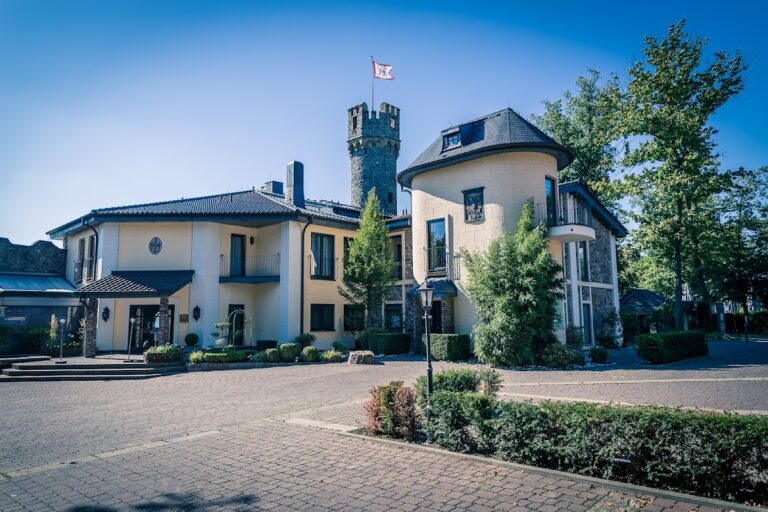
Schloss Johannisberg should be distinguished from the Neue Kloster Johannisberg, roughly one kilometre away. That complex was built as a sanatorium in 1856, acquired by Benedictine nuns in 1920, and given a church in 1928 that later served as an emergency church after the original monastery church was destroyed. It has no historical continuity with the original monastery and has operated as a hotel with a garden and restaurant since 2006.
Remains
Vineyard landscape
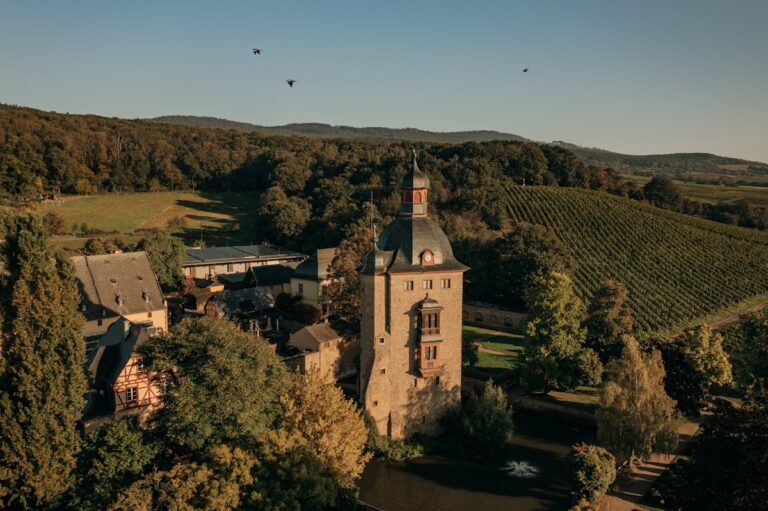
The vineyards occupy a south-facing quartzite hill in front of the Taunus. The slope rises from approximately 114 metres above sea level at its foot to 181.8 metres at the highest terrace and is considered particularly steep for the Rheingau. Its soils combine medium- to deep-depth loess and loess loam with iron-oxide-bearing slate over quartzite bedrock. The stony, gravelly ground drains well, retains daytime heat, and moderates temperature changes, although the upper slope can suffer water shortage during dry summers.
The Rhine reaches approximately one kilometre in width at this point and moderates the vineyard climate. Johannisberg lies on the fiftieth parallel, marked by two steles. Autumn humidity from the river encourages noble rot, while severe winter frost and extreme summer heat are uncommon. Historical expansion under Fulda increased the planted area from 14.3 to 18.9 hectares, with half of the expanded area newly planted. In 1720 and 1721 alone, 293,950 vines were planted, corresponding to at least 30,000 vines per hectare at the time.
Modern descriptions give the vineyard area as approximately 35 hectares in some contexts and 50 hectares for the full vineyard designation, of which about 45 hectares are regularly productive. The vines are exclusively Riesling, with a modern density of approximately 5,000 vines per hectare. The vineyard is not entirely uniform: the upper area supplies grapes for Kabinett wines, the lower area produces ordinary quality wine, the western Schlossberg is especially suited to noble-sweet wines up to Trockenbeerenauslese, and the upper eastern slope is particularly suited to Eiswein because of its lower humidity.
Palace and wine-production buildings
Baroque palace
The eighteenth-century palace is a three-winged Baroque complex arranged around a courtyard on the north side. Andrea Gallasini and Johann Kaspar Herwarthel, leading Mainz architects, designed it for Konstantin von Buttlar. The two outer pavilions and the courtyard gate survive in substantially unchanged form. The former pressing house occupied a central position within the complex, reflecting the continuing integration of residence and wine production.
Neoclassical main building
The main building was remodeled in 1826 under the direction of Georg Moller, court architect of the Grand Duchy of Hesse. The work gave the palace a Neoclassical character and shifted its emphasis from the vertical lines of the Baroque design toward stronger horizontal elements. A Hall of Mirrors occupies the centre of the main wing.
East wing and park
The east wing was rebuilt after the Second World War as an indoor tennis hall rather than as living quarters. It was later converted into the Fürst-von-Metternich-Saal concert hall. An English-style park was laid out for Metternich, initially with the involvement of Frankfurt city gardener Sebastian Rinz and later according to plans by Heinrich Siesmayer. The palace terrace remains associated with a wine bar and includes vine-covered pergolas, espaliered fig trees, and an avenue lined with sweet chestnut trees.
Cellar and wine archive
A 260-metre-long vaulted cellar was completed in 1721. Wines were historically stored there for long periods before bottling, while some eighteenth-century bottling took place in the cellar of the orangery at Fulda’s city palace. The cellar now houses the Bibliotheca Subterranea, which contains approximately 25,000 Riesling bottles, most from the nineteenth century. Its oldest bottle dates to 1748 and preserves the estate’s long record of wine production.
Modern production continues the relationship between the vineyard, cellar, and palace. Harvesting is generally carried out by hand in the first half of October. The grapes are gently pressed, and the must remains for three days at 20 degrees Celsius before alcoholic fermentation begins. Fermentation takes place in stainless-steel tanks at about 18 degrees Celsius and in large wooden casks in the historic cellar. Historically, differently coloured sealing waxes identified wine quality; modern capsule colours distinguish the principal levels from ordinary quality wine and dry wines through Grosses Gewachs, Kabinett, Spatlese, Auslese, Beerenauslese, Trockenbeerenauslese, and Eiswein.
Monastery church and basilica
The original monastery church was a large three-aisled pillar basilica with nine bays and a projecting transept. Only its foundations remain as archaeological evidence of the medieval structure. The church, dedicated to Saint John the Baptist, was rebuilt after the destruction of 1942 in strict Romanesque forms under the direction of Rudolf Schwarz. The reconstruction exposed buried pillar bases, restored the transept’s side apses, and added a crossing tower and a baptistery beside the north aisle.
The rebuilt basilica’s plan reflects features of the former St. Alban mother monastery near Mainz. Its historic and reconstructed furnishings include a sandstone lectern, sculptures from the fifteenth and sixteenth centuries, a wooden Saint Nicholas figure from around 1350, a wooden Gothic Madonna from around 1480, and a wooden standing monk probably representing Saint Benedict from around 1720. Anneliese Degen created the engobed-clay Stations of the Cross and a Saint John the Baptist sculpture in 1962. The basilica functions as the Catholic parish church of Johannisberg and also serves as a venue for sacred music.
Memorial feature
A monument in the courtyard commemorates the Spatlesereiter, or late-harvest rider, associated with the estate’s late-harvest tradition. It connects a physical feature of the palace courtyard with the wine history that developed during the Fulda administration and continued through the later estate.
Nearby sites