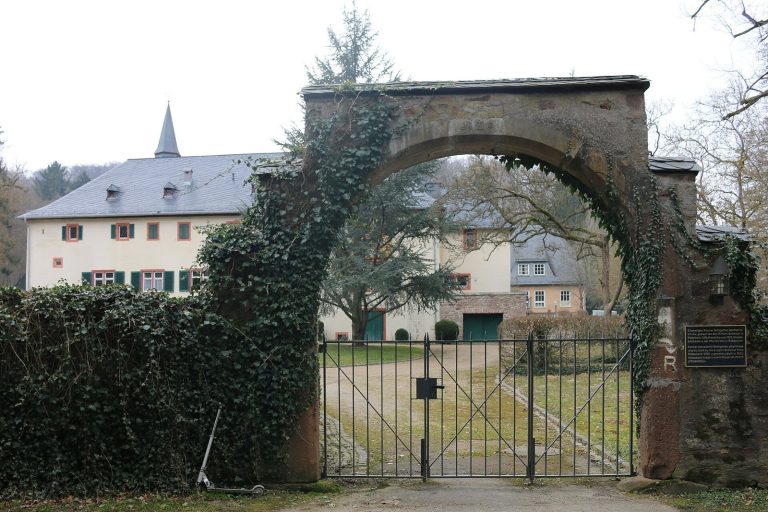
Schloss Vollrads: A Water Castle and Wine Estate in Germany


Site at a Glance
- Rating
- 4.6
- Popularity
- Low
- Country
- Germany
- Primary era
- Early Modern
- External website
- Open
- Eras represented
- Medieval, Early Modern, Modern
- Civilizations
- German, Holy Roman Empire
- Site type
- Domestic
- Remains
- Castle
On this page9 sections
History
Schloss Vollrads is a castle and wine estate in Germany near Oestrich-Winkel in the Rheingau, with a winemaking tradition documented for more than 800 years. The surviving water-castle tower has a medieval core from the first third of the fourteenth century, while the present manor house was built in 1684. The estate developed alongside viticulture in the Rheingau, a region where vines were cultivated in Roman times.
Origins and medieval development
The estate’s name combines the Lords of Winkel with the given name Vollradus. A man called Vollradus in Winkela appears in a document from 1218, followed by Conradus dictus Vollradus armiger in 1268. No surviving building can be connected securely with those references. The oldest wine invoice associated with Schloss Vollrads dates from 1211, showing the early place of wine production in the estate’s history.
After the donation of Verona in 983, the Archbishopric of Mainz, an ecclesiastical territory whose archbishop also held political authority in the Holy Roman Empire, invested in viticulture in the Rheingau. The core of the castle was later formed by a residential tower built as a water castle, a fortified residence surrounded by protective water. It is associated with the Greiffenclau family, who inherited from the Lords of Winkel. Their coat of arms was placed above the tower entrance.
The Greiffenclau building campaign
Georg Philipp Greiffenclau von Vollrads built the existing two-winged manor house beside the medieval tower in 1684. Around 1700, his son Johann Erwein expanded the estate with additional buildings, enclosed the garden with boundary walls, and replaced the water tower’s roof with a Baroque design. Winegrowing also continued to develop around the castle. Viticulture in the present Rheingau single vineyard Schloßberg, a geographically defined named vineyard site, is first recorded in 1412.
Twentieth-century changes and financial crisis
Countess Clara Matuschka-Greiffenclau undertook major alterations in 1907 and 1908. The southern wing of the manor house gained another storey, two towers with onion domes were added, and the terraces were enlarged. Richard Graf Matuschka-Greiffenclau acquired the estate in 1935. He later served as president and honorary president of the German Wine-Growing Association and as a member of the state parliament.
Erwein Graf Matuschka-Greiffenclau took over the heavily indebted estate in 1975. During the 1980s and 1990s, he also cultivated 16 hectares of the princely Löwenstein-Wertheim-Rosenberg vineyards at Hallgarten, increasing the operation to 64 hectares, but he could not restore its finances. When the principal bank sought bankruptcy proceedings in 1997, he died by suicide. Nassauische Sparkasse subsequently took over Schloss Vollrads and has continued to operate the estate, winery, and restaurant.
Wine production and conservation
Since the German Wine Law of 1971, Schloss Vollrads has been recognized as a legal place designation for wine. This permits wine from the site to be labelled without the village name “Winkel.” The estate belongs to the Verband Deutscher Prädikatsweingüter, or VDP, a German association of quality-focused wine estates whose members follow defined production and vineyard-classification standards.
The winery grows only Riesling, a white grape variety associated with the Rhine and Moselle regions, and produces the full range of Prädikat wines. These categories classify wines according to grape ripeness at harvest and include Kabinett, Spätlese, Auslese, Beerenauslese, Trockenbeerenauslese, and Eiswein, made from grapes harvested while naturally frozen. In 2022, the estate was in the final year of its qualification period for organic farming.
Early-eighteenth-century leather wallpapers in the manor house’s gentlemen’s room were restored in 2011 with support from the State of Hesse, the Schloss Vollrads support association, and the German Foundation for Monument Protection. The intervention preserved an important interior element of the early modern house.
Remains
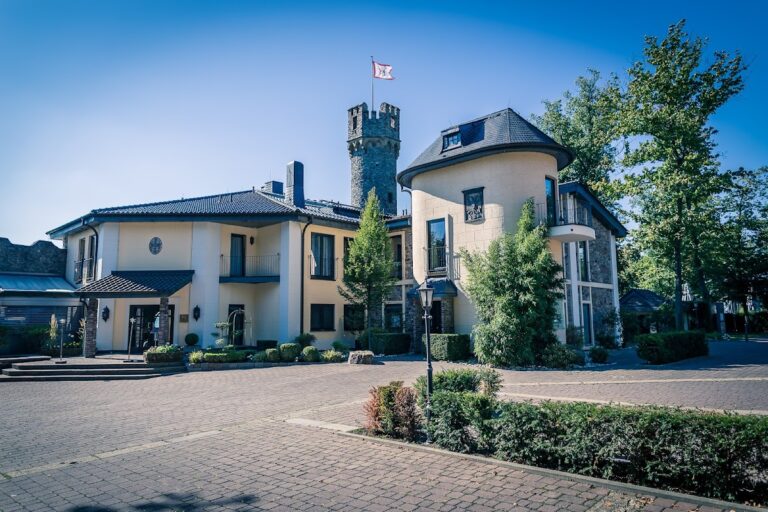
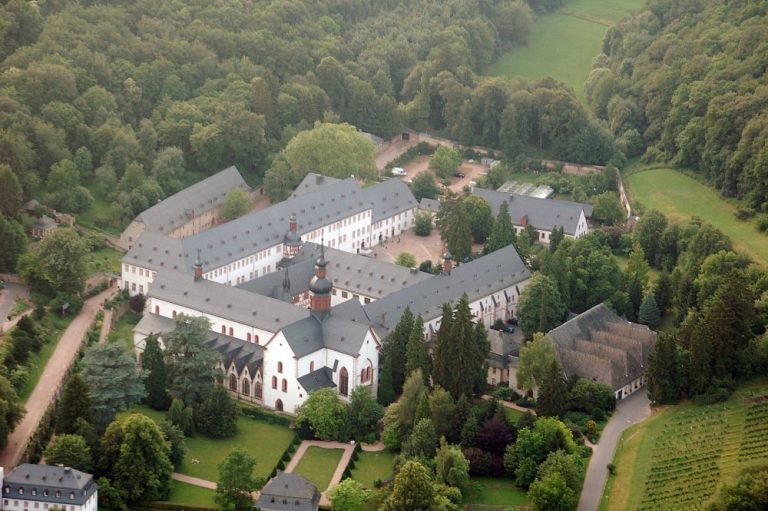
Schloss Vollrads stands about two kilometres from the Rhine at an elevation of approximately 160 metres, among woodland and vineyards. Its physical organization brings together a water-enclosed medieval tower, a later manor house, estate buildings, enclosed garden areas, and vineyard land extending around the castle.
Water castle and medieval tower
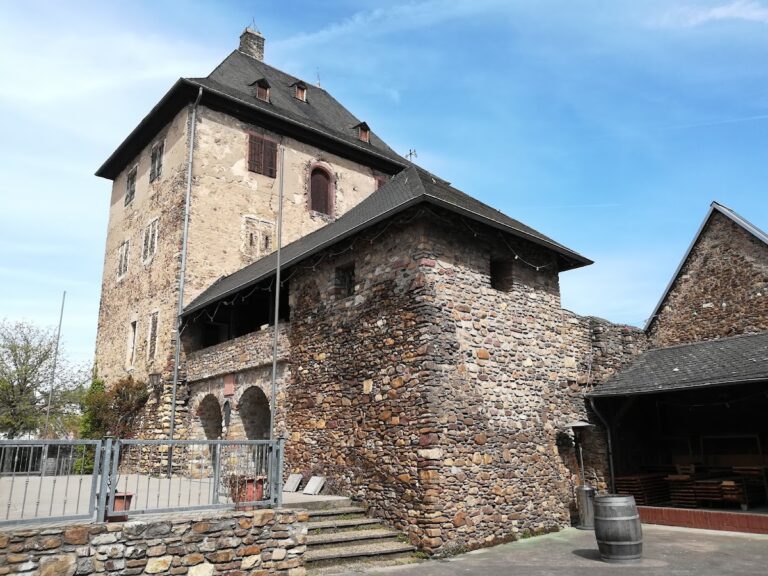
The oldest surviving part is a substantial residential tower forming the core of the water castle. A square pond surrounds it, and a bridge provides the approach across the water. The tower functioned as the donjon, the principal defensive or residential tower of a medieval castle. An octagonal stair tower was added beside it in 1471. The tower also retains a bay window from 1620, which was raised during the alterations of 1907 and 1908. The Greiffenclau coat of arms remains displayed above the entrance.
Manor house and estate buildings
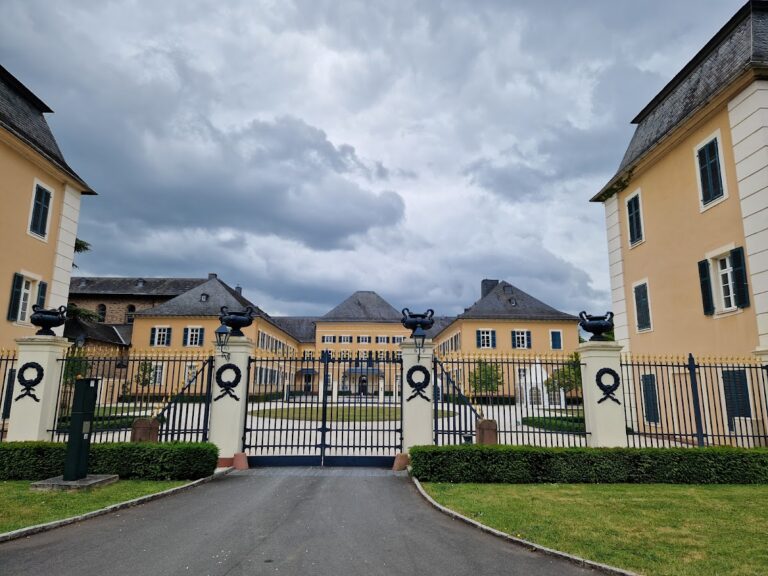
The two-winged manor house was erected beside the tower in 1684. Its southern wing was raised by one storey in 1907 and 1908, when two towers with onion domes were also added and the terraces were enlarged. Additional estate buildings from around 1700 form part of the complex. These include a wine-estate courtyard, a wine shop, the Cavalier House, an ancillary residence or service building associated with a manor or castle, and an orangery. The courtyard is also used as an open-air performance venue for the Rheingau Music Festival.
Vineyard landscape
The Schloss Vollrads vineyard district includes parts of the Winkel single vineyards Schloßberg and Dachsberg. Its named subdivisions are Greiffenberg to the east, Schlossberg to the south, Marienberg to the southwest, and Honigberg to the west of the castle buildings. The estate cultivates 48 hectares within the Schloss Vollrads district. Other vineyards in Oestrich-Winkel, Hattenheim, and Geisenheim bring the total estate area to 63 hectares, and the estate also belongs to the Rheingau collective vineyard site Erntebringer, which combines multiple smaller vineyard areas.
Since 2004, the estate has used Vino-Lok glass closures instead of traditional corks, with the bottles converted to screw caps in 2017. The glass closures were intended to preserve freshness and prevent cork taint and other cork-related wine faults.