Forte Mollinary: An Austrian Fortification in Sant’Ambrogio di Valpolicella


Site at a Glance
- Rating
- 4.4
- Popularity
- Low
- Country
- Italy
- Primary era
- Modern
- Eras represented
- Modern
- Civilizations
- Habsburg, Italian
- Site type
- Military
- Remains
- Fort
On this page9 sections
History
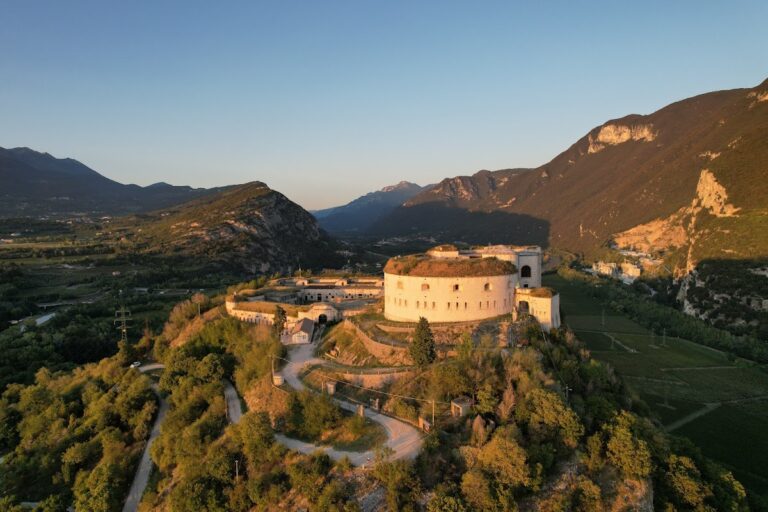
Forte Mollinary is an Austrian military fortification in Italy, outside Monte in Sant’Ambrogio di Valpolicella. Built between 1849 and 1852, it formed part of the nineteenth-century defensive works created after the 1848 uprisings in Lombardy. The project was promoted by Field Marshal Radetzky, who commanded imperial forces in northern Italy, and was intended to strengthen Verona and the surrounding territory.
Austrian construction and strategic role
The fort originally belonged to the Kingdom of Lombardy-Venetia, which remained under the Austrian Empire until 1866. Together with Forte Hlawaty, now Forte Ceraino, Forte Wohlgemuth, now Forte Rivoli, and the Chiusa road barrier, now Forte di Chiusa, it formed the second defensive barrier on the Adige behind Pastrengo. This group controlled the route from the south toward Tyrol, including the strategically important narrows through which the Brenner road and railway passed.
Forte Mollinary also protected the rear of Forte Hlawaty and the interval toward the fortress of Peschiera. Planning was undertaken by the Imperial-Royal Fortification Bureau in Verona, while the military engineering corps directed construction. The fort was named after Anton Mollinary, an Austrian military engineer and later senior artillery officer who served there for seven years as a pioneer commander.
Italian modernization
When Veneto was annexed to the Kingdom of Italy in 1866, the Italian Royal Army took control of the fort. A ministerial commission considered its position strategically suitable, and extensive modernization followed by 1884. Among the changes was the alteration of its artillery direction from south toward north. The fort was then renamed Forte Monte, after the settlement in which it stood. The later Italian defensive group was called the Gruppo di Rivoli, although Forte San Marco was added only after 1888.
Despite the modernization, the fort soon became militarily obsolete because its design was outdated. It continued in Italian Army use and from 1943 served the German Wehrmacht, the armed forces of Nazi Germany from 1935 to 1945, as a magazine.
Destruction and abandonment
In 1945 the fort was rendered unusable and abandoned. During the German withdrawal, it suffered severe damage from an explosion associated with abandoned ammunition or gunpowder, as well as from artillery fire and aerial bombardment. Earlier, from 10 December 1944, B-25 bombers of the United States Air Force’s 57th Bomb Wing had attacked the area during the Battle of the Brenner, attempting to trigger landslides near the fort and above Domegliara station to interrupt the railway below. German forces may have left the fort as early as 1944. On 24 April 1945, Anglo-American forces led by the United States Army’s 10th Mountain Division engaged the position with howitzers to prevent possible attacks from it.
Forte Mollinary is now privately owned, abandoned, and ruinous. Local history enthusiasts have periodically cleared vegetation in efforts to protect the remains.
Remains
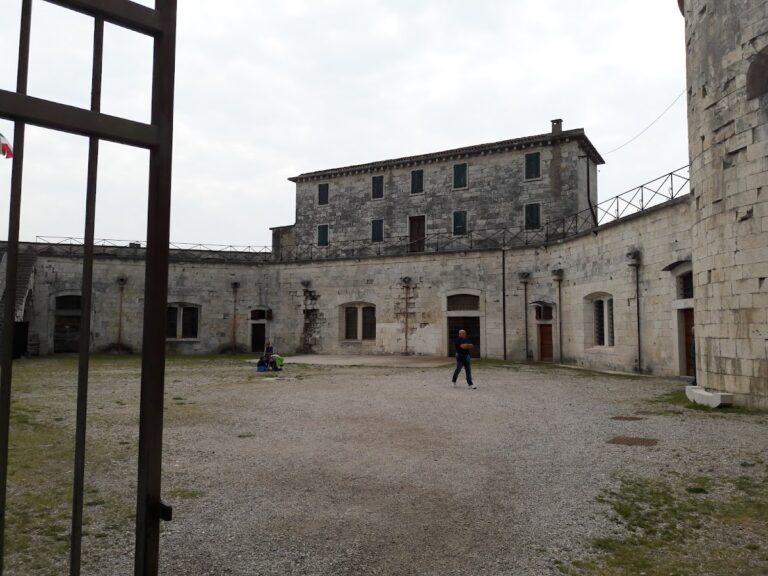
The fort stands at approximately 410 metres above sea level on a rocky spur of Monte Pastello, on the left side of the Adige valley, immediately outside Monte. Its irregular plan follows the rocky ground. The entire structure was built from dressed blocks of locally quarried stone from Sant’Ambrogio, especially red ammonitic limestone. A waterproof clay layer formed part of the roof, which was covered by an earth embankment reaching approximately two metres in thickness.
Artillery sections
The principal layout consists of a frontal casemated section and an adjacent section with open artillery positions. A casemate is an enclosed artillery chamber protected by masonry. The casemated section faced south, west, and north, while the open section faced east; two additional open positions lay to the south. The upper level of the frontal battery had five artillery embrasures, or openings through which guns could fire. The lower level contained rifle loopholes, with two cannon embrasures toward the south, five toward the west, and four toward the north. Rifle fire could also cover the courtyard.
Guns and internal defense
Field artillery pieces stood at courtyard level, and the fort could accommodate up to 24 guns. The inventory after the 1884 Italian modernization included approximately 20 guns of various calibres, among them five 120-millimetre or 210-millimetre breech-loading guns, twelve field guns, and two mortars. Some weapons were kept in reserve for placement when required.
Ditch, entrance, and military road
A dry defensive ditch approximately three metres wide and two metres deep protected the gorge side. Entry was provided by a drawbridge. An old military road connected the fort with the surrounding defensive works, rising from Ceraino through Forte Ceraino and continuing steeply and narrowly to Monte. From there it continued east toward the settlement, while a crossing of the Adige linked the defensive network with Forte Wohlgemuth at Rivoli Veronese.
Condition of the masonry
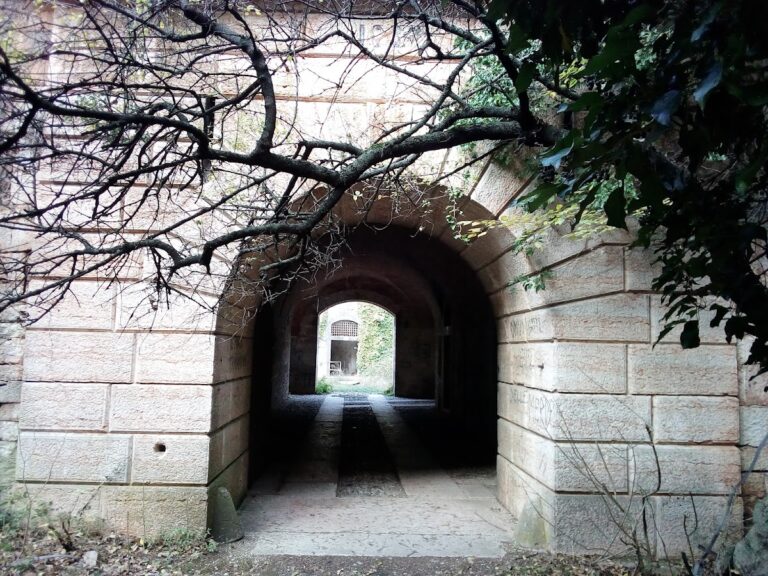
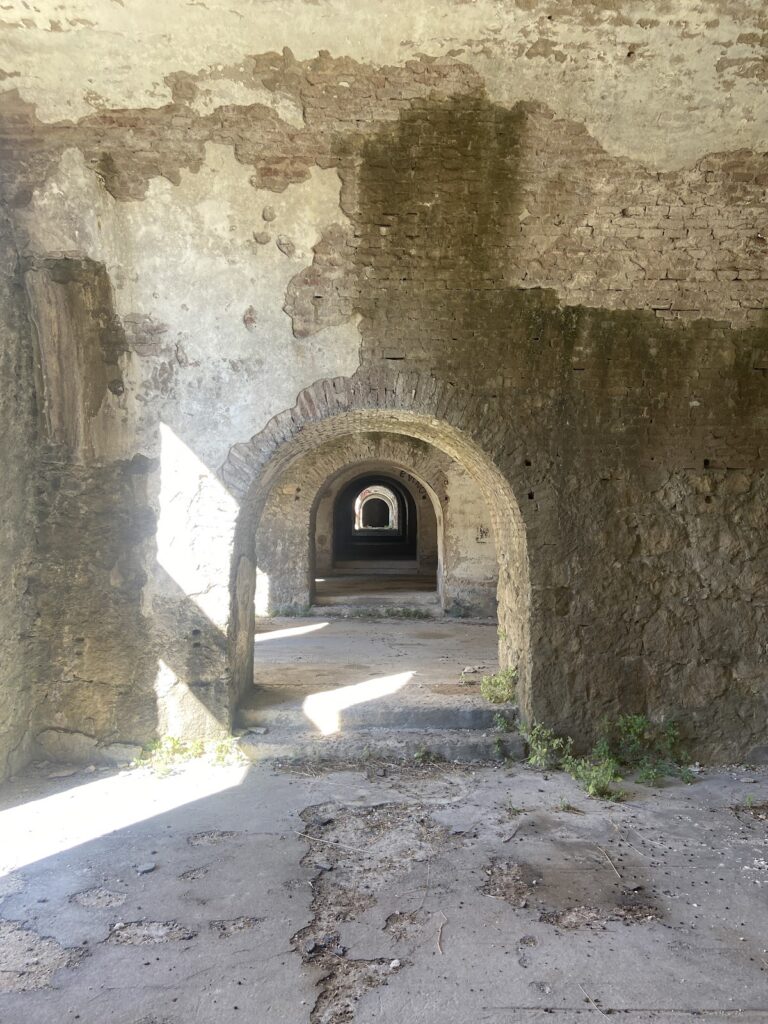
The masonry was executed with particular care and included details regarded as artistically notable. The surviving structure is heavily damaged and overgrown. Shelling destroyed exterior and interior walls, while aerial bombardment caused the northern perimeter wall within the fort to collapse.
Nearby sites