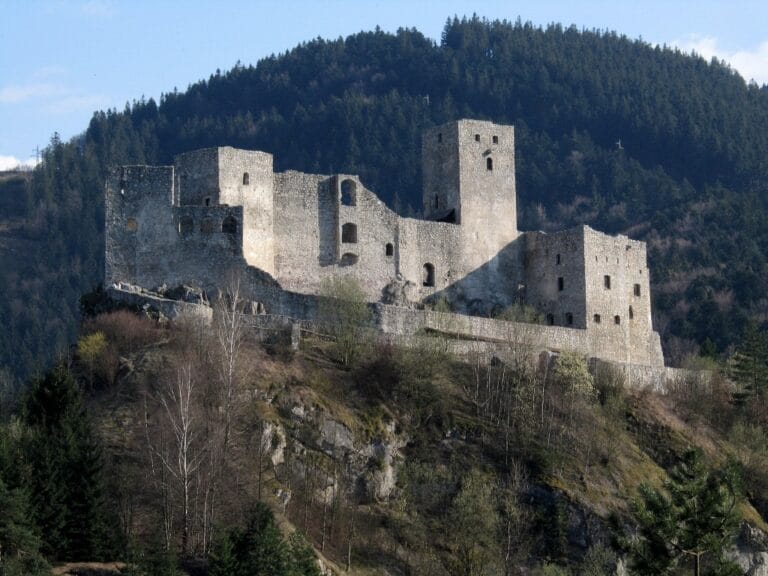
Blatnica Castle: A Medieval Stronghold on the Via Magna in Slovakia


Site at a Glance
- Rating
- 4.7
- Popularity
- Low
- Country
- Slovakia
- Primary era
- Medieval
- Eras represented
- Medieval, Early Modern
- Civilizations
- Hungarian
- Site type
- Military
- Remains
- Castle
On this page7 sections
History
Blatnica Castle is a medieval castle in Slovakia, probably founded in the second half of the thirteenth century to protect the Via Magna, a long-distance commercial route linking the Nitra region with the Turiec Basin and routes toward Silesia, Orava, and the Baltic. Its position gave it a strategic role in controlling movement through the region.
Royal stronghold and changing routes
The first written reference to Blatnica Castle dates from 1300, when it belonged to Peter of Brezovica. The castle later became royal property. After the Via Magna shifted toward the valley axis, including the routes through Mošovce and Martin, Blatnica lost much of its strategic importance. The Hungarian kings repeatedly pawned the castle, and its owners during the fifteenth and early sixteenth centuries generally used it without substantially enlarging or maintaining it.
In 1414, royal control passed to Pongrác of Liptovský Mikuláš. The castle later came into the possession of the Polish knight Peter Komorowski, who governed Orava on behalf of the Hungarian king. These transfers reflected the changing political and strategic role of the stronghold within the medieval Kingdom of Hungary.
The Révay period
The Révay family acquired Blatnica Castle in 1540. As hereditary župans, senior county officials in the historical Kingdom of Hungary, they expanded the complex substantially during the later sixteenth and early seventeenth centuries. Their work added a lower section containing residential and service buildings, changing the castle from its earlier compact form into a more extensive fortified residence.
The castle was occupied by Stephen Bocskai’s forces in 1604 and by Gabriel Bethlen’s troops in 1619. Both men led major anti-Habsburg movements in the Kingdom of Hungary. In the late 1670s, the kuruc forces of Imre Thököly, an anti-Habsburg insurgent leader, also took control. During Thököly’s occupation, a major fire destroyed a substantial part of the buildings.
Rákóczi uprising and decline
At the beginning of the eighteenth century, forces associated with Francis Rákóczi captured the castle. The Révays recovered it in 1708 after the rebels were defeated at the Battle of Trenčín. Because the family had not joined Rákóczi’s uprising, Blatnica was excluded from the imperial list of fortresses designated for demolition.
Repairs were carried out in 1744, but the castle’s defensive importance had already collapsed. It was no longer inhabited from 1790 and subsequently fell into ruin.
Remains
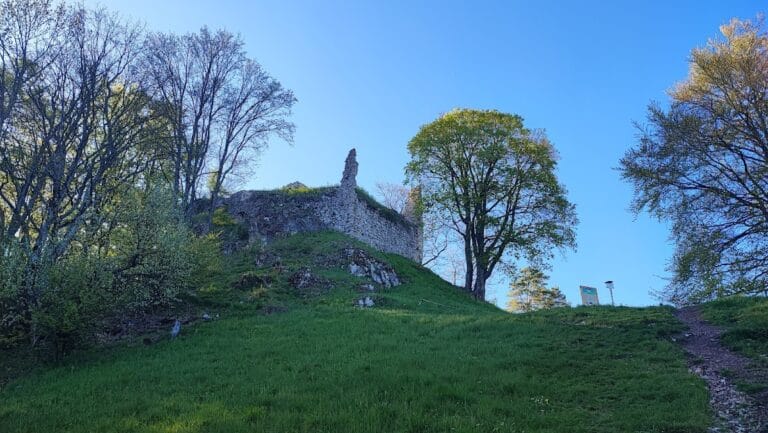
The ruins stand about two kilometres north of Blatnica on a prominent karst ridge between the Turiec Basin and the Greater Fatra Range, at approximately 658 metres above sea level. The site lies above the Gader Valley near the ridge separating the valley from the basin. Masonry ruins are partly concealed by forest. The hill was bare while the castle was occupied and was planted with pine after abandonment, limiting views from the ruins toward the Gader Valley and opposite Tlstá Mountain.
Original upper castle
The original castle formed a long, narrow residential building aligned from east to west, with a semicircular tower at each end. The western tower was considerably larger and more strongly developed than the eastern tower because of the exposed position of that side. A rocky precipice or ravine protected the castle to the northeast. On the southeast, a forecourt was enclosed by ramparts, while the entrance on the west crossed a ditch cut into the rock.
Lower section and defensive enclosure
The later lower section contained numerous residential and service buildings together with two partly open towers. Its southeast forecourt was enclosed by ramparts, extending the fortified complex beyond the original upper castle. These additions belonged to the Révay enlargement of the later sixteenth and early seventeenth centuries and formed part of the masonry complex that later survived as ruins.
Nearby sites