Polhawn Fort: A Coastal Defence Battery at Rame Head

Site at a Glance
- Rating
- 4.8
- Popularity
- Low
- Country
- United Kingdom
- Primary era
- Modern
- External website
- Open
- Eras represented
- Modern
- Civilizations
- British
- Site type
- Military
- Remains
- Fort
On this page6 sections
History
Polhawn Fort is a nineteenth-century coastal defence work in the United Kingdom, built at Rame Head between 1861 and 1865 to protect Plymouth Harbour and the Devonport naval base. Constructed as Polhawn Battery on the recommendations of the Royal Commission on the Defence of the United Kingdom, the British body responsible for assessing national and coastal defences, it formed part of a new ring of forts around Plymouth.
Construction and defence
The fort was designed by Edmund Du Cane, a British Army officer involved in military fortification design. Planned as a single gun emplacement, it was intended to prevent enemy landings in Whitsand Bay. Polhawn Fort was linked with Tregantle Fort to the west by a road now known as Military Road. Although built for active defence, it never took part in combat.
Its original armament consisted of seven 68-pounder guns. In 1869, heavier coastal artillery was proposed because of concern over new French ironclad warships such as La Gloire, whose appearance raised doubts about the effectiveness of existing coastal guns. The original weapons were eventually replaced in 1885 by seven 64-pounder rifled muzzle-loading guns. These front-loaded cannons had rifling inside their barrels to improve the accuracy of their projectiles, but they were dismantled in 1898.
Later military and civilian use
After 1898, the fort was not equipped with modern guns. During the First World War, it provided accommodation for the gun crews of the nearby Whitesand Bay Battery and also contained a detention cell. The fort was sold in 1927 and became a hotel and café during the 1930s, the period when it acquired the name Polhawn Fort. During the Second World War, it was converted into residential accommodation.
Since 1988, the former fort has operated as a guesthouse, principally rented for wedding celebrations. It is protected as a Grade II* listed structure, an English heritage designation for a building or structure of more than special interest below the highest Grade I category.
Remains
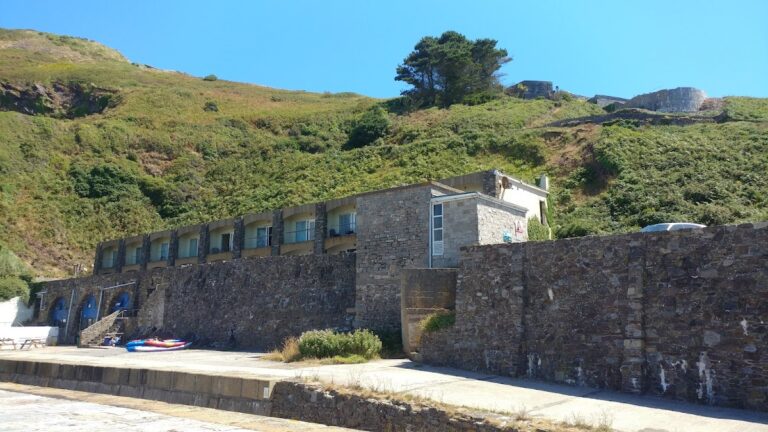
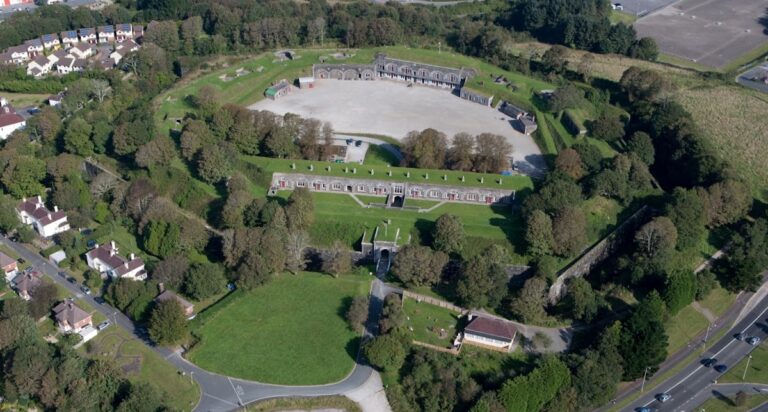
Polhawn Fort stands at Queener Point at the southeastern end of the Rame Peninsula, at the eastern end of Whitsand Bay. It lies about 500 metres west of Rame hamlet and 500 metres north of Rame Head. The fort was built on a steep, shrub-covered slope, with its defensive position shaped by the coastal terrain.
Defensive exterior
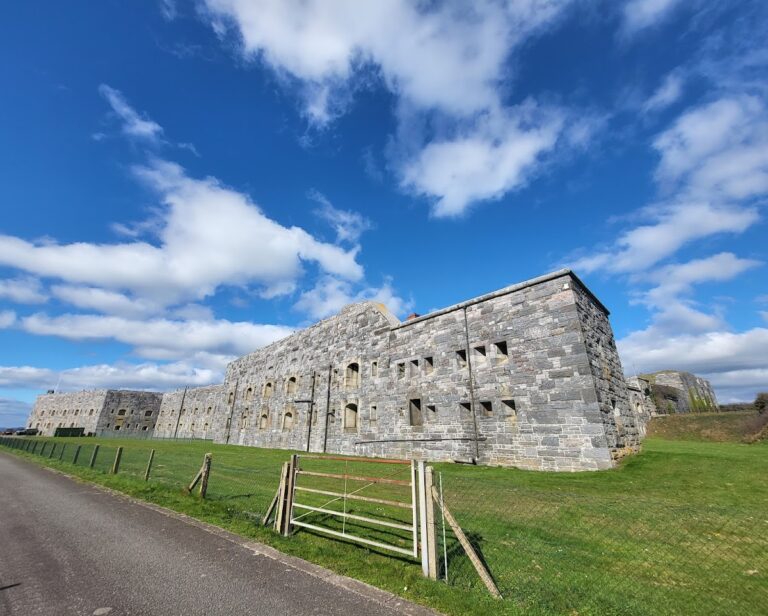
The principal structure is a two-storey casemate, a fortified chamber that could house guns or provide protected accommodation. It is built of limestone faced with granite, while the internal walls are made of brick. On the landward side, a ditch and a small ravelin, a detached triangular defensive work placed before a fortification, protected the approach. Entry was provided by a drawbridge.
Internal arrangement
The interior has undergone little change since 1865. The upper storey was arranged as a gun battery, while the lower storey contained a magazine, or military ammunition storehouse, together with accommodation. This arrangement reflects the fort’s original combination of artillery positions, protected storage, and living quarters within one casemated structure.