Burg Liebenstein: A Medieval Hilltop Castle in Germany


Site at a Glance
- Rating
- 4.7
- Popularity
- Low
- Country
- Germany
- Primary era
- Medieval
- External website
- Open
- Eras represented
- Medieval, Modern
- Civilizations
- Holy Roman Empire
- Site type
- Military
- Remains
- Castle
On this page7 sections
History
Burg Liebenstein is a former medieval hilltop castle in Germany, above Bad Liebenstein, probably built between 1360 and 1375. Its builders are uncertain, although the Lords of Stein of Altenstein and possibly the Counts of Frankenstein have been considered. The castle belonged to a landscape of competing territorial interests between Eisenach and Breitungen on the Werra, where the Landgraves of Thuringia, the Counts of Henneberg, the Bishopric of Würzburg, the Archbishopric of Mainz, and the monasteries of Fulda and Hersfeld contested influence.
Origins and the Liebenstein Branch
This unstable political environment contributed to the Thuringian War of Succession and to the construction of numerous castles and fortifications. After Altenstein changed hands, members of the Stein family appear at Liebenstein from about 1386. They established the family branch known as Stein zu Liebenstein, while the name Lybinstein first appears in 1406.
In 1393, Heinrich of Henneberg temporarily pledged the Vogtei of Brotterode to the Lords of Stein. A Vogtei was an administrative district overseen by an official called a Vogt. The district associated with Liebenstein could not have developed from the former Altenstein possessions, since contemporary boundary descriptions place the Hunde of Wenckheim, rather than the Lords of Stein, as the western neighbors of Brotterode’s forest estate.
War, Fire, and Noble Succession
During the German Peasants’ War in 1525, Lips von Stein is said to have protected the castle from destruction and plunder by pretending to submit to the peasants. In 1567, a fire destroyed parts of the castle during its capture by the Imperial Execution Army. This force had been sent toward Gotha to settle the Grumbach disputes, a series of sixteenth-century political and military conflicts, and to restore public order in central Germany.
Hermann von Stein continued repairing the castle until 1599. In 1610, he recommended a nearby healing spring to his feudal lord, Casimir. A healing spring was traditionally regarded as having therapeutic properties, and the settlement of Sauerbrunnen later developed around it. After the Liebenstein branch of the Lords of Stein died out, the castle served as a widow’s residence until 1667. When the line became extinct in 1673, its landed property reverted as a vacant fief to Ernst the Pious. A vacant fief was a feudal holding returned to its superior lord after the vassal family ended.
From Ruin to Heritage Site
During the partitions of the Ernestine duchies, Liebenstein passed to the Duchy of Saxe-Meiningen. The Ernestine duchies were Thuringian territories ruled by the Ernestine branch of the Wettin dynasty. Around 1800, Duke George I initiated repairs to the ruin.
As the spa town of Liebenstein grew, the ruin and the attractions of Altenstein Park became romantic excursion destinations for predominantly aristocratic spa visitors. Images of the castle appeared in illustrated guidebooks, on hand-colored album leaves, and as miniature designs on teacups produced by the ducal porcelain manufactory.
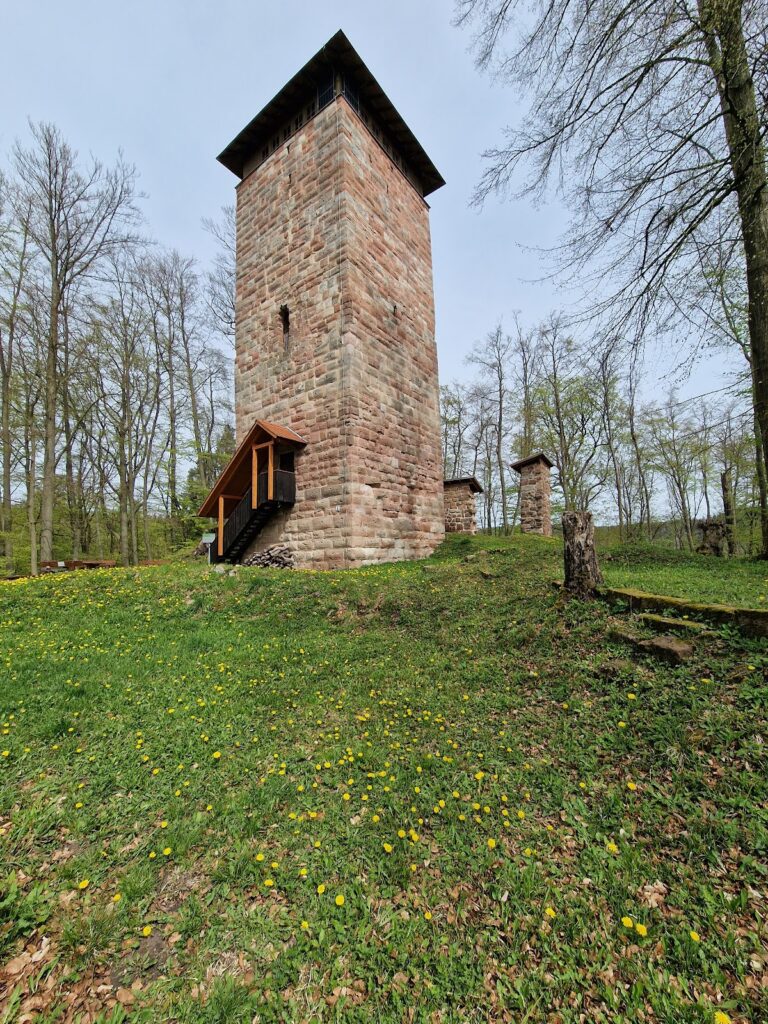
The ruin has belonged to the Free State of Thuringia since 1920. In 1932, the Liebenstein Castle Community created an ascent inside the ruin so that it could function as a viewing tower, and a block hut was built at its foot for its operation. During the German Democratic Republic period, local heritage enthusiasts associated with the Cultural Association of the GDR cared for the site, arranging guided tours and carrying out structural securing and maintenance. The Association of Nature and Local Heritage Friends of Bad Liebenstein took over the monument in 1991. Since 1998, it has been owned by the Thuringian Castles and Gardens Foundation. Extensive conservation work and related archaeological excavations have taken place since 2006.
Remains
Burg Liebenstein survives as a medieval castle ruin on the Castle Hill, at approximately 460 metres above sea level on the southwestern slope of the Thuringian Forest. The site stands north of and above Bad Liebenstein on a moderately steep hill, about three kilometres east of Altenstein Castle. Its elevated position formed the physical setting for a fortified residence and stronghold, where the terrain supported defense and surveillance.
Entrance and Internal Ascent
The former drawbridge was replaced around 1800 by a stone arched bridge. Inside the ruin, the ascent created in 1932 allows the surviving structure to be used as a viewing tower. A block hut stands at the foot of the ruin and was built in connection with this use of the site.
Conservation Features and Landscape
Water and electricity connections were installed during later conservation work. Archaeological excavations have accompanied the conservation measures since 2006, adding evidence while the physical fabric of the ruin is secured. Two sycamore maples stand in front of Burg Liebenstein; both were designated natural monuments in 1958.
Nearby sites