Fort Rapitán: A Nineteenth-Century Artillery Fort in Jaca


Site at a Glance
- Rating
- 4.3
- Popularity
- Low
- Country
- Spain
- Primary era
- Modern
- External website
- Open
- Eras represented
- Modern
- Civilizations
- Spanish
- Site type
- Military
- Remains
- Fort
On this page4 sections
History
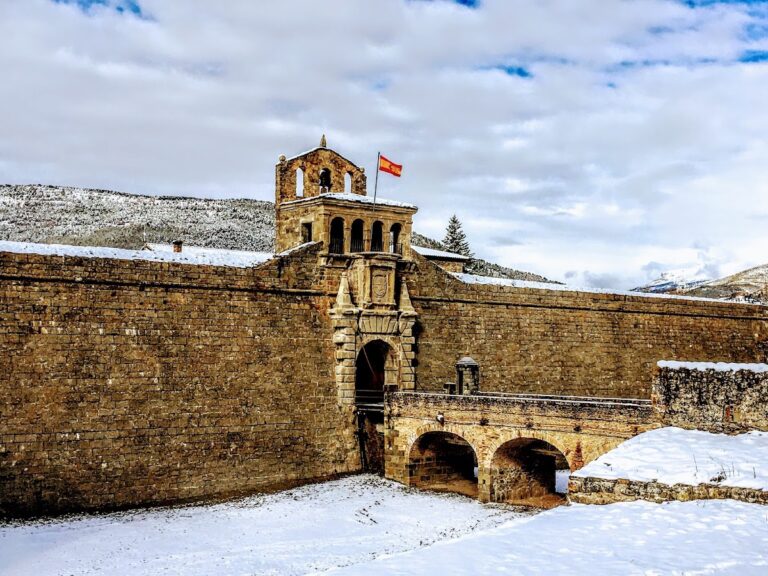
Fort Rapitán is a nineteenth-century polygonal artillery fort in Jaca, Spain, built on Mount Rapitán as part of the unfinished Entrenched Camp of Jaca. An entrenched camp was a coordinated defensive system made up of a principal stronghold and associated fortified positions. The fort guarded the entrance to the Aragón River valley and therefore held an important place in the state’s frontier defense plans.
Planning and construction
The municipal council had used Mount Rapitán as pasture since 1675. Work on the future fort began with earthworks and ground leveling in 1884, followed by completion of the access road to the summit in 1886. Eleven cannons from the Spanish state’s Trubia Foundry, a military-industrial establishment producing artillery and other armaments, arrived in 1890 for installation.
Construction proceeded alongside Fort Coll de Ladrones at Canfranc and Fort Santa Elena at Biescas. The state spent six million pesetas on the project, which employed 250 laborers as well as numerous stonemasons. A Lower Western Battery was built near Fort Rapitán, while a second battery planned to the east was never constructed. The fort itself never saw military action.
War, preservation, and later use
During the first days of the Spanish Civil War, dozens of Republicans were executed in front of the fort’s walls. Fort Rapitán was declared an Asset of Cultural Interest by a resolution of 17 April 2006, published on 22 May that year. The former fortress now serves as a civic reception venue and a setting for municipal cultural activities. It no longer houses the Military Miniatures Museum, which was transferred to the Citadel of Jaca.
Remains
Fort Rapitán stands at 1,142 metres above sea level on the mountain that bears its name. It is an artillery position designed for eighteen large-calibre guns, with rooms for the personnel who served and defended it. Most of the structure lies beneath the ground, a defensive arrangement intended to place the fort under cover from enemy fire. The nearby Lower Western Battery formed part of the wider artillery position, while the planned eastern battery remained unbuilt.
Nearby sites