Sentinum: A Roman Municipium and Archaeological Park in Italy



Site at a Glance
- Rating
- 4.3
- Popularity
- Low
- Country
- Italy
- Primary era
- Classical
- External website
- Open
- Eras represented
- Classical
- Civilizations
- Roman
- Site type
- City
On this page13 sections
History
Sentinum is a Roman town in Italy, developed as a municipium and monumentalized during the Augustan period, the political era of Augustus from 27 BC to AD 14. It stood on an alluvial plateau where the Sentino and Marena watercourses meet, near the Via Flaminia and a road leading through Suasa toward Sena Gallica. The present city appears to have been founded on previously unused ground, although the area was connected to inland routes before the Roman settlement.
Roman conquest and civic development
The area gained importance after Rome established control over the region. In 295 BC, the Battle of the Nations was fought near Sentinum during the Third Samnite War, a conflict through which Rome expanded its power in central Italy. Roman forces defeated a coalition of Gauls and Italic peoples, including the Samnites, allowing Rome to consolidate its control of the central Adriatic region.
Sentinum later became a municipium, a Roman community with local civic institutions whose inhabitants held Roman citizenship or legal privileges. It belonged to the Lemonia tribe, a Roman civic and voting division, and was included in the sixth Augustan region, Umbria. During the Augustan period, the town was rebuilt, expanded, and given a more monumental form. Its economic stability continued for several centuries, as shown by the range of public, domestic, industrial, and religious remains recovered from the site.
Destruction and reconstruction
During the civil conflict between Mark Antony and Octavian, Sentinum supported Antony, reportedly because former veterans of Antony lived there. In 41 BC, Octavian’s forces commanded by Quintus Salvidienus Rufus captured and destroyed the town. Traces of fire found in the ruins in 1947 are consistent with this event.
Sentinum was subsequently rebuilt and enlarged. The later town retained its civic and economic life into the imperial period, with urban baths, workshops, public buildings, and private houses developing within its regular street plan. Its last known inscriptional date is AD 343.
Decline and archaeological rediscovery
After the fourth century, civic life declined under the pressures of hunger, plague, and enemy incursions. The town was abandoned by the fifth century, with attacks by the Lombards associated with its final abandonment. The population later moved to higher ground, where Sassoferrato arose around the year 1000. From the early Middle Ages, stone and other material from Sentinum were reused in Sassoferrato and nearby settlements.
Ciriaco d’Ancona was the first recorded humanist scholar to investigate the local antiquities, rediscovering the site by transcribing several inscriptions. Discoveries continued intermittently during the nineteenth century. The Fabriano-Urbino railway, built in 1890 across the ancient city, prompted systematic excavations in 1890 and 1891 by Edoardo Brizio and Raniero Mengarelli. Their work established parts of the walls and identified major and minor streets and other structures.
Investigations resumed between 1954 and 1960 under Laura Fabbrini, covering the roads, urban baths, metalworking area, and Santa Lucia complex. Luisa Brecciarioli Taborelli continued research on the baths in 1974, while later studies by Mara Silvestrini clarified the thermal and hospitality functions proposed for Santa Lucia. Between 2002 and 2007, the Universities of Genoa and Urbino investigated areas on both sides of the railway and exposed further public buildings. Magnetometric surveys produced a new city plan and helped identify the forum.
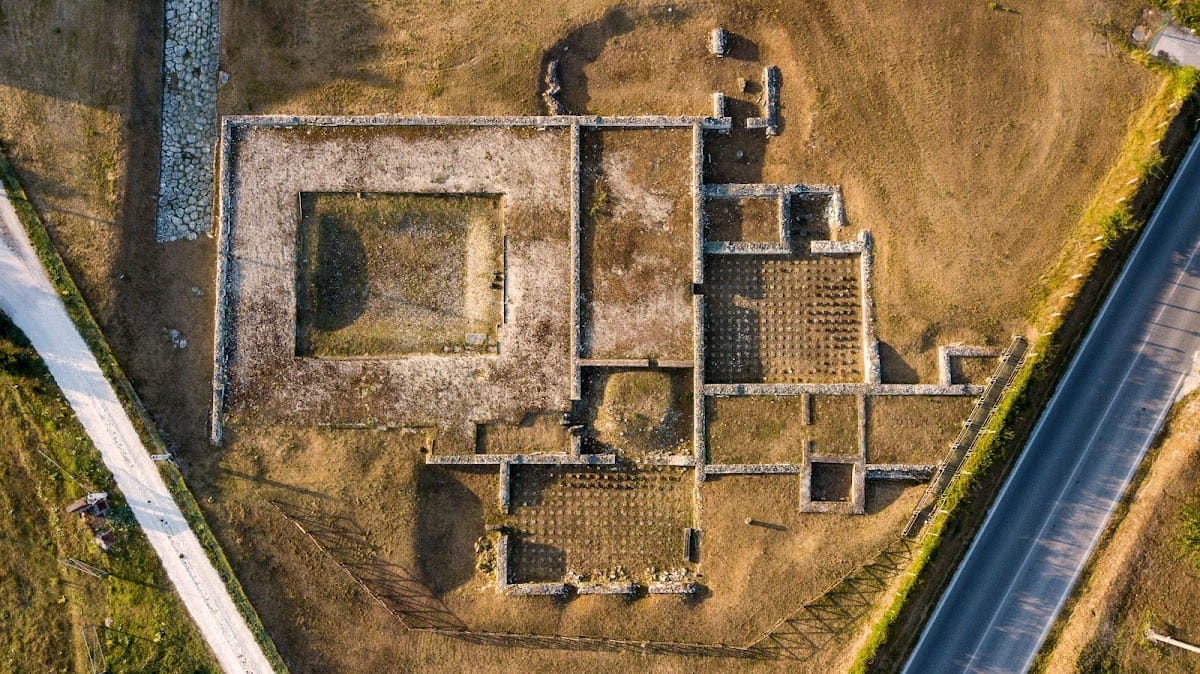
The Sentinum Archaeological Park was established by regional law in 1994. It protects the Civita and Santa Lucia archaeological areas, which are separated by the provincial road to Fabriano and linked by a walkway. Because modern rebuilding has not covered the ancient city, much of its Roman urban layout remains legible.
Remains
Urban plan and defenses
The archaeological park covers approximately 16,000 square metres and preserves a modest part of the ancient city’s former extent. The excavated remains are divided between Civita, with the forum and urban buildings, and Santa Lucia, with the extra-urban bathing complex. Sentinum followed an orthogonal Roman plan. The cardo, a principal north-south street, and the decumanus, a principal east-west street, formed a regular grid organized around the forum, the town’s main civic and public space.
The streets were paved with broad white limestone blocks several decimetres thick and bordered by pavements. A substantial sewer network served the urban area. Sections of the Augustan city wall also survive. The wall used opus vittatum, a masonry technique made from regular horizontal courses of small stones or bricks, over a core of Roman concrete. A building at the north-west corner was probably defensive.
Civita buildings and industries
Urban baths
The urban baths stood beside cardo B and originated in the late Republican period. They were reconstructed several times, with the final changes extending to the beginning of the third century AD. The complex included a large rectangular pool surrounded by a colonnaded court, a western cold room with an apse decorated in polychrome marble, a warm room, and a hot room along the southern and eastern sides.
A large figured mosaic from the baths is now preserved in the National Archaeological Museum of the Marche. Another coloured pavement, made in the second century AD, depicts Mithra and Sol. Mithra was the central deity of the Roman Mithraic mystery cult, while Sol personified the sun. The pavement is preserved in the Glyptothek in Munich. Animal reliefs connected with Mithraic initiation were reused in the Church of Santa Croce, and Mithraic inscriptions were also found at Sentinum.
Insula del Pozzo
The area called the insula del Pozzo contained domestic rooms and several buildings near an ancient well. A group of mosaic-floored rooms discovered in 1956 probably belonged to more than one structure. Its most notable pavement used polychrome checkerboard motifs enclosed by a fan pattern. The mosaic is now buried, while a colour drawing made when it was found preserves its appearance.
Aion mosaic
A room in a house within the insula del Pozzo contained the Aion mosaic, discovered in 1806. Measuring approximately 5.34 by 4.94 metres, it shows Aion, the personification of eternal or cyclical time, as a standing young man associated with the Zodiac. Tellus, the personification of Earth, sits nearby with the four seasons. The pavement was removed from its original room and is now held in the Glyptothek in Munich.
The composition presents eternity as the recurring movement of events and things. Its imagery is associated with the Golden Age, fertility, and abundance, and has been connected with late Stoicism, a Roman-era form of philosophy emphasizing rational order, ethical self-control, and life according to nature. The mosaic is attributed to the period when this philosophy was especially prominent under Antoninus Pius, around AD 138-161.
Other mosaics and sculpture
Other pavements include a scene of the Rape of Europa, now in the Civic Archaeological Museum of Sassoferrato, and a large marine-monsters mosaic measuring 14 by 9.80 metres. Removed in 1922, the latter was restored at the National Archaeological Museum of Ancona and damaged by bombing in 1943. It used black tesserae, small pieces of stone, ceramic, or glass, on a white ground. Its fantastic creatures had rear bodies ending in coiled fish tails and foreparts with the heads of tritons, griffins, or horses. G. Moretti attributed the varied styles to several craftsmen working in the second half of the second century AD, with later repairs. The forepart of a bull has been lost.
Additional black-and-white tessellated floors survive in situ. A polychrome pavement with a central image of Oceanus was found in a neighboring room in poor condition, and its appearance survives in a watercolour record. Sentinum also produced votive bronzes, marble sculpture, large inscriptions, and an alabaster bust of Isis. Two marble heads were found in later excavations, one dating to the Julio-Claudian period, the early imperial era from Augustus to Nero, and another representing a finely executed young ephebe.
Workshops and civic inscriptions
The Civita area preserves a metalworking workshop, cisterns, houses, and a possible glass-working furnace. Two rooms used for bronze casting were active between the first century BC and the third century AD. A fragment recovered from a bronze-working context has been linked to the sculptural group known as the Gilded Bronzes of Cartoceto.
Three important tabulae patronatus were also found. These were formal inscriptions recording patronage relationships between a Roman community and appointed patrons. Together with other inscriptions and architectural elements, they illustrate the civic institutions and public life of Sentinum.
Santa Lucia thermal complex
The Santa Lucia complex lies outside the city walls near the main Roman road leading south. It occupies part of an area of approximately 7,000 square metres, including about 3,000 square metres of bathing facilities. The building includes a vestibule, an atrium, a large exercise court, several changing rooms, a cold room with pools, warm rooms, and hot rooms.
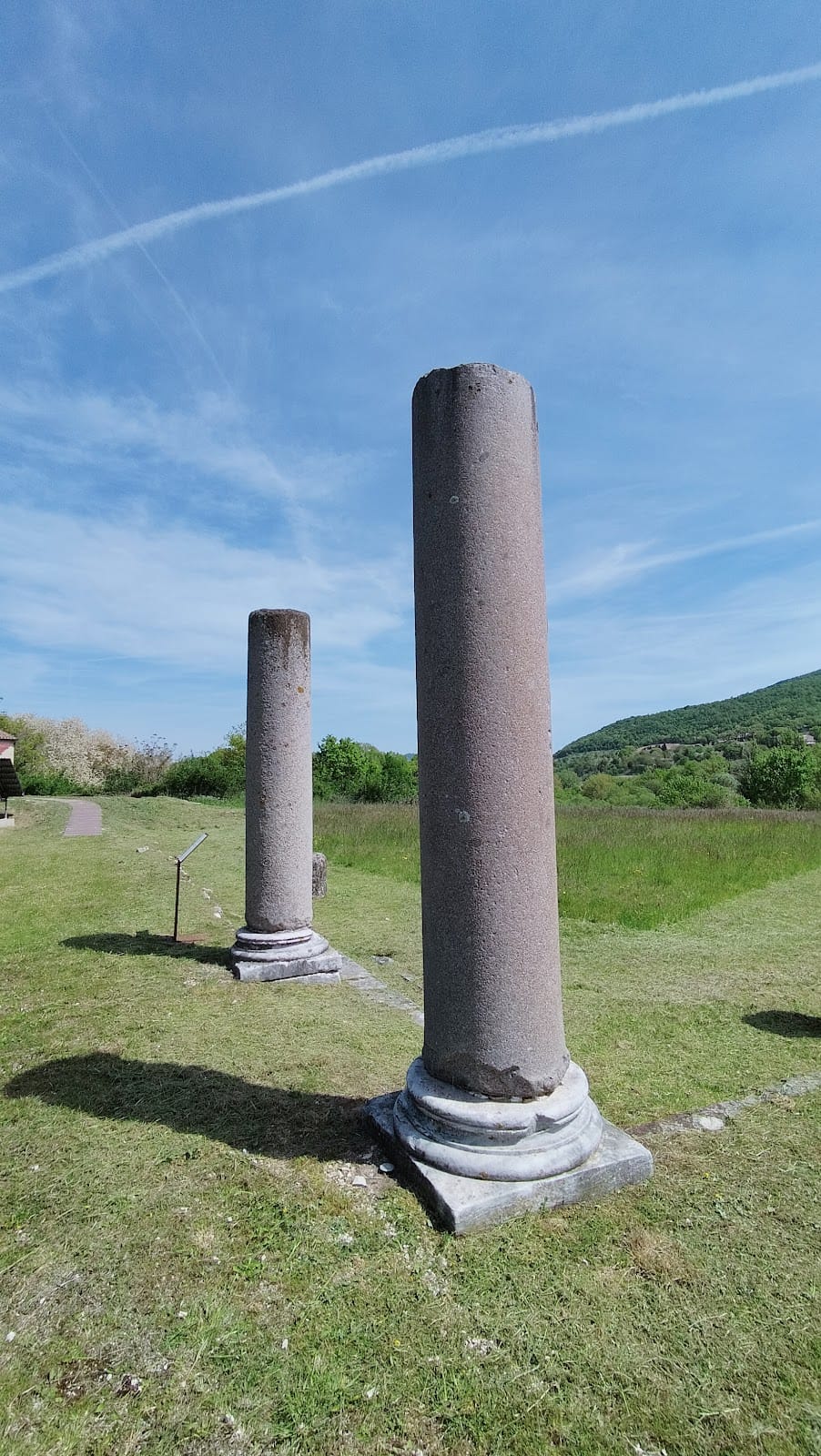
An extensive court had a mosaic pavement and was enclosed by columns made from red Verona breccia. The building was once interpreted as a large suburban villa. It is now more often understood as a thermal complex associated with the road and intended in part to accommodate travellers, although its precise identification remains difficult.
The local archaeological museum houses many finds from Sentinum, including the Rape of Europa mosaic, fragments of marble sculpture, architectural elements, funerary material, everyday objects, and evidence of bronze working. It also contains a full-scale reproduction of the Aion mosaic and a fragment of the marine-monsters pavement.