Newhaven Fort: A Victorian Coastal Defence Fortification in England


Site at a Glance
- Rating
- 4.6
- Popularity
- Medium
- Country
- United Kingdom
- Primary era
- Modern
- External website
- Open
- Eras represented
- Modern
- Civilizations
- British
- Site type
- Military
- Remains
- Fort
On this page11 sections
History
Victorian origins and construction
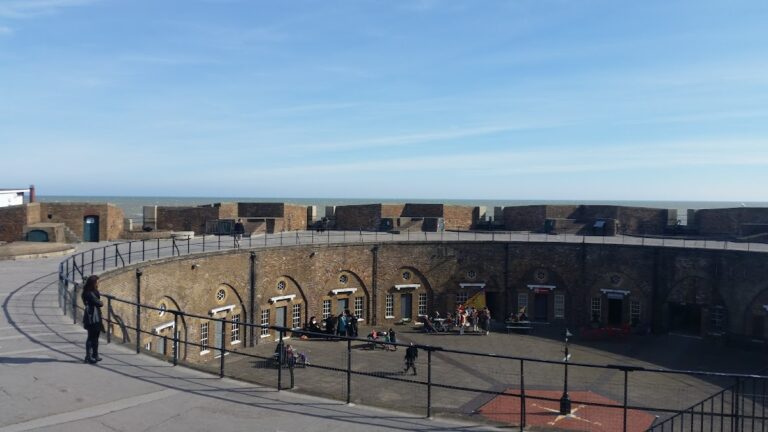
Newhaven Fort is a nineteenth-century British coastal fortification in the United Kingdom, built on Castle Hill to defend Newhaven harbour on the south coast of England. Its creation followed the 1859 Royal Commission on the Defence of the United Kingdom, a British commission that assessed national military and coastal defences and recommended new fortifications during the administration of Lord Palmerston, a nineteenth-century British statesman who served several times as prime minister.
The fort’s design began in 1862 under the supervision of John Charles Ardagh, a 22-year-old British Army officer and military engineer who worked from an office in Brighton. The chosen hill already held a battery dating from the mid-sixteenth century. Construction started in 1864 with 250 workers and three steam engines, and the fort was completed in summer 1871. Its guns were emplaced in 1873.
Newhaven Fort became the largest defensive work ever built in Sussex. In the 1870s, its eastern armament consisted of two 9-inch rifled muzzle-loading guns. These weapons were loaded from the front and used rifled barrels to improve the stability of their projectiles. They stood on Moncrieff disappearing carriages, mountings designed to lower a gun behind cover after firing. This combination was the only one of its kind in the United Kingdom.
Changing armament and wartime service
Around 1906, the original guns were replaced by two 6-inch Mark VII breechloading naval guns and two light QF 12-pounder guns. Breechloading guns were loaded from the rear, while QF meant quick-firing. The smaller weapons were intended to defend the harbour against torpedo boats.
In 1941, the two 6-inch Mark VII guns were replaced by a battery of BL 6-inch Mk 24 coastal guns positioned west of the fort. BL also denoted breechloading. During the Second World War, the fort was manned by the 521st Kent and Sussex Coast Regiment of the Royal Artillery.
Army withdrawal and preservation
The army vacated Newhaven Fort in 1962. Restoration began in 1982 after a commercial redevelopment venture failed. Lewes District Council now preserves and maintains the fort, which operates as a museum. The 6-inch Mk VII guns have been reinstalled to approximate the armament used between 1906 and 1941.
Remains
Hilltop layout and outer defences
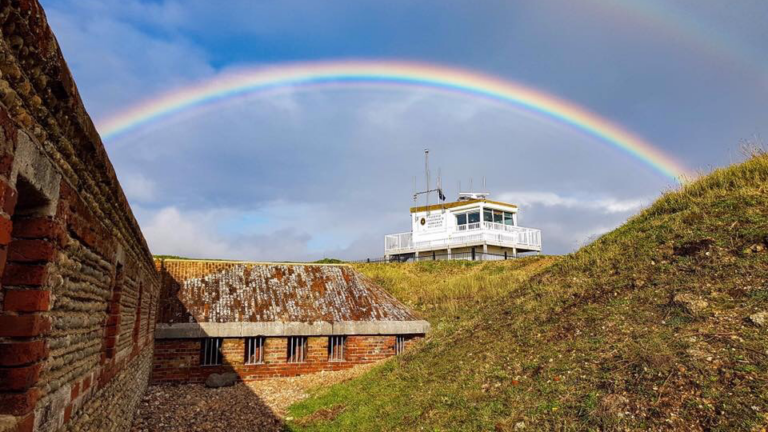
Newhaven Fort occupies Castle Hill on cliffs above Newhaven harbour. Instead of levelling the hill, Ardagh shaped the design around its existing contours. The fort was built from concrete, brick, and earth. Shingle for the concrete came from the beach, while nearby clay supplied material for approximately six million bricks.
Moats and defensive passages
A 40-foot-wide moat protected the northern and western sides. Its concrete lining represented an extensive and pioneering use of concrete in a British fortification. At the meeting point of the northern and western moat arms stood a counterscarp gallery, a protected defensive passage or firing position associated with the outer side of a ditch, together with a sally port, a secure passage for defenders to enter or leave the fort.
The eastern side, which faced the harbour, was protected by a short wet moat and the harbour embankment. A caponier, a protected structure projecting into a ditch so defenders could fire along or across it, stood at the foot of the chalk cliffs. A tunnel from inside the fort provided access to it.
Ramparts, entrance, and gun positions
Casemated barracks
Casemated barracks were built into the northern and western ramparts. These were protected rooms designed to house the garrison within the fortified structure, integrating accommodation with the defensive earthworks.
Main entrance
The main entrance was placed at the north-east angle of the fort. It was approached by an Equilibrium Bridge, which Ardagh designed and patented.
Armament areas
The original eastern gun positions held two 9-inch rifled muzzle-loading guns on Moncrieff disappearing carriages. The later eastern arrangement comprised two 6-inch Mark VII breechloading guns and two QF 12-pounder guns. The battery of BL 6-inch Mk 24 coastal guns introduced in 1941 occupied a position west of the fort, while the restored 6-inch Mk VII guns represent the earlier twentieth-century arrangement.
Nearby sites