Brean Down Fort: A Victorian Coastal Defence Fortification




Site at a Glance
- Rating
- 4.7
- Popularity
- Medium
- Country
- United Kingdom
- Primary era
- Modern
- External website
- Open
- Eras represented
- Modern
- Civilizations
- British
- Site type
- Military
- Remains
- Fort
On this page8 sections
History
Brean Down Fort is a Victorian coastal fortification in the United Kingdom, built by Britain on Brean Down to protect the Bristol Channel and the approaches to Bristol and Cardiff. Construction began in 1864 and was completed in 1871 as part of the Palmerston Forts, a nineteenth-century British coastal-defence programme created to protect important ports and waterways against a feared French invasion.
Victorian origins and military use
The fortification programme followed concerns about the strength of the French Navy after Queen Victoria and Prince Albert visited France. The Royal Commission on the Defence of the United Kingdom, acting under the direction of Lord Palmerston, recommended a chain of coastal fortifications. Four acres at the end of Brean Down were requisitioned for the new fort.
Brean Down Fort formed part of a wider defensive system extending between the mainland and the islands of Steep Holm and Flat Holm. From 1871 until 1901, it was in strategic use and was garrisoned by 50 officers and men of the Coast Brigade, Royal Artillery. The Royal Artillery was the British Army branch responsible for operating artillery and related defensive installations. The fort never fired a shot in action during this original period.
Wireless experiments and the end of active service
In 1897, Guglielmo Marconi moved wireless-transmission equipment to Brean Down after experiments between Lavernock Point and Flat Holm. He established a record of 14 kilometres for wireless transmission over open sea, giving the fort a role in the early development of long-distance wireless communication.
In 1900, an explosion destroyed the No. 3 magazine, which contained approximately three tons of gunpowder. Gunner Haines was killed and a colleague was seriously injured. An inquiry attributed the explosion to Haines firing a ball cartridge down a ventilator shaft after being punished for returning late to barracks, although that explanation was challenged and suicide was also suggested. The explosion contributed to the end of the fort’s active service. Its guns were subsequently removed, and the fort left strategic use in 1901.
Reuse and Second World War service
After decommissioning, the fort was adapted for other purposes. The Hillman family operated a café there from at least 1907 until 1936. The property was then sold to an organization associated with a bird sanctuary and later used for recreation.
During the Second World War, the fort was rearmed and operated as a coastal artillery battery from 1940 to 1945. The wartime garrison included the 365 and 366 Coast Batteries of the 571st Coast Regiment, Royal Artillery. The regiment was formed in December 1941 and disbanded in April 1944.
The site also hosted trials by the Admiralty’s Directorate of Miscellaneous Weapons Development, based at HMS Birnbeck. Experimental equipment included a seaborne bouncing bomb designed to skip across the water and potentially pass over torpedo nets, the anti-submarine missile AMUCK, and an expendable acoustic emitter intended to confuse torpedoes that homed on underwater sound. The National Trust has owned the site since 2002, when it became part of the Trust’s Brean Down property.
Remains
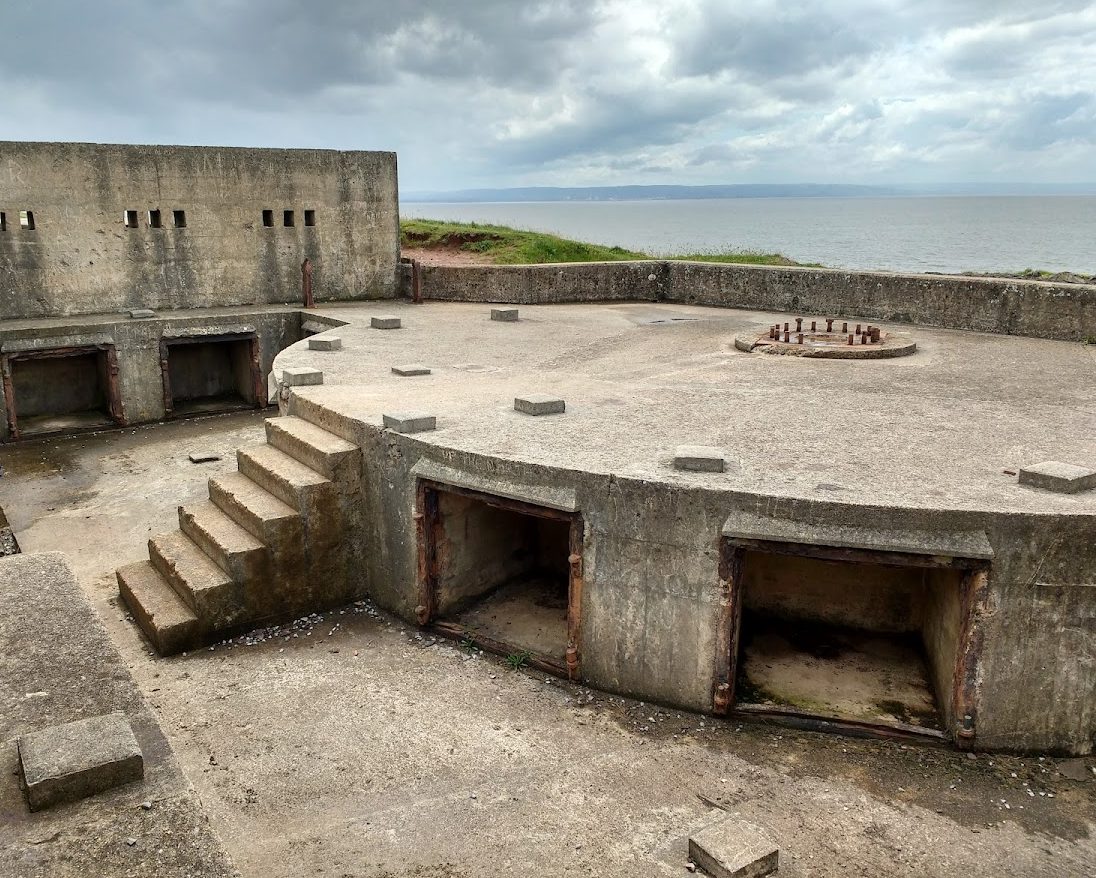
Brean Down Fort stands on a prominent headland about 60 feet (18 metres) above sea level and approximately 9 miles (14 kilometres) south of Weston-super-Mare, overlooking the Bristol Channel. Its surviving fabric combines the original Victorian fort, later wartime gun positions and associated military structures. The remains also preserve archaeological evidence of activity on Brean Down before the fort was built.
Victorian gun batteries and magazine
The original fort was arranged around barrack blocks and gun batteries, including west and north-west batteries. Its principal armament consisted of seven 7-inch rifled muzzle-loading guns in three main gun positions. These guns were among the last of their type manufactured at the Woolwich Gun Foundry. A rifled muzzle-loading gun was loaded through the front of the barrel, while internal rifling spun the projectile to improve range and accuracy over earlier smoothbore weapons.
Each gun weighed 7 tons and used a 30-pound (14-kilogram) charge of gunpowder to fire a 112-pound (51-kilogram) Palliser shot at 1,560 feet (475 metres) per second. The armour-piercing shot could penetrate 8 inches (20 centimetres) of armour at 1,000 yards (910 metres). W Battery contained two guns mounted on C pivots. Each pivot rotated around a reused Georgian cannon set upright in the ground. A proposal made in 1888 to replace the 7-inch guns with 9-inch weapons was never implemented.
A large underground main gunpowder magazine measured 15 by 18 feet (4.6 by 5.5 metres) and was 20 feet (6.1 metres) high. The No. 3 magazine was destroyed in the 1900 explosion, which also demolished the wall separating the fort from the moat at the south-west corner. Wreckage was thrown as far as 200 yards (183 metres), leaving the explosion physically marked in the surviving layout.
Second World War defences
The Second World War gun positions partly reused or obscured the earlier battery areas. Two six-inch ex-naval guns were installed in turrets on newly built positions. These positions were later protected by “plastic” anti-aircraft roofs, while some windows in the barrack blocks were blocked to reduce the effects of blast.
Additional wartime structures stood outside the original fort. They included searchlight batteries for illuminating seaborne targets, a command post and barracks for the garrison. A short surviving length of launching rail provides physical evidence of the experimental weapons trials carried out at Brean Down.
Earlier archaeological evidence
Before sea erosion exposed the Bronze Age settlement area as a cliff, Brean Down contained evidence of an Early to Middle Bronze Age settlement. The archaeological remains include a probable roundhouse, pottery and jewellery. Most of these finds are now held by the Museum of Somerset in Taunton.
Roman activity is represented by gold and silver coins associated with the emperors Augustus, Nero, Drusus and Vespasian, together with a cornelian ring. These finds place the fort’s later setting within a much older archaeological landscape, long before the Victorian military construction.