Cheddar Palace: An Anglo-Saxon and Medieval Royal Hunting Lodge


Site at a Glance
- Rating
- 4.7
- Popularity
- Low
- Country
- United Kingdom
- Primary era
- Medieval
- External website
- Open
- Eras represented
- Medieval
- Civilizations
- English
- Site type
- Domestic
- Remains
- Palace
On this page7 sections
History
Cheddar Palace is a former Anglo-Saxon and medieval royal complex in the United Kingdom, established at Cheddar in Somerset during the ninth century. It began as a religious and royal centre before becoming a royal hunting lodge, and it later hosted important political assemblies.
Early religious and royal phases
A wooden great hall was built around the reign of Alfred the Great, the Anglo-Saxon king who died in 899. At this stage, the building served as a minster, an important early medieval religious foundation for a wider community with associated clergy. The community at Cheddar received special mention in Alfred’s will.
The complex was rebuilt around 930. A chapel and other buildings were added, and Cheddar became a royal hunting lodge. Further expansion followed during the transition from the Anglo-Saxon period into the medieval period.
Royal assemblies and later ownership
Cheddar Palace hosted the Witenagemot, an assembly of leading nobles, churchmen, and other influential figures, in 941, 956, and 968. These meetings took place during the tenth century, when the site remained connected with royal government as well as royal residence.
Henry I, the Norman king of England, visited the palace in 1121 and 1130, while Henry II, the twelfth-century Angevin king, visited in 1158. Ham Green pottery fragments found at the site date from approximately 1200 to 1220.
In 1230, the palace was given to the Dean and Chapter of Wells Cathedral. During the tenure of William Barlow, Bishop of Bath and Wells, the site was sold to Edward VI in 1548. Excavations later took place during construction of the school, after which the remains were reburied. The palace is now within the grounds of The Kings of Wessex Academy, where concrete slabs or plinths indicate its former layout.
The site has been protected as a scheduled monument since 16 December 1999 under the designation “Roman settlement site, Anglo-Saxon and Norman royal palace, and St Columbanus’ Chapel.” The former chapel is also separately listed at Grade II level, with that designation dated 29 January 1985.
Remains
Buried palace layout
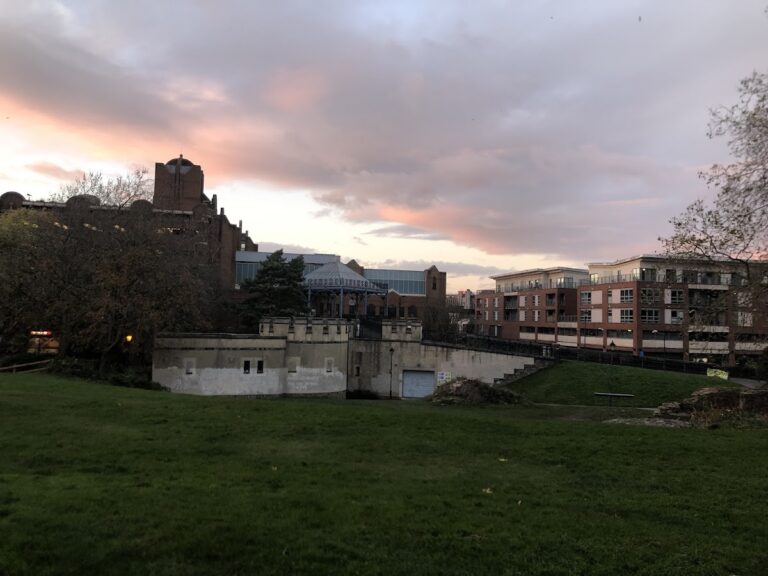
The remains of Cheddar Palace lie beneath the school grounds. The former arrangement of the royal complex is marked at ground level by concrete slabs or plinths, preserving an indication of its layout after the archaeological remains were reburied.
St Columbanus’ Chapel
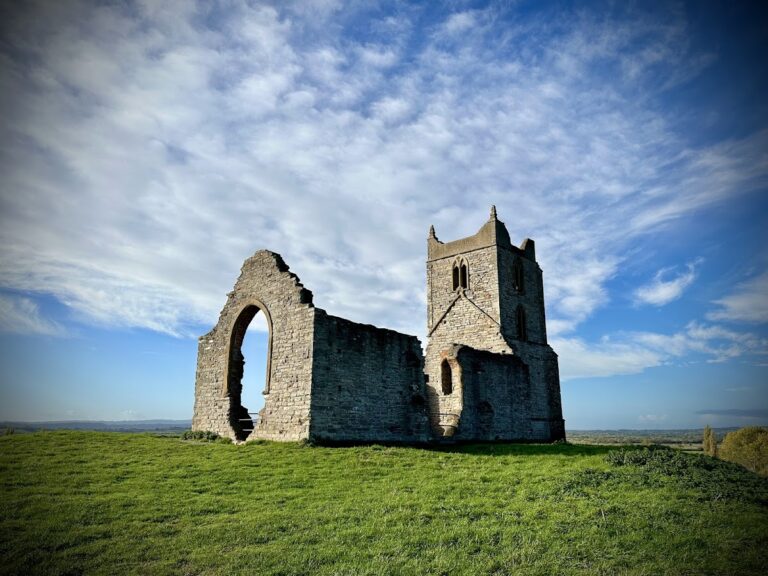
The adjacent ruins of St Columbanus’ Chapel date from the fourteenth century. The chapel stands on ground first built on during the tenth century and enlarged in the eleventh. Octagonal in plan, it retains its end walls, which are strengthened by diagonal corner buttresses, projecting supports that reinforce the masonry. The north and south walls survive to about 1 metre high.
During the seventeenth century, the chapel was converted into a private dwelling. That use continued until 1910, leaving the surviving structure as a later phase in the history of the former palace complex.
Roman evidence
Construction of a new languages block in January 2006 uncovered a grave believed to be Roman. It contained the skeleton of a man thought to have been about 50 years old. His north-south burial orientation was taken to indicate pagan rather than Christian practice.
Roman finds from the site include wall plaster and tesserae, small pieces of stone, glass, or other material used to form mosaics. They date from the first to the fourth centuries. Their presence has been suggested as a possible connection with Iscalis, a settlement whose location remains unknown.
Nearby sites