Rocca: The Fortified Castle of Lonato del Garda



Site at a Glance
- Rating
- 4.5
- Popularity
- Medium
- Country
- Italy
- Primary era
- Medieval
- External website
- Open
- Eras represented
- Medieval
- Civilizations
- Holy Roman Empire
- Site type
- Military
- Remains
- Castle
On this page15 sections
History
Rocca, also known as the Castle of Lonato, is a fortified complex in Italy overlooking the centre of Lonato del Garda. Construction began in the tenth century, when the site was developed for the military defence of the settlement, and its position later made it an important stronghold in the conflicts of northern Italy.
Early Settlement and Medieval Rule
The hill had been settled before the fortress was built. Restoration work in 1985 brought to light coarse handmade pottery, a bronze pin, and a flint arrowhead associated with prehistoric occupation. The fortified complex itself began to take shape in the tenth century and was regarded from the beginning as strategically important to Lonato’s defence.
The Rocca was successively controlled by the counts of Montichiari and the Scaligeri, the ruling dynasty of Verona and its surrounding territories. In 1376 it passed to the Visconti, the powerful ruling family of Milan. Bernabò Visconti and his wife Regina della Scala ordered stronger defences, including the extension of the walls around the entire inhabited settlement. These works reflected the strategic value of Lonato’s position.
Gonzaga and Venetian Control
Nicolò d’Este captured Lonato in August 1403, although Visconti authority continued until 1404. Lonato, the Rocca, and territories including Castiglione, Castel Goffredo, and Solferino then passed to the Gonzaga of Mantua before later coming under the Republic of Venice, a major territorial power whose mainland possessions included Lonato at various stages.
The Venetian chronicler and historian Marin Sanuto supplied the first recorded description of the Rocca in 1483. During the War of the League of Cambrai, a major European conflict involving northern Italian territories, Francesco II Gonzaga, Marquis of Mantua, fought against Venice in 1509 in exchange for the promised territories of Lonato, Asola, and Peschiera. The fortress returned to the marquises of Mantua between 1509 and 1515, and Isabella d’Este, Francesco’s wife and a Renaissance noblewoman and cultural patron, stayed there during this period.
Decline of the Military Stronghold
By 1610 the castle was in precarious condition, as Giovanni Da Lezze, the podestà of Brescia, described in his Catastico. A podestà was a civic magistrate or chief administrative official in an Italian town. Repairs followed in 1617, but the fort suffered further damage during the 1629 war of succession to the Duchy of Mantua.
Military activity again surrounded Lonato during the War of the Spanish Succession, another major European conflict involving northern Italy. In 1705, two opposing armies camped around the town while Venetian neutrality allowed forces to cross Venetian territory. The Imperial army commanded by Prince Eugene of Savoy, numbering about 40,000 men, established its camp below the western walls. A Franco-Spanish army of about 37,000 soldiers, led by General Vendôme, occupied fields and hills to the east.
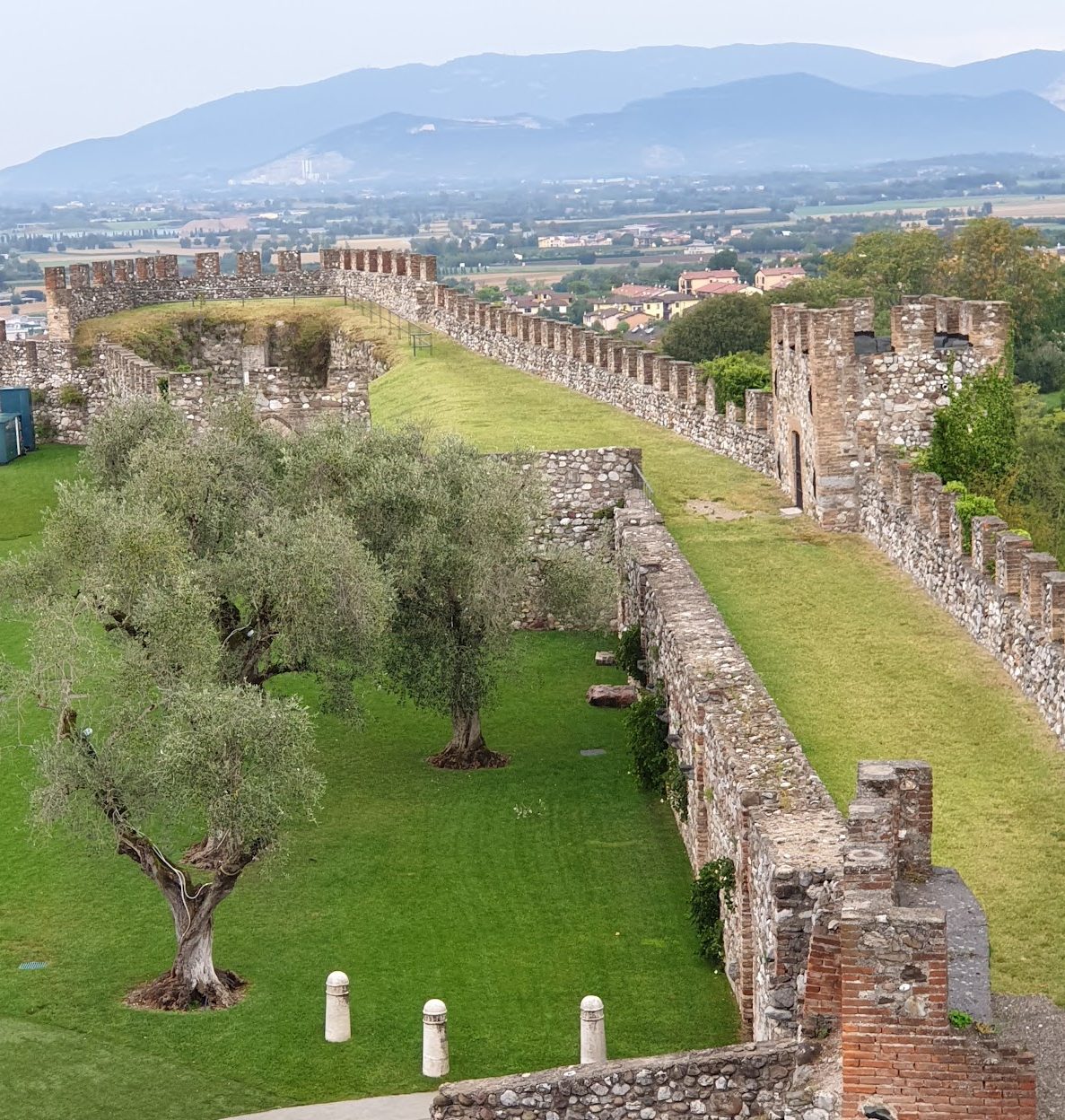
The Battle of Lonato took place beneath the Rocca on 31 July 1796. French troops arriving from Brescia, under Napoleon Bonaparte, attacked Austrian positions and artillery on Monte della Rova, the long ridge visible from the fortress’s northwestern extremity. The Austrian army, commanded by Field Marshal Peter Vitus von Quosdanovich, was eventually forced to withdraw toward Desenzano.
Napoleon’s victories ended the Republic of Venice and reduced the strategic importance of Lonato and its fortress. A slow and irreversible decline followed. Austria acquired the structure after the 1797 Treaty of Campo Formio, which transferred Venetian territories and possessions to the Austrian state. In 1827 the Austrian state domain transferred the Rocca to the Raffa family. The family demolished the remaining barracks and turned the interior and exterior areas into cultivated fields.
Preservation and Cultural Use
The Rocca became a national monument in 1912. Senator Ugo Da Como, an Italian senator and cultural patron, purchased it in 1920 after acquiring the fifteenth-century Venetian podestà’s house in 1909. The site is now owned by the foundation named after him. The Fondazione Ugo Da Como oversees the conservation of the fortress and administers the Museo Civico Ornitologico Gustavo Adolfo Carlotto, the Casa del Podestà museum, and a library containing more than 50,000 volumes.
The southern entrance, including its gate and drawbridge, was restored in 1980 through an intervention directed by the architectural-heritage authorities. Restoration work in 1985 also recovered the prehistoric material associated with the site’s earliest occupation.
Remains
The Rocca occupies the summit of a rise in the moraine amphitheatre above the southern part of Lake Garda. A moraine amphitheatre is a curved landform created by glacial deposits. Built chiefly of stone, mortar, and large moraine cobbles, the fortress consists of two bodies at different elevations. The higher section is the Rocchetta, while the lower section is the Quartiere Principale, or Main Quarter. Rough later restorations gave the complex Guelph-style crenellation, with rectangular merlons traditionally associated with the Guelph faction in medieval Italy.
Southern Approach and Main Quarter
Gateway and Bastion
Entry from the south passes through a restored gateway and drawbridge. A postern, or small secondary gateway for pedestrians, opens to the right of the principal entrance. Above it, a Lion of St. Mark survives in a niche as a reminder of Venetian rule. Immediately before the entrance stands the massive cobble-and-brick bastion. Recesses on its summit may represent former positions for gun embrasures that defended the fortification. Beyond the gateway are the remains of the guardhouse service rooms, which lead into the bastion’s casemate, a protected chamber designed for defensive use and often fitted for artillery.
Main Quarter
A short ramp reaches the Main Quarter, where the remains of troop barracks retain their fireplaces. The area also contains a room with a large oven and a well used to collect rainwater. These surviving elements show how the lower level combined accommodation, food preparation, and water storage within the defensive complex.
Northern and Upper Defences
Northern Quarter
A pointed-arch portal opens into the Quartiere di Tramontana, or Northern Quarter. At its far end are the remains of an observation and artillery position with gun emplacements on both the right and left. The position on the right also provided access to underground guard passages. An inscription records the discovery of the gun emplacements.
Rampart Walk and Keep
The rampart walk returns toward the entrance to the Rocchetta and overlooks Lake Garda. Beside that entrance stands the solid Mastio, the principal fortified keep and the highest point of the fortress. Its interior contains a prison. Restored rooms in the Quartiere di Monizione, or Munitions Quarter, provide access to the top of the keep.
Castellan’s Residence and Water Supply
Casa del Castellano
The Casa del Castellano runs parallel to the inner eastern side of the Rocchetta and follows a rectangular plan. It was the residence of the castellan, the officer responsible for the fortress. The rooms on its raised ground floor retain a Renaissance fireplace and now house the Museo Civico Ornitologico Gustavo Adolfo Carlotto.
Cisterns and Well
Several rainwater cisterns have been uncovered behind the Casa del Castellano. A spring-water well beside the building remains visible and supplied those cisterns, adding a separate source to the fortress’s system for collecting and storing water.