Castle of Bardi: A Medieval Fortress in Northern Italy


Site at a Glance
- Rating
- 4.7
- Popularity
- Medium
- Country
- Italy
- Primary era
- Medieval
- External website
- Open
- Eras represented
- Medieval
- Civilizations
- Holy Roman Empire
- Site type
- Military
- Remains
- Castle
On this page15 sections
History
Origins and medieval stronghold
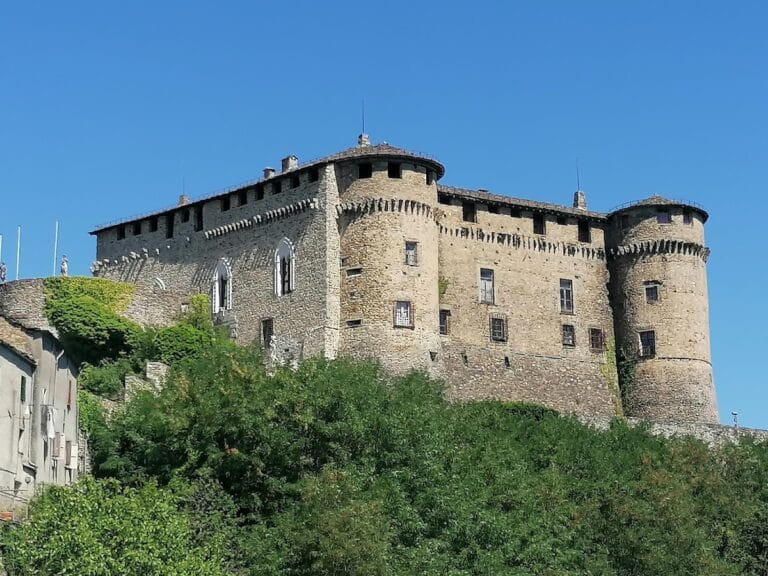
Castle of Bardi, also known as Castello Landi, is a medieval fortress above Bardi in northern Italy. Its earliest fortress was founded in the early ninth century during the reign of Berengar I of Friuli, a medieval Italian king and emperor, and its principal construction works were completed in the early tenth century. In 898, the fortress was sold to Everardo, bishop of Piacenza, who used it as a secure refuge during Hungarian raids in the Po Valley.
The castle occupied a strategic position above the confluence of the Noveglia stream and the Ceno River. It controlled the town and communication routes through the Ceno and Noveglia valleys. During the Middle Ages, Bardi lay on the Via degli Abati and near routes used by pilgrims traveling along the Via Francigena.
The Landi domain
By 1257, the fortress was controlled by a group of local nobles known as the counts of Bardi. That year, Ubertino Landi of Piacenza, a Ghibelline, purchased Bardi together with the neighboring Castle of Compiano. The Ghibellines and Guelphs were rival political factions in medieval Italy, broadly aligned with imperial and papal interests. Ubertino made Bardi the administrative center of the Landi family’s territories.
The surrounding area then became the scene of repeated fighting between the Landi and the Guelphs. The Guelphs were defeated at Bardi in 1313. In 1321, Galeazzo Visconti, a member of Milan’s ruling Visconti family, came to the aid of the besieged fortress and defeated a Guelph army there.
Artillery, rank, and princely residence
During the fifteenth century, the Landi family altered and modernized the fortress to respond to the development of artillery. Its defenses therefore continued to change after the medieval period, while the castle retained its military importance.
In 1551, Charles V of Habsburg, Holy Roman Emperor and King of Spain, granted the Landi family the rank of marquises and the privilege of minting its own coins. At the end of the sixteenth century, Federico Landi transformed the fortress into a princely residence. The complex then included an art gallery, family archive, library, and display of arms, alongside its defensive and administrative functions.
Decline and modern recovery
The Landi line became extinct in 1682, beginning a period of decline for the castle. After negotiations at the imperial court conducted by Count and ambassador Fabio Perletti, the fief of Bardi, together with Compiano, passed to the Farnese, the Landi family’s historic rivals. It later came to the Bourbon-Parma family.
The complex continued to deteriorate during the nineteenth century. At different times, it served as a military prison, the seat of the local magistracy, and the municipal government. Recovery and restoration began after the 1960s. The restored castle is owned by the Municipality of Bardi and houses permanent exhibitions devoted to the history, culture, natural environment, and archaeology of the surrounding valley.
The tradition of Moroello
A local tradition links the castle with the ghost of Moroello, a knight who supposedly took his own life after returning from war and learning that his beloved Soleste had died. According to the story, Soleste had thrown herself from the keep after seeing troops carrying enemy insignia approaching the castle. She did not know that Moroello and his men were wearing the insignia as a gesture of contempt toward the defeated enemy.
The story gained public attention in 1995, when journalists Gianni Santi and Daniele Kalousi reported photographing an unstable, milky form inside the fortress. Daniele Gullà later claimed to have photographed a kneeling knight using thermal photography. The reliability of the images became controversial, and later investigations produced no definitive conclusion.
Remains
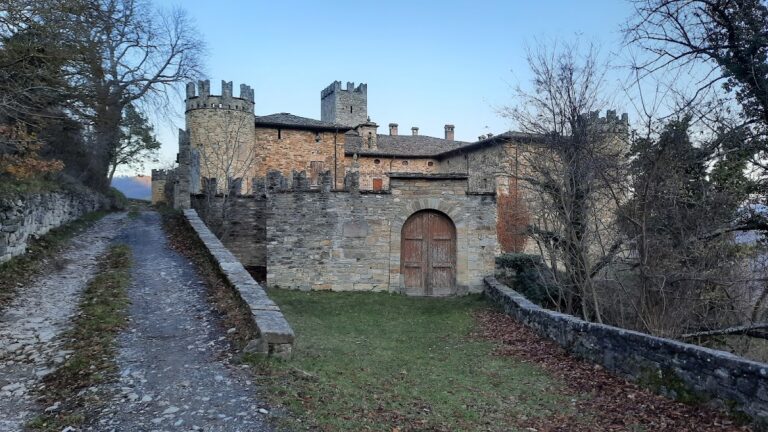
Castle of Bardi occupies a red-jasper rocky outcrop at an elevation of approximately 589 metres in the center of the Ceno Valley. Built entirely of stone, the complex developed around a central keep, the principal fortified tower and strongest defensive core of a castle. Its irregular plan follows the shape of the rocky spur, while massive sloping walls enclose the interior buildings and support a continuously walkable wall-walk.
Defenses and circulation
Access to the fortress follows a narrow road along the rock and passes through several defensive levels incorporating towers, gates, and drawbridges. Bastions strengthen the complex, and a courtyard contains a well. The inner courtyard, parade ground, and buildings are joined by winding passages and stairways. The stairways turn to the right, a defensive arrangement that made ascent more difficult for attackers carrying weapons in their right hands.
Fortress buildings
Princely residence and round tower
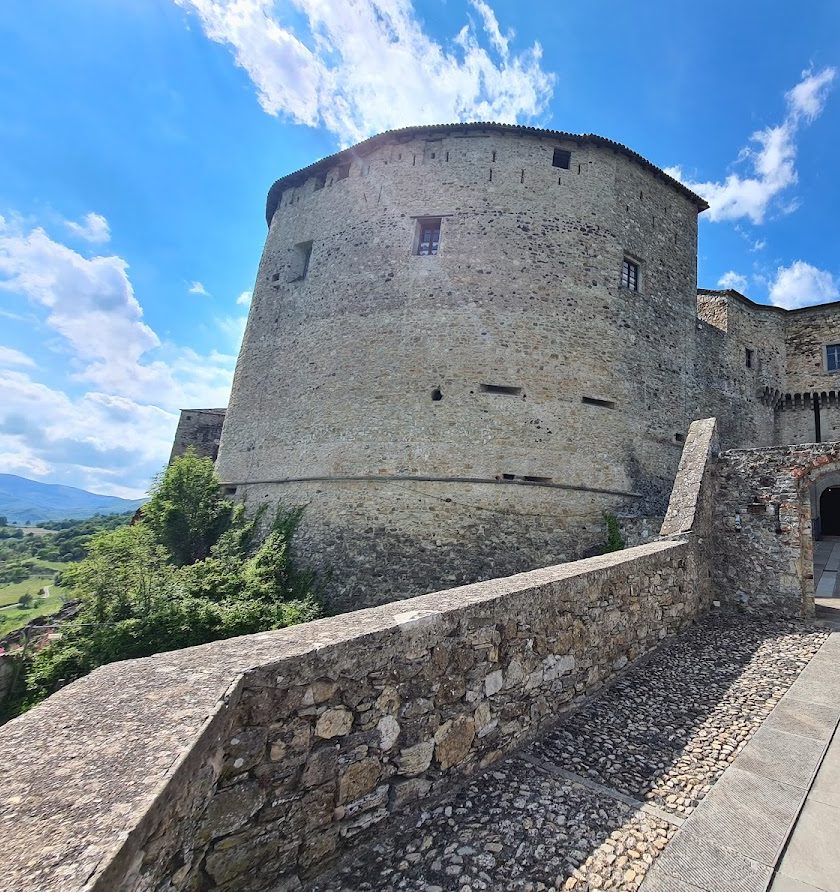
The interior contains the princely or lordly residence, arranged among compact groups of buildings on different levels. A single powerful round tower projects from one corner of the palace. For a period, this tower served as an arsenal, combining the residential complex with the military needs of the fortress.
Chapel and service areas
Other levels contain a chapel, military quarters, a torture chamber, and service buildings. These spaces are connected to the courtyard, parade ground, and defensive routes by the narrow passages and stairways that organize movement through the irregular complex.
Museums and permanent exhibitions
Valley culture and archaeology
The fortress houses the Museum of Valligiana Civilization, which presents the local valley culture, and the Archaeological Museum of the Ceno Valley. Both collections occupy rooms within the castle and relate the surviving stronghold to the history and material heritage of its surrounding territory.
Pietro Cella and the Alpine Corps
Five rooms are dedicated to Captain Pietro Cella, a native of Bardi who received the first gold medal of the Alpine Corps. The Alpine Corps is a specialized mountain infantry formation of the Italian armed forces. The exhibition commemorates Cella’s distinction within that corps.
Fauna and poaching
A separate museum explores fauna and poaching. Together with the other permanent exhibitions, it gives the restored fortress functions beyond its earlier roles as a military stronghold, residence, and seat of local government.