Magdeburg Citadel: A Prussian Fortress on the Elbe


Site at a Glance
- Rating
- 4.7
- Popularity
- Medium
- Country
- Germany
- Primary era
- Early Modern
- External website
- Open
- Eras represented
- Early Modern
- Civilizations
- Brandenburg-Prussia, Holy Roman Empire
- Site type
- Military
- Remains
- Citadel
On this page8 sections
History
Magdeburg citadel was a Prussian fortress built on an island in the Elbe at Magdeburg, Germany, during the late seventeenth and early eighteenth centuries. Its masonry construction began in 1683 and was completed in 1702. The citadel formed the riverside core of the larger Magdeburg fortress, whose position helped secure the Elbe crossing and protect Brandenburg’s inland territory.
Creation of the riverside fortress
Magdeburg suffered severe destruction during the Thirty Years’ War, the major European conflict of 1618 to 1648. The city later lost its independence in the second half of the seventeenth century. A Brandenburg garrison arrived in 1666, and on 12 June of that year the Brandenburg Elector ordered repairs to the damaged fortifications.
On 23 June 1666, the Elector ordered a citadel on the Elbe side of the city. The riverside defenses were considered comparatively weak, and an attack from that direction had contributed to Magdeburg’s destruction in 1631. Brandenburg also sought to control the Elbe crossing at Magdeburg, described as the only crossing between Hamburg and Wittenberg, and to prevent forces approaching from the west from entering Brandenburg’s heartland.
Planning and construction extended over many years. Lieutenant General de Maestre reported a prepared design on 18 July 1679, while Colonel and Commandant Schmied von Schmiedseck marked out the future site on 4 February 1680. Masonry work began in 1683 and reached completion in 1702. The casemates, vaulted protected chambers within the fortification, were occupied only several years later, after the masonry had dried. Engineer Captain Heinrich Schmutze directed the work and also designed Magdeburg’s town hall and the citadel gates.
Garrison, worship, and imprisonment
The fortress and citadel were never directly involved in a military conflict. Their scale would have required an exceptionally large attacking force and heavy losses. Their strategic position nevertheless influenced military operations indirectly by helping secure the Elbe crossing.
The citadel’s garrison also shaped its religious life. During the reign of Frederick William I, a growing Catholic presence among the soldiers led to the first Catholic service in 1728. A Catholic garrison church was established in 1729, and civilians attended its services as well. The church was cleared in 1806, when worship moved to the Church of the Holy Spirit. Catholic services resumed at the citadel around 1816, before being transferred to the Church of Our Lady monastery on 1 March 1818.
Magdeburg citadel became an important and feared Prussian prison. Convicts performed demanding earthmoving and quarrying work, while harsh labor, inadequate food, and poor hygiene caused very high mortality. Prisoners were harnessed to work carts and confined in dark casemates on rarely changed straw. Judicial punishments carried out there included flogging, branding, shooting, strangulation, and quartering.
Prisoners of higher status could receive much better conditions, and some were allowed to bring servants. Among those held in the citadel were Werner Siemens, Friedrich von der Trenck, Gustav Adolph Schlöffel, Dietrich Wilhelm Landfermann, Fritz Reuter, Eduard Michelis, Józef Piłsudski, Gerhard Cornelius von Walrave, Polikarp Gumiński, Gustav Rawald, and Armand von Ardenne.
Werner Siemens, a German electrical engineer and inventor, was imprisoned there in 1842 for illegally acting as second in a duel. During his confinement he developed a method of galvanically gilding and silvering metals, electrochemical processes that coat metal with a thin layer of gold or silver. After receiving a pardon after one month, he asked to remain longer so that he could continue his studies.
Friedrich von der Trenck arrived in 1754 and tried to escape by digging an underground passage. He was later transferred to Fort Berge, another part of the Magdeburg fortress. In 1788, Count Friedrich Wilhelm von Wartensleben secured lifelong confinement in the citadel for his son Hermann from Frederick William II, king of Prussia. Hermann had married Johanna Rosina Hartung against his father’s wishes and had two children with her. He was released after twenty months when he received a maternal inheritance, despite his father’s opposition.
War, prisoners of war, and decline
The citadel frequently served as a prisoner-of-war camp. In 1715, 286 Swedes captured at Stralsund were interned there. Austrians, French, and Russians were also held at the citadel during the Seven Years’ War.
During the Napoleonic period, 23,000 Prussian soldiers and 800 officers were stationed in the fortress in 1806, while only 7,000 French soldiers appeared before it. Despite this numerical disparity, the commander, Franz Kasimir von Kleist, surrendered without a fight after Prussia’s major defeats at Jena and Auerstedt.
French forces withdrew without combat in 1814. Prussia and its allies chose not to attack because of the expected losses, and the French garrison surrendered only after Paris had fallen. It received permission to withdraw freely to France.
The future entrepreneur and inventor Hermann Gruson was born in the citadel on 13 March 1821. He was the son of Premier Lieutenant Louis Abraham Gruson. By the end of the nineteenth century at the latest, changing weapons technology had deprived the Magdeburg fortress and citadel of their military importance. The fortress was formally abolished in 1912. After Magdeburg acquired the property, most of the citadel was demolished between 1922 and 1927, and its rubble was used to raise and fill newly constructed streets in Cracau.
Remains
Island fortification
The citadel occupied an island in the Elbe as part of the wider fortress complex. Its walls rose approximately eight metres on the western side facing the city and about five metres on the eastern side facing the Turmschanze, a detached tower redoubt used for defense. The lower eastern walls allowed the Turmschanze to fire into the citadel if an enemy captured it. Large vaulted casemates lay within the fortification, protected from enemy artillery by earth embankments.
Water defenses and altered channels
Maintaining deep water around the island required major hydraulic works. In 1736, a weir east of the citadel directed water from the former Great and Middle Elbe through the channel between the citadel and Holzstreckenwerder into the Stromelbe. Water continued to flow into the Old Elbe between Holzstreckenwerder and Friedrichstadt during floods. An overflow weir was built upstream at Rothehornspitze, while a groyne was added upstream of the citadel in the Middle Elbe in 1739.
The Middle Elbe had carried the main volume of water, but the hydraulic works blocked that course and redirected water into the previously shallow Stromelbe. The Middle Elbe then silted up, and its former course survives as a depression in the terrain of Rotehorn Island. A lock canal was later built south of the citadel between the Stromelbe and the Zollelbe. The present street at that location is called Schleusenstraße.
Surviving structures and present ground
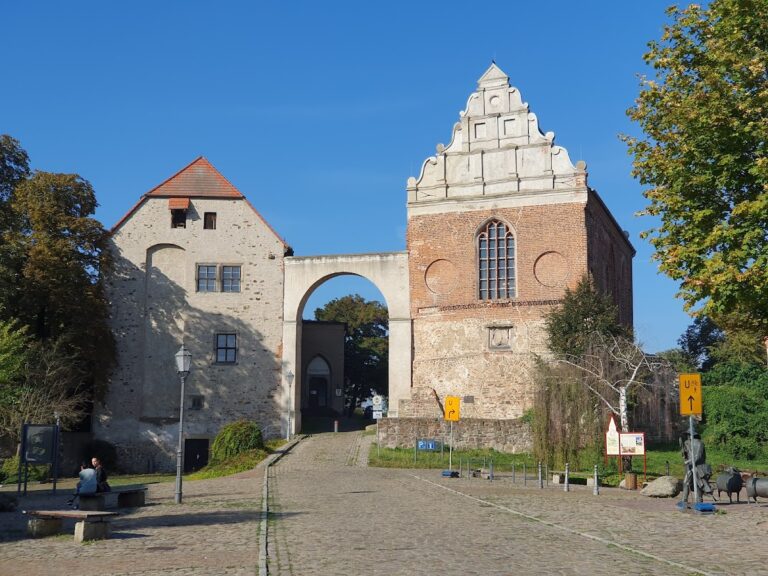
Most of the citadel was removed between 1922 and 1927. On the northern side of the former site, the brick-built former officers’ residence still stands. The grounds are now an event area used by visiting circus companies and for folk festivals. The road leading to the site retains the name Citadel, and an allotment garden there also bears that name.
Nearby sites