Palazzo dei Diamanti: A Renaissance Palace in Ferrara


Site at a Glance
- Rating
- 4.5
- Popularity
- High
- Country
- Italy
- Primary era
- Early Modern
- External website
- Open
- Eras represented
- Medieval, Early Modern
- Civilizations
- Duchy of Ferrara
- Site type
- Domestic
- Remains
- Palace
On this page11 sections
History
Palazzo dei Diamanti is a Renaissance urban palace in Ferrara, Italy, designed in 1492 by the Ferrarese court architect Biagio Rossetti for Sigismondo I d’Este. Construction continued from 1493 to 1503, during the major expansion of Ferrara sponsored by Duke Ercole I d’Este. The building became one of the defining palaces of the new quarter and later housed the city’s principal picture gallery.
The Addizione Erculea
The palace formed part of the Addizione Erculea, a planned Renaissance extension of Ferrara beyond the northern medieval walls. The walls were demolished in 1492, and the new district was conceived around the idea of an ordered “ideal city.” Palazzo dei Diamanti occupied a prestigious intersection corresponding to the ancient Roman urban axes called the Decumanus Maximus and Cardo Maximus.
Its design has long been associated with Rossetti, although the precise authorship and the architectural models that may have influenced him remain debated. Proposed comparisons include Palazzo Sanuti Bevilacqua degli Ariosti in Bologna, Palazzo Raimondi in Cremona, Palazzo Steripinto in Sciacca, and part of the Church of Gesù Nuovo in Naples.
The Este residence
Members of the Este family occupied the palace intermittently until Ferrara passed to the Holy See in 1598. From 1586, it was the residence of Cesare d’Este, cousin of Duke Alfonso II d’Este, and Virginia de’ Medici, daughter of Cosimo I de’ Medici and Camilla Martelli.
The rooms facing Corso Biagio Rossetti were arranged for Virginia de’ Medici’s apartment. The palace also held Cesare d’Este’s library cabinet, probably on the ground floor of the southern wing. Its decoration was produced in 1592 and 1593, while paintings made by the Carracci and Gaspare Venturini for the apartment’s balcony room date from 1592.
Between 1567 and 1570, the late Renaissance architect Galasso Alghisi carried out alterations that may have affected the brick cornice, the corner balcony, and the form and arrangement of the facade windows. These changes belonged to the palace’s continuing adaptation during the later Este period.
From the Villa family to the city
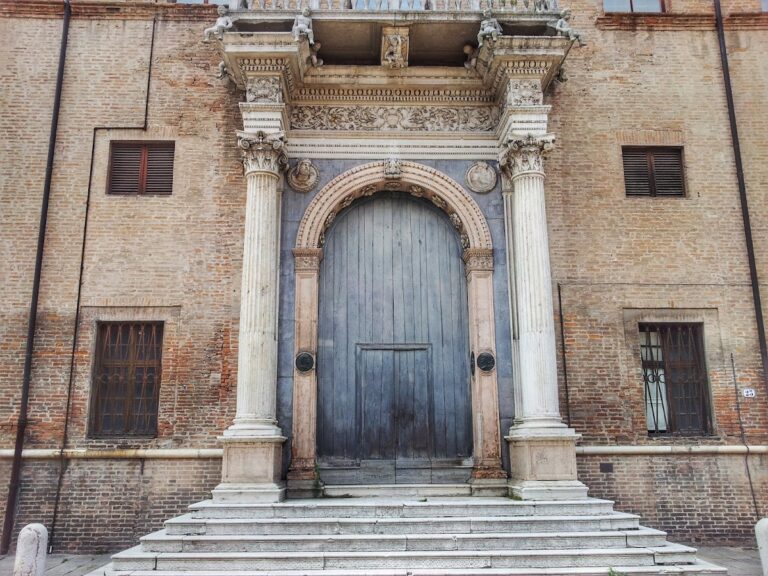
In 1641, Francesco I d’Este, Cesare’s nephew and successor, transferred the palace to Marquis Guido I Villa. The Villa family altered the entrance portal and commissioned new mouldings and the two lateral candelabra beside the entrance. Portraits of Villa family members remain in the entrance hall.
The Municipality of Ferrara acquired Palazzo dei Diamanti in 1842. The building was intended to house the city’s picture gallery and Civic Athenaeum, Ferrara’s municipal higher-education institution. It now accommodates the National Picture Gallery of Ferrara and spaces for temporary exhibitions.
The palace was damaged during the bombing of Ferrara in 1944, and part of the artwork stored in its deposits was lost. Restoration followed the Emilia earthquake of 2012. Palazzo dei Diamanti forms part of Ferrara’s historic centre, which is inscribed on the UNESCO World Heritage List.
Remains
Facade and urban setting
Palazzo dei Diamanti stands at the Quadrivio degli Angeli, where Corso Ercole I d’Este meets Corso Biagio Rossetti, in the centre of the Addizione Erculea. Together with Palazzo Prosperi-Socrati and Palazzo Turchi di Bagno, it forms the historic “golden core” of the intersection. Its exterior is covered with approximately 8,500 white marble blocks veined with pink. Each block is carved into a four-sided pyramid or faceted diamond, giving the palace the feature from which its name derives.
The points of these marble projections vary in direction across the facades. Some face toward the ground, others toward the centre or upward, catching and reflecting light and creating changing effects of perspective and chiaroscuro, the contrast between light and shade. Corner candelabra and plant-like ornament complete the facade decoration. This work is traditionally attributed to Gabriele Frisoni, a Mantuan stonecutter resident in Verona. The corner pilaster above the balcony was remade by the Ferrarese sculptor Gaetano Davia.
Interior court and decorated rooms
Renaissance court
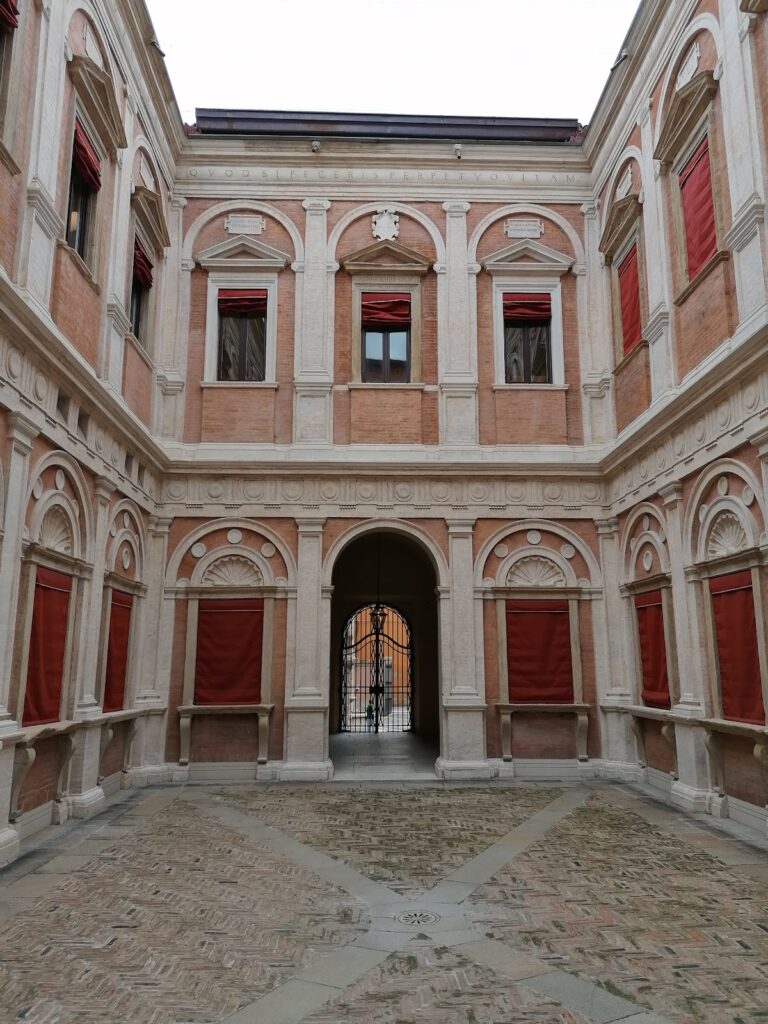
The interior includes a Renaissance cortile, or internal court, surrounded by galleries set on arcades. A marble well stands within the court. Together, the court, galleries, and well represent characteristic elements of Ferrara’s palace gardens and organize the building around an open internal space.
Virginia de’ Medici’s apartment
Three rooms facing Corso Biagio Rossetti belonged to Virginia de’ Medici’s apartment. The coffered ceilings and friezes of the “marriage room,” made in 1589 and 1590, and the “childbirth room,” made in 1591, were produced mainly by Giulio Belloni and his assistants. Parts of this decoration remain visible in the palace.
Entrance and library decoration
The entrance portal has carved decoration on its pilasters, while the Villa family’s later work added mouldings and two candelabra at the sides. Four rectangular canvases attributed to Gaspare Venturini, once part of the decoration of Cesare d’Este’s library cabinet, are now in the Estense Gallery in Modena. Other elements of that decorative cycle are held in private collections.
National Picture Gallery of Ferrara
The National Picture Gallery of Ferrara occupies the palace and focuses especially on Ferrarese painting of the fifteenth and sixteenth centuries, alongside works by artists from elsewhere in Italy. The collection includes works associated with Cosmè Tura, Gentile da Fabriano, Ercole de’ Roberti, Andrea Mantegna, Benvenuto Tisi, known as Garofalo, Dosso Dossi, Carlo Bononi, Guercino, and Carpaccio.
Among the named works are Gentile da Fabriano’s Madonna and Child, Cosmè Tura’s Martyrdom of Saint Maurelius, Ercole de’ Roberti’s Madonna and Child among Roses, Andrea Mantegna’s Christ with the Soul of the Madonna, and Garofalo’s Costabili Altarpiece, produced in collaboration with Dosso Dossi. The gallery also preserves remnants of old frescoes transferred from churches that no longer survive, works connected with Este family collections, and two paintings by unknown artists that once belonged to Marquis Leonello d’Este’s collection at Belfiore Palace.
The lower-floor exhibition spaces have hosted temporary exhibitions devoted to artists and subjects including Claude Monet, Marc Chagall, Paul Gauguin, Max Klinger, Camille Pissarro, Dosso Dossi, Rubens, Picasso, Canaletto and Constable, Alfred Sisley, Degas, Cubism, Corot, Symbolism, Miró, Turner, Boldini, Chardin, Modigliani, Michelangelo Antonioni, Zurbarán, Matisse, Gaudí, Banksy, Antonio Ligabue, and Renaissance and sixteenth-century Ferrarese art.
Nearby sites