Ludwigsburg Palace: A Baroque Residence of the Württemberg Rulers


Site at a Glance
- Rating
- 4.6
- Popularity
- High
- Country
- Germany
- Primary era
- Early Modern
- External website
- Open
- Eras represented
- Early Modern, Modern
- Civilizations
- Duchy of Württemberg, German, Holy Roman Empire
- Site type
- Domestic
- Remains
- Palace
On this page17 sections
History
Ludwigsburg Palace is a Baroque palace complex in Ludwigsburg, Germany, begun in 1704 for Eberhard Louis, Duke of Württemberg. Known as the “Versailles of Swabia,” it developed from a hunting estate into the principal residence of the Württemberg dukes and later kings, combining Austrian and Bohemian Baroque with French Baroque, Rococo, Neoclassical, and Empire design.
From abbey farm to ducal residence
The site began at the Erlachhof, formerly the largest economic farm belonging to Bebenhausen Abbey. After repeated destruction and rebuilding, it became a Württemberg hunting estate. Eberhard Louis then expanded it into a major residence influenced by Versailles, reflecting the political culture of absolutist courts.
Construction officially began in May 1704, when Eberhard Louis laid the cornerstone of the Alter Hauptbau. Philipp Joseph Jenisch prepared the first design, and Johann Friedrich Nette subsequently developed the complex as a three-wing Baroque palace. In 1715, Donato Giuseppe Frisoni replaced Nette and directed further work, including the palace churches, galleries, and the Neuer Hauptbau.
Eberhard Louis founded the town of Ludwigsburg beside the palace on 17 August 1709. The residence temporarily replaced Stuttgart as the capital and seat of government of Württemberg. As the court expanded, the original palace became too small for official functions, so construction of the Neuer Hauptbau began in 1725. Its exterior was complete by 1733, although its interiors remained unfinished when Eberhard Louis died that year.
Rococo and royal transformations
Charles Eugene, Duke of Württemberg from 1737 to 1793, continued to use Ludwigsburg while developing a new palace in Stuttgart. The architect Philippe de La Guêpière introduced important Rococo alterations, including changes to the court apartments and theatre.
Frederick I, who became Württemberg’s first king in 1806, commissioned Nikolaus Friedrich von Thouret to remodel much of the palace in Neoclassical and Empire styles. These changes reshaped parts of the interiors while retaining the complex’s earlier architectural layers. Queen Charlotte Mathilde, Frederick’s wife, continued to live at Ludwigsburg after his death and was the last Württemberg ruler to reside there.
Constitutional, cultural, and modern history
The palace remained associated with the Württemberg ruling family until the monarchy was abolished in 1918. Württemberg’s constitutions were ratified there in 1819 and 1919. The palace opened to the public in 1918 and survived the Second World War undamaged. Restoration campaigns followed in the 1950s, 1960s, and 1990s, with further work carried out around the complex’s tricentenary in 2004.
The palace and gardens are administered by Staatliche Schlösser und Gärten Baden-Württemberg. The Blooming Baroque gardens opened in 1954, and the Baroque Gallery, Ceramics Museum, and Fashion Museum have formed part of the palace’s public cultural use since 2004.
Ludwigsburg’s cultural history also includes the Ludwigsburg Festival, which developed from palace concerts begun in the 1930s and resumed after the Second World War. It became an official state event of Baden-Württemberg in 1980. On 9 September 1962, French President Charles de Gaulle delivered his “speech to the German youth” in the palace courtyard before about 20,000 people. The address became an important symbol of postwar French-German reconciliation.
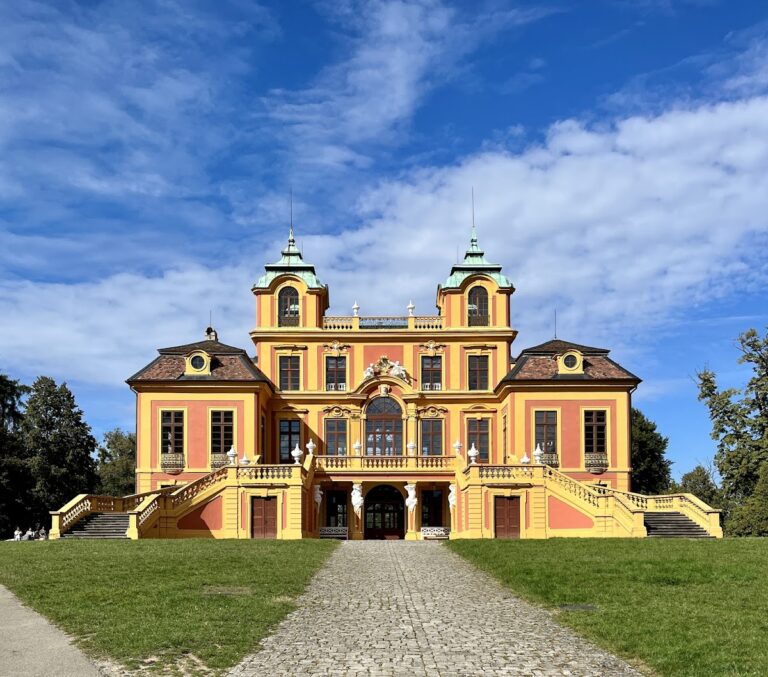
The wider palace ensemble includes Schloss Favorite and Schloss Monrepos. Favorite developed as a hunting retreat in the early eighteenth century and was remodeled by Thouret in 1800. Monrepos was built during the 1760s. A straight avenue constructed between 1764 and 1768 connected Ludwigsburg with Solitude Palace west of Stuttgart.
Remains
Ludwigsburg Palace is a four-wing complex of 18 buildings containing 452 rooms. Together with its gardens, the estate covers about 32 hectares. Its surviving fabric brings together Austrian and Bohemian Baroque, French Baroque, Rococo, Neoclassical, and Empire architecture. The principal wings organize residential apartments, ceremonial rooms, chapels, galleries, service areas, and cultural collections around the palace grounds.
The principal palace wings
Alter Hauptbau
The north wing, known as the Alter Hauptbau, is the oldest part of the palace. Its facade was built between 1705 and 1708, most interiors were completed by 1715, and work on its pavilions continued until 1722. The building originally contained the apartments of Eberhard Louis and Princess Henrietta Maria.
At its center is a corps de logis, the principal residential block of a palace, together with a vestibule, guard room, four principal suites, galleries, the Jagdpavillon, the Spielpavillon, and arcaded connecting galleries. Among its early Baroque rooms is the Marmorsaletta, decorated with scagliola, a polished composite material made to imitate marble, by Riccardo Retti and with frescoes by Luca Antonio Colomba.
Neuer Hauptbau
The Neuer Hauptbau forms the south wing. It contains the Marble Hall, royal apartments, Charles Eugene’s apartment, and the Ceramics Museum. Its Neoclassical interiors include work by Nikolaus Friedrich von Thouret, Antonio Isopi, Johannes Klinckerfuß, and Jean Pernaux.
East and west wings
The east wing contains the Riesenbau, the East Cavaliers’ Building, the Schlosstheater, the Schlosskapelle, and the Ahnengalerie. The west wing contains the Ordensbau, the Ordenskapelle, the West Cavaliers’ Building, the Festinbau, the Küchenbau, and the Bildergalerie. Together, these buildings preserve the range of court, ceremonial, religious, residential, and service functions that supported the palace.
Theatre and chapels
Schlosstheater
Frisoni constructed the Schlosstheater between 1729 and 1733. La Guêpière furnished it in 1758 and 1759, and Thouret remodeled it in 1811 and 1812. The theatre retains largely original stage machinery, scenery, and props, including oil lamps and eight sets of original scenery. It can accommodate up to 350 spectators.
Schlosskapelle
The Schlosskapelle was built from 1716 to 1724 as a two-storey central-plan church. It has a rotunda, three semi-domes, a private ducal box, and galleries for the court. A crypt beneath the chapel contains the burials of Württemberg rulers and members of the ruling family, including Eberhard Louis, Charles Alexander, Charles Eugene, Frederick I, and Queen Charlotte.
Ordenskapelle
The Ordenskapelle is an oval chapel built between 1715 and 1723. It was remodeled for Duchess Elisabeth Fredericka from 1746 to 1748 and later adapted by Thouret in the Empire style. The chapel was used by the Order of the Golden Eagle, a ducal chivalric order whose ceremonies also gave their names and functions to the Ordensbau and the chapel.
Gardens and landscape buildings
Historic garden arrangement
The original grounds included an Italian terraced garden to the north and a symmetrical French garden to the south. Frederick I reorganized the southern garden in 1797 and created English and medieval-themed landscape gardens to the east. The Emichsburg, built between 1798 and 1802, is a folly, a decorative building intended primarily as a landscape ornament.
Blooming Baroque and Fairy-Tale Garden
The Blooming Baroque gardens cover 32 hectares. They were reconstructed in the 1950s to evoke the palace gardens around 1800 while incorporating freely interpreted Baroque forms. The Fairy-Tale Garden opened in 1959.
Museums and collections
The Baroque Gallery occupies the first and third floors of the Alter Hauptbau. Most of the third floor of the Neuer Hauptbau houses the Ceramics Museum, while the Fashion Museum occupies the Festinbau and West Cavaliers’ Building. A lapidarium and the interactive Children’s Kingdom museum are also located within the palace.