Schloss Reinhartshausen: A Historic Palace and Winery in Germany


Site at a Glance
- Rating
- 4.3
- Popularity
- Very Low
- Country
- Germany
- Primary era
- Modern
- External website
- Open
- Eras represented
- Modern
- Civilizations
- German, Holy Roman Empire
- Site type
- Domestic
- Remains
- Palace
On this page8 sections
History
Schloss Reinhartshausen is a historic palace and winery in Eltville am Rhein, Germany. The present palace was built in 1801 after the earlier knightly residence was demolished, and the estate later became the home of Marianne of Orange-Nassau, a Dutch princess whose cultural and charitable work shaped the history of the Rheingau.
Knights and the New Palace
From 1189 to 1275, the site served as the seat of the Knights of Erbach. It then belonged for about four centuries to the Knights of Allendorf. In 1797, the Langwerth von Simmern noble family acquired the estate. Clemens August von Westphalen, a member of a Westphalian noble family, had the earlier residence demolished in 1801 and commissioned the palace that forms the basis of Schloss Reinhartshausen today.
Marianne of Orange-Nassau
Marianne of Orange-Nassau acquired Schloss Reinhartshausen from Clemens August von Westphalen in 1855. She had been married to Prince Albrecht of Prussia from 1830 to 1849, and after their divorce she lived at the estate with Johannes van Rossum, a Dutch commoner, and their son Johann Wilhelm von Reinhartshausen.
Marianne turned the palace into a cultural center on the Rhine. She welcomed numerous guests and young artists, helped artists financially, and became well regarded in the Rheingau for her social work among people in need. Her artistic interests also influenced the palace itself. She expanded it with a gallery building for her collection, although that structure no longer survives. The collection probably contained more than 600 paintings, prints, and sculptures.
Johann Wilhelm died of scarlet fever at the age of 12. In 1861, Marianne donated land and 60,000 gulden to the people of Erbach for the construction of the Evangelical Johanneskirche, the first Protestant church in the Rheingau. The church was dedicated ceremonially in 1865, and Johann Wilhelm was buried in its crypt behind the altar.
Johannes van Rossum died in 1873, and Marianne died ten years later. They were buried together in Erbach’s public cemetery. Their wish to be buried beside Johann Wilhelm in the church crypt was not granted, apparently because of disputes with the pastor concerning their socially unequal way of life. In 1896, the Rhine floodplain in front of the estate was renamed Mariannenaue in Marianne’s honor.
Prussian Inheritance and Postwar Residence
Marianne bequeathed the palace to her son, Prince Albrecht of Prussia. It ceased to be the residence of the heirs, whose principal estates were centered on Schloss Kamenz in Silesia. At the end of the Second World War in 1945, Waldemar of Prussia, then lord of the palace, fled Kamenz with his wife and staff. He died during the journey at Tutzing in Bavaria.
Princess Waldemar later moved to Schloss Reinhartshausen, the only estate from her husband’s inheritance that remained after the war. Because their marriage was childless, the property passed under the inheritance rules of the House of Prussia, the royal and dynastic house associated with the former Kingdom of Prussia, to Friedrich of Prussia, who lived in England. Princess Waldemar retained the right to live in an apartment in the north wing until her death in 1982. The palace remained in Prussian ownership until 1987, most recently as a joint inheritance of Friedrich’s three sons, Friedrich Nikolaus, Andreas, and Rupert.
Renovation, Hospitality, and Wine Production
Willi Leibbrand purchased Schloss Reinhartshausen in 1987 and oversaw its renovation through 1991. The property was expanded, its winemaking facilities were modernized, and the vineyard estate was enlarged through the acquisition of vineyards formerly belonging to Tillmanns’ heirs. The Schloss Reinhartshausen vineyard itself has existed since 1337.
The palace restaurant Marcobrunn was directed by Joachim Wissler from 1991 to 1999 and received two Michelin stars from 1996. A Michelin star is an international distinction awarded by the Michelin Guide, while two stars indicate cooking considered worth a special journey. Alfred Friedrich served as the restaurant’s chef from 1999 to 2004.
On 1 March 2013, the winery was sold to the Lergenmüller family of Hainfeld in the Palatinate. Through the acquisition, the family became Germany’s largest private vineyard owner. Kempinski Hotel & Resorts operated the hotel until the end of 2015. Hotel Schloss Reinhartshausen GmbH Co. KG took over in 2016 and planned an extension, but those plans were postponed. The French company Châteauform later used the palace for corporate events. In March 2022, the hotel temporarily accommodated about 200 war refugees from Ukraine. Hotel renovation has been underway since 2023 under an investor from Iraq. The property functions as a hotel and winery.
Remains
Palace and Art Collection
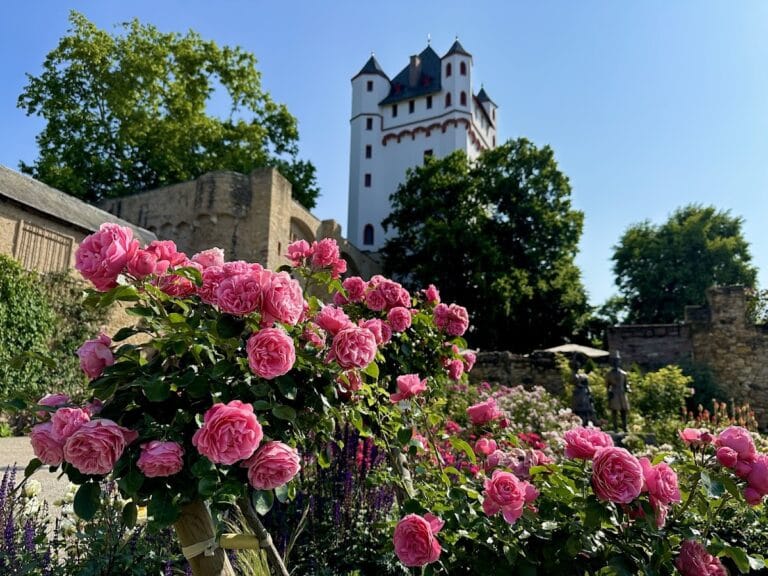
Schloss Reinhartshausen stands at the western edge of Erbach, a district of Eltville am Rhein in the Rheingau. Vineyards surround the estate, while the Rhine bank is separated from it by Federal Highway 42. The present palace occupies the site of the earlier knightly residence and was constructed in 1801 after that building had been removed.
The palace’s later form reflects the renovation of 1987 to 1991, which raised the central tract and added a west wing. Marianne’s gallery building, created to house her art collection, no longer survives, but part of the collection remains associated with the palace and its garden. Works are displayed in the Festival Hall, and the palace contains the marble statue Adam and Eve by the Dutch sculptor Louis Royer.
Wine Estate and Agricultural Buildings
The estate includes vineyards and facilities for wine production. A new flood-protected wine cellar and a new winery building were constructed during the later expansion of the property. A farmstead was relocated to the end of Eberbacher Straße in Erbach. These agricultural buildings form part of the estate’s continuing function as a combined hotel and winery.