Erlacherhof: A Late-Baroque and Rococo Town Palace in Bern


Site at a Glance
- Rating
- 4.5
- Popularity
- Very Low
- Country
- Switzerland
- Primary era
- Early Modern
- External website
- Open
- Eras represented
- Early Modern
- Civilizations
- Swiss
- Site type
- Domestic
- Remains
- Palace
On this page8 sections
History
Erlacherhof is a late-Baroque and Rococo town palace in Bern, Switzerland, built in the Old City between 1745 and 1752 for the imperial counts of Erlach. Probably designed by the Bernese architect Albrecht Stürler and commissioned by Hieronymus von Erlach, it is regarded as Bern’s most representative patrician residence and is designated a Swiss cultural property of national importance.
Construction for the Erlach family
The palace replaced two earlier houses, including one that had belonged to Adrian I von Bubenberg, a fifteenth-century Bernese military commander and political figure. Stürler and Hieronymus von Erlach both died in 1748, before the work was complete. Hieronymus’s son, Albrecht Friedrich von Erlach, then brought the project to completion, probably with assistance from the sculptor and decorative artist Johann August Nahl the Elder. Albrecht Friedrich placed his father’s monogram, “HvE,” in the gable fields of the side wings.
From patrician residence to public institution
In 1795, Erlacherhof passed to the butcher Albrecht Hegi and the merchant David Rudolf Bay. Three years later, the political upheaval that ended Bern’s patriciate, the city’s former ruling elite, brought a new occupant. The French general Guillaume-Marie-Anne Brune, a figure of the French Revolutionary and Napoleonic period, used the palace as his headquarters.
During the Mediation period, the political order established under Napoleon after the collapse of the old Swiss Confederation in 1798, Erlacherhof became a schoolhouse for Bern’s Matte district. It later housed the French embassy until 1831. From 1848 to 1857, the palace contained the official offices of the Swiss Federal Council, Switzerland’s national executive government. It therefore served as the council’s first official seat before the completion of the first Federal Palace.
Municipal administration
Since 1857, Erlacherhof has housed parts of Bern’s municipal administration, including the mayor’s directorate, the city chancellery, and the municipal council chamber. It remains the official seat of Bern’s mayor and is owned and managed by the city of Bern.
Remains
Courtyard and entrance sequence
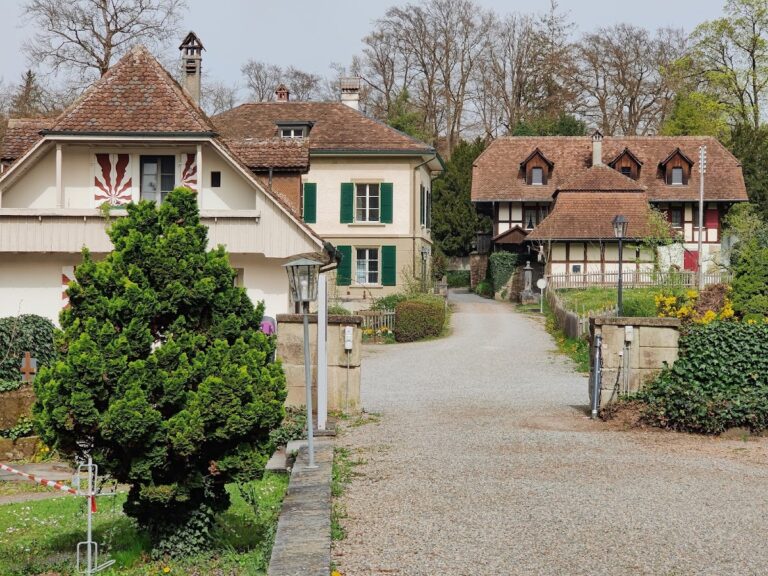
Standing at Junkerngasse 47, Erlacherhof is distinguished by its courtyard of honor, the only courtyard of this kind in Bern’s Old City. An elaborately decorated iron gate encloses it toward the street. The space was designed so carriages could draw in and is preceded by a covered arcade. This unusual arrangement reflects the strict enforcement of Bernese legislation requiring property owners to provide a covered, dry passage through the city.
Interior rooms and decoration
The vestibule contains two large painted views of Bern by Johannes Dünz, an eighteenth-century Swiss painter. From there, the interior leads to an antechamber on the left and to a large horseshoe-shaped staircase on the right. A gallery with freestanding columns rises above the staircase. Its ceiling bears a mythological painting attributed uncertainly to Johann Ulrich Schnetzler, depicting Mars returning to Venus. The image was understood as a symbol of the patron’s farewell to military service.
At the top of the staircase is a ceremonial hall decorated with stucco by Johann August Nahl the Elder. Its ornament presents allegories of the arts and sciences, while the ceiling painting by Jakob Emanuel Handmann shows Apollo and the nine Muses. Opposite the palace entrance, the municipal council chamber continues the building’s civic use, with Bern’s municipal executive meeting there once a week.
Garden terrace
Behind the main building, a raised and tunnelled garden terrace extends toward the Aar valley. It forms a distinct landscaped element of the palace complex and survives as part of Erlacherhof’s arrangement above the river valley.
Nearby sites