Trolleholm Castle: A Danish Water Fortress in Sweden


Site at a Glance
- Rating
- 4.8
- Popularity
- Very Low
- Country
- Sweden
- Primary era
- Early Modern
- Eras represented
- Early Modern
- Civilizations
- Danish
- Site type
- Military
- Remains
- Castle
On this page11 sections
History
Trolleholm Castle is a water castle in Sweden that began as the Danish fortress of Eriksholm in the sixteenth century. Located in Scania, the site developed from a medieval settlement into a fortified residence, and it remains associated with the Trolle-Bonde family.
Medieval estate and the foundation of Eriksholm
During the Middle Ages, two farms stood at the site in a settlement called Kattis Nabbe. Ownership before 1400 is uncertain. The armourer Erik Nielsen owned one of the farms in 1424, and Mogens Svensen was listed as an owner in 1471. The estate later came under Herrevad Monastery.
The name Eriksholm first appears in 1528. In 1533, Tage Ottesen Tott of the Tott family acquired the Kattis Nabbe estate with approval from the Danish government, while the monastery received other agricultural land. Tage established the first defensive works, and construction of the castle began in 1538 by decision of the Danish Rigsraad, the royal council that took part in major government decisions under Danish rule. At this time, Scania belonged to the Danish Crown. Eriksholm was named after Tage Tott’s elder brother Erik, who had died in 1533.
Tage Ottesen Tott was a nobleman, senior official, and commander of the fortresses at Landskrona and Bohus. His heirs retained Eriksholm for about 150 years. His son Otte Tagesen Tott inherited the estate in 1562, and Otte’s wife, Sophie Ottesdatter Brahe, became its sole owner in 1588.
Sophie Brahe and the Tott family
Sophie Ottesdatter Brahe pursued interests in science, astronomy, medicine, alchemy, and genealogy. She raised her son at Eriksholm and carried out alchemical experiments there. She also wrote the Latin poem Urania Titani, dedicated to the nobleman and adventurer Erik Lange.
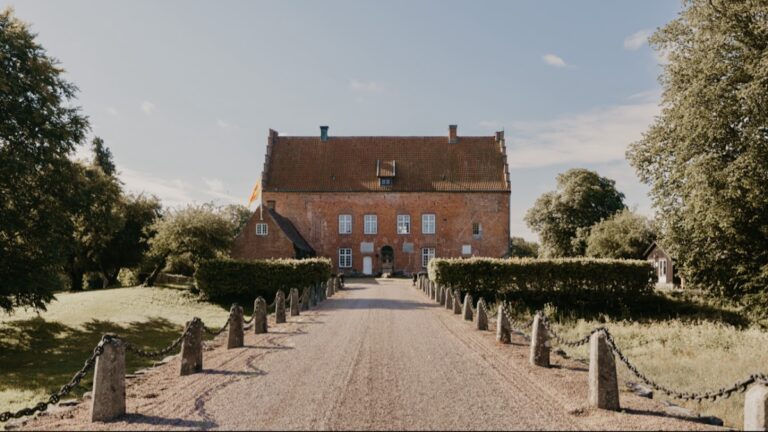
Sophie had met Lange while visiting her brother Tycho Brahe on the island of Hven. Tycho Brahe, a prominent astronomer, owned Knutstorp Castle. Sophie and Erik Lange married in 1602, but Lange’s debts led to the sequestration of her property. Their son Tage helped settle part of the debt after reaching legal adulthood. Lange later fled abroad and died in Prague in 1613. Sophie continued her scholarly work until her death, and her genealogical writings are held by the library of Lund University.
Sophie’s only son, the privy councillor Tage Ottesen Tott, was known as the “King of Scania.” He died in 1658, shortly before the Treaty of Roskilde, which transferred Danish territories, including Scania, to Sweden. His death spared him persecution by Swedish emissaries during the political repression directed at the old Danish nobility in southern Scandinavia. Eriksholm nevertheless remained with the Tott family.
War, destruction, and the name Trolleholm
Tage Ottesen Tott’s eight-year-old grandson, Tage Ottesen Tott the Younger, was the designated heir. During the Danish-Swedish War of 1675–1679, Danish forces captured and destroyed the castle in 1678 after a Swedish garrison had occupied it. The previous year, Swedish authorities had accused the young owner of treason and attempted defection to King Christian V of Denmark. He was sentenced to death in absentia, meaning that the judgment was issued while he was away. A symbolic execution using an effigy was carried out in Malmö, and Knud Holger Tott, his half-brother, underwent the same ritual. Lawyers later overturned the sentence, but Tage did not return to Sweden. He sold the inherited estate and castle.
In 1680, Helle Rosenkrantz, the widow of Niels Trolle, Admiral and Governor of Norway, bought the estate. The castle was restored soon afterward. Her grandchildren sold it in 1727 to their relative Lieutenant Colonel Frederik Trolle, who gave the residence its present name, Trolleholm, in 1755.
The Trolle-Bonde estate
Through the marriage of Frederik Trolle’s daughter Viviki to Count Gustav Bonde, the property passed to the Bonde family. Later owners belonged to the Trolle-Bonde family, which continues to own the castle and estate.
Gustav Trolle-Bonde, Viviki’s grandson, divided much of the estate between 1808 and 1837 and leased the parcels in perpetuity to local farmers. Farm buildings, storehouses, schools, and poorhouses were built around the castle in the following years.
After Gustav Trolle-Bonde’s death, the castle passed to his nephew, Count Gustav Trolle-Bonde the Younger, and later to the younger count’s second son, Count Carl Johan Trolle-Bonde. Carl Johan began the restoration of the deteriorated family castle. The Danish architects Ferdinand Meldahl and Albert Jensen directed a comprehensive reconstruction and restoration between 1886 and 1889.
Carl Trolle-Bonde (1843–1912) assembled most of the castle library, which contains approximately 45,000 volumes. Its collecting interests include Swedish history, genealogy, topography, biography, and medieval literature. The collection also contains valuable manuscripts from the Soop family archive and the library of Stora Bjurum Castle. Most of the complex remains under the control of the Trolle-Bonde family, whose descendants continue to live at the castle.
Remains
Fortified island complex
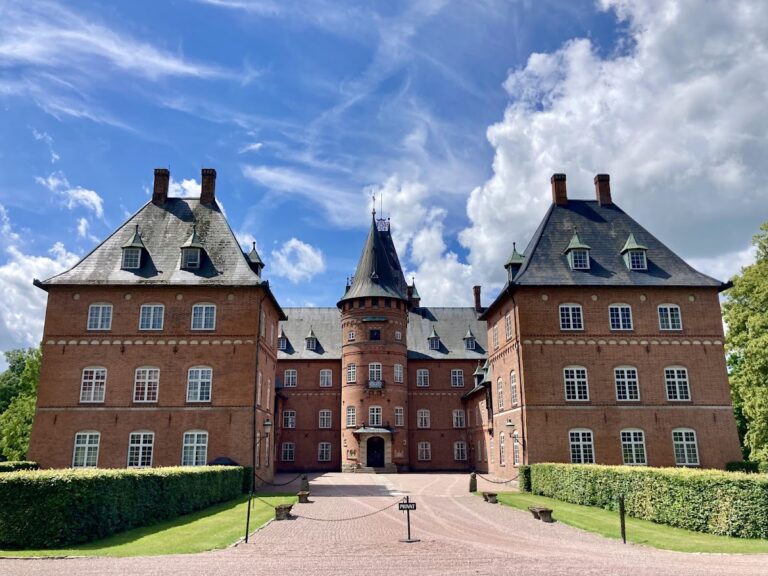
Trolleholm stands in the parish of Torrlösa in Svalöv Municipality, within the former Onsjö district and about nine kilometres northwest of Eslöv. The original Eriksholm fortress was arranged around a three-storey stone main building. Additional buildings and walls formed a rectangle around a small courtyard, creating a four-wing castle. The complex retains prominent sixteenth-century features, including stepped gables, while the buildings were comprehensively reconstructed and restored in 1886–1889.
Towers and artillery positions
Towers occupied the southwestern and northeastern corners of the fortress, and two further towers were added later. The defensive complex also included positions for artillery, reflecting its role as a fortified residence during the period of Danish rule.
Moat, drawbridge, and foreburg
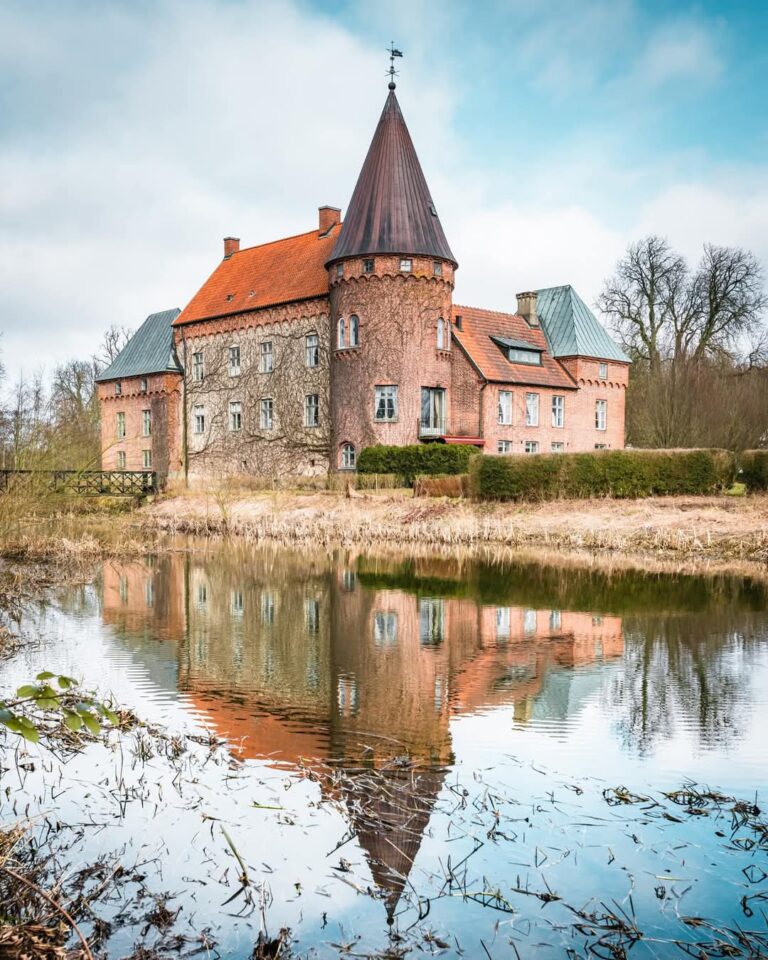
A moat surrounded the fortress, with a drawbridge on the eastern side. Farm buildings east of the castle also formed a foreburg, an outer defensive enclosure placed before the main fortress to protect its approaches. The castle originally stood on an island amid lakes. Much of the surrounding water was later drained or filled, but the approximately quadrilateral main complex remains enclosed by broad water-filled moats.
Garden and scholarly collections
After Otte Tott’s death, Sophie Brahe established a Renaissance garden at Eriksholm. The Renaissance was a European cultural and artistic period that revived interest in classical forms and often used symmetrical planning and classical decoration. The garden was described as the most renowned of its kind in Scandinavia. The site also contained Sophie’s chemistry laboratory.
Library and manuscripts
The castle contains a substantial art collection and a private library of approximately 45,000 volumes. The library preserves valuable manuscripts originating partly from the Soop family archive and the library of Stora Bjurum Castle, alongside works on Swedish history, genealogy, topography, biography, and medieval literature.
Nearby sites