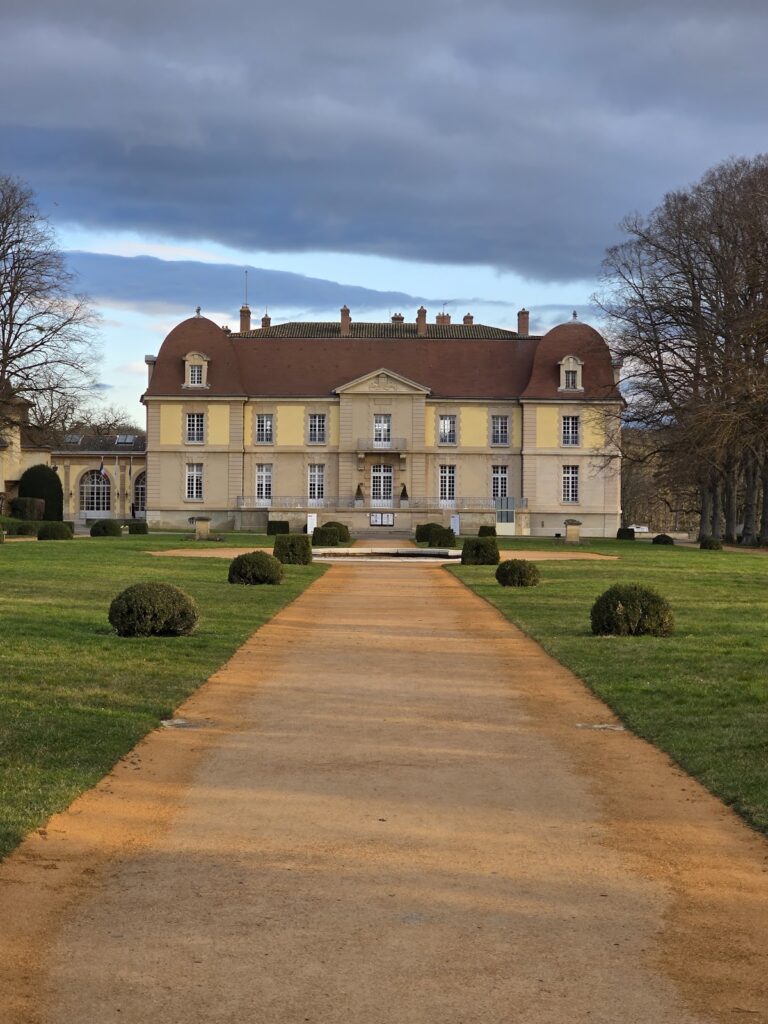
Château de la Barollière: A Former Fortified Castle in France


Site at a Glance
- Rating
- 4.6
- Popularity
- Very Low
- Country
- France
- Primary era
- Medieval
- Eras represented
- Medieval, Early Modern
- Civilizations
- French
- Site type
- Domestic
- Remains
- Castle
On this page10 sections
History
Château de la Barollière is a former medieval fortified castle in France, situated at Limonest on the slopes of Mont Verdun. Its precise construction date is unknown, while the earliest surviving document connected with the site is a sale from 1374, when Françoise de Meiresieu, widow of Mathieu de Mure, sold it to Jean de Villiers.
From the fourteenth to the seventeenth century
The château remained associated with prominent Lyonnais owners. On 15 July 1588, Jeanne de Villiers, widow of Antoine Faure, sold it to Vincent Richard, a Lyon bourgeois, for 2,000 gold écus. Richard was the son of the Lyon merchant Cosme Richard and became a Lyon alderman on 8 June 1603.
Claude Richard transferred the property to Pierre Lanchenu on 3 April 1665 for 48,000 livres. Lanchenu was a royal councillor and provincial treasurer responsible for extraordinary military expenditure. The seventeenth century also brought major building works, including changes to the interior courtyard, the well casing, and the entrance portal.
Eighteenth-century transformation
On 8 November 1750, Charles-Alphonse Pilotte de la Barollière sold the château to Jean II Maritz for 65,000 livres. Maritz was an official responsible for artillery casting, following a family tradition associated with his father, Jean Maritz, who was known for developing a method of boring cannon barrels. Jean II Maritz modernized the residence, improving its comfort and altering its windows while creating salons that opened onto the large terrace.
The decorative work of this period included reception rooms with ornamental plasterwork, painted illusions of three-dimensional forms, and wood panelling. Fireplace plaques bearing the arms of Jean II Maritz and the date 1769 help establish the date of this campaign.
Revolutionary and nineteenth-century ownership
Judith Déonna, widow of Jean II Maritz, sold the château to property dealers on 18 October 1793, shortly after the Siege of Lyon. This military operation against Lyon during the French Revolutionary period lasted from 9 August to 9 October 1793. During the siege, Châteauneuf-Randon, a representative of the National Convention, stayed at La Barollière while helping supervise military operations. Déonna later chose to spend the rest of her life in Switzerland, the country from which the Maritz family originated.
Romain Baboin purchased the château on 2 February 1810 for 90,000 francs. During the Siege of Lyon, Baboin had been among the besieged. He escaped with his brother Benjamin to Switzerland and then continued to Austria, where the brothers established successful banking careers. The Baboin family was an established Lyonnais family whose activities included important silk factories from the seventeenth to the twentieth century, as well as banking.
During the First Restoration, the period following Napoleon’s fall when Louis XVIII initially returned to the French throne, Romain Baboin was ennobled by letters patent issued by Louis XVIII on 20 June 1814. He took the title Baron de la Barollière, received the Silver Lily, and became Receiver-General of Finance, a senior official responsible for collecting and administering public revenue.
Romain-Joseph Baboin had no children, so the château passed to his eldest daughter Sophie, who had married Sébastien Gaillard on 27 November 1810. Their only son, Sébastien, became a Jesuit and provincial of Lyon. Their daughter Marie married the master of forges Eugène Neyrand on 5 January 1876, bringing La Barollière into the Neyrand family. The property remains inhabited by their descendants and is identified as belonging to the Neyrand family.
Military stays and preservation
The château’s elevated position brought several historically notable visitors. Châteauneuf-Randon stayed there during the Siege of Lyon. Marshal Pierre Augereau slept there in March 1814 during the Battle of Limonest, part of the Campaign of France. In December 1831, during the first Canut revolt, an uprising of Lyon’s silk workers that began in 1831, Ferdinand-Philippe, Duke of Orléans, and Marshal Jean-de-Dieu Soult temporarily installed themselves at the château but did not remain.
Château de la Barollière has been listed as a historic monument since a decree of 7 June 1926. A major restoration campaign has been under way since 2016 with support from the Regional Directorate of Cultural Affairs and the Auvergne-Rhône-Alpes Region. The work includes the restoration of the Jean II Maritz salons.
Remains
Château de la Barollière occupies a broad, high terrace that formed part of its defensive system. The elevated site overlooks Limonest, Dardilly, and many other villages toward the Monts du Lyonnais. The name has a Gaulish origin: the element “Bar” is associated with construction on rocky ground.
Castle buildings and courtyard
Residential block and towers
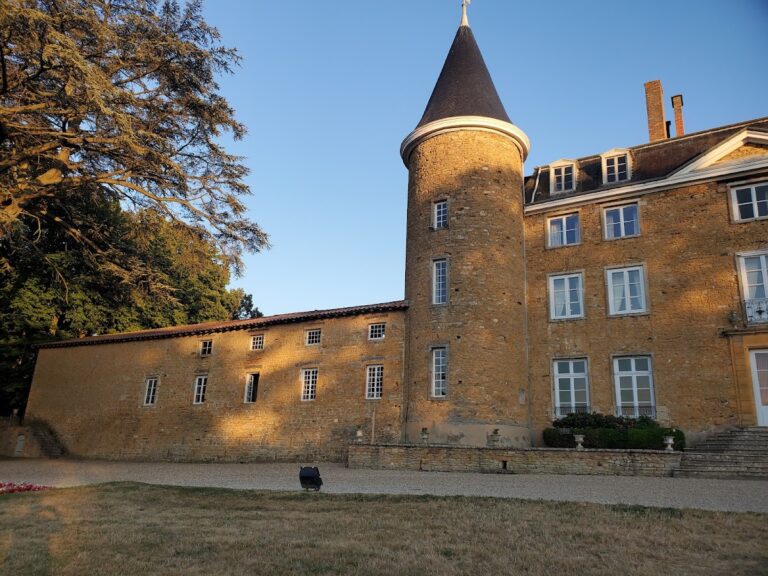
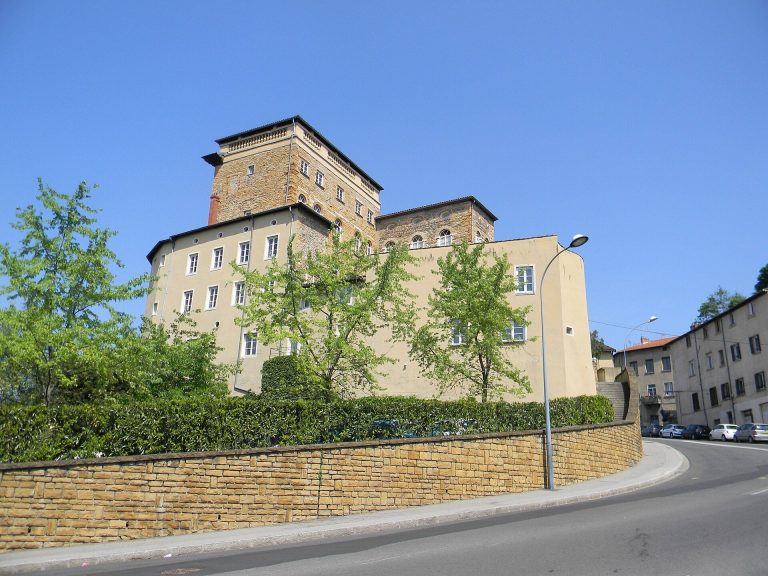
The principal building is a rectangular residential block surrounded by four square towers. Each tower has a pavilion-style roof. A fifth tower, formerly used as a watchtower, stands at a corner of the interior courtyard. Together, these elements preserve the fortified character of the residence while expressing its adaptation to domestic use.
Courtyard and entrance portal
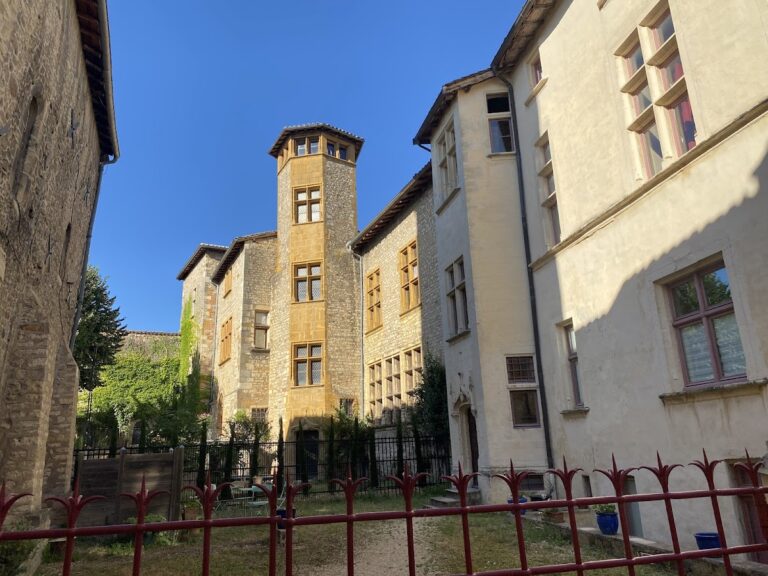
The interior courtyard contains arcades dating from the seventeenth-century building works. A well stands at its centre, and its casing belongs to the same period. The entrance portal has projecting masonry blocks, known as bossage, and is decorated with lion masks.
Eighteenth-century interiors
The eighteenth-century alterations are visible in the numerous windows added or modified around the building, as well as in the balconies and wrought-iron railings bearing the initials “JM” of Jean II Maritz. The reception salons date from about 1760 and open onto the large terrace. Their decoration combines varied ornament, painted trompe-l’œil scenes, ornamental plasterwork, and wood panelling. Fireplace plaques carrying Maritz’s arms and the date 1769 remain as evidence for the chronology of this interior campaign.