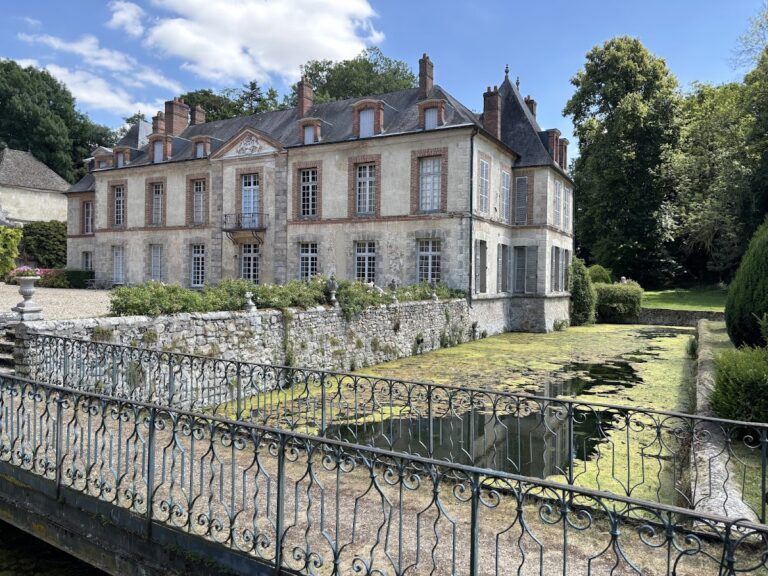
Château de Sainte-Assise: A Historic Estate in Seine-Port, France

Site at a Glance
- Rating
- 4.1
- Popularity
- Very Low
- Country
- France
- Primary era
- Early Modern
- Eras represented
- Medieval, Early Modern, Modern
- Civilizations
- French
- Site type
- Domestic
- Remains
- Castle
On this page16 sections
History
Château de Sainte-Assise is a historic château in Seine-Port, France, whose construction began in 1608 on the grounds of a former priory and whose present character is described as eighteenth-century Neoclassical. The estate developed from a religious foundation into an aristocratic residence, later becoming a site of literary and theatrical activity before its transformation into a radio-telegraphy station.
From Saint-Acire Priory to Barbeau Abbey
The site began as the Saint-Acire priory, founded around 1135 under the invocation of Saint Acire or Achérie, also known as Acerius. Its name later evolved into Sainte-Assise or Saint-Assise. The priory soon became the royal abbey of Sainte-Acire, a daughter house of Preuilly Abbey. As a dependent monastery, it ultimately belonged to the Cistercian network, whose mother abbey was Cîteaux.
Louis VII, king of France from 1137 to 1180, placed the abbey under royal protection and granted it lands in 1146 and 1147, including the nearby forests of Sénart and Beaulieu. Further gifts followed, and Pope Alexander III confirmed them in 1164.
During the 1150s, a new abbey was begun at Barbeel, or Barbeau, on a healthier site overlooking the Seine. Its church was consecrated in 1178, after which the institution became Barbeau Abbey and Saint-Acire returned to the status of a priory. The priory was later moved to higher ground above the Seine, probably for the same sanitary reasons.
The Caumartin château
At the end of the sixteenth century, the Caumartin family sought to replace the thirteenth-century feudal manor of Saint-Port because it was in poor condition and badly situated. In 1608, Louis Lefèvre de Caumartin obtained the former priory grounds in an exchange with Benjamin de Brichanteau, the commendatory abbot of Barbeau. A commendatory abbot held the office while often leaving the day-to-day administration of the monastery to others. Caumartin then commissioned the château, while Henry IV raised the lordship of Saint-Port to a barony for him.
The barony of Saint-Port and the lordship of Sainte-Assise passed in 1623 to Caumartin’s widow, Marie Miron, and in 1645 to their son, Jacques Lefèvre de Caumartin. His heirs sold the domain to Antoine de Benoist in 1682. Benoist’s widow, Catherine Goy, transferred it in 1695 to Jean de La Chapelle, a diplomat and poet.
Glucq, Montullé, and Madame de Montesson
Jean de La Chapelle rarely stayed at Sainte-Assise and sold it around 1700 to Jean Glucq, a Dutch-born industrialist who had established a dye manufactory in Paris. Glucq made his fortune in partnership with the cloth manufacturer François Jullienne, whose sister he married. In 1709, he gave the château to his eldest son, Jean-Baptiste Glucq.
Jean-Baptiste Glucq became a major patron of the arts. He hosted artists including Watteau and received Louis XV at Sainte-Assise. After the king remarked on the dining room’s small size, Glucq had a third pavilion built beside the château immediately after the visit. The Countess of Verrue, closely associated with the court of Louis XV, also maintained strong links with Sainte-Assise and bequeathed Glucq several paintings and a crystal chandelier in 1736.
After Glucq’s death in 1748, the estate passed to his nephew, Jean-Baptiste-François de Montullé. Montullé and his wife, Élisabeth Haudry, lived more quietly at Sainte-Assise and raised their children according to contemporary educational ideals that emphasized close contact with nature. The writer Marmontel admired this arrangement during his stays. The murder of Montullé’s gamekeeper in 1773, together with probable financial difficulties, led Montullé to dispose of the château.
In 1773, the domain was given to Madame de Montesson on the occasion of her morganatic marriage to the Duke of Orléans. In such a marriage, a spouse of unequal rank and the children of the union did not receive the full dynastic or inheritance rights of a regular royal or aristocratic marriage. Madame de Montesson hosted men of letters and staged comedies at Sainte-Assise, sometimes performing in plays she had written herself. The Duke of Orléans died there soon after Marie Antoinette refused to stop at the estate during a journey by galley on the Seine.
Revolutionary dispersal and nineteenth-century ownership
Madame de Montesson sold Sainte-Assise to the Count of Provence in 1787. Six months later, he resold it to the Duchess of Kingston, who died the following year in mysterious circumstances. Her nephew, Philip Glower of Winspegton, sold the domain in 1790 to Claude-Xavier Carvillon des Tillières.
Carvillon des Tillières began subdividing the estate. He sold Madame de Montesson’s house in the village, transferred the kitchen garden in 1794 to the pharmacist and writer Charles Louis Cadet de Gassicourt, and sold the Dutch farm to the surgeon Jean-Jacques Segard. In 1795, he sold the fire pump, a small house in the upper park, and the pavilions beside the principal entrance grille. He then exchanged the château and the remaining park with Guillaume-Joseph de Casaux for a château near Tournan-en-Brie.
Casaux, a native of Bordeaux and owner of the Château Pape Clément vineyard, repurchased the Dutch farm but went bankrupt in 1801. He sold the château’s furnishings for 10,000 francs to Nicolas-Louis Juteau, imperial prosecutor general at the criminal court of Sarthe. After Casaux failed to meet his payments, the Banque territoriale seized the château and sold it in 1807 to the demolition contractors Jean Genest and Pierre Roussel. They demolished the lateral wings added under Madame de Montesson, but the destruction stopped when Count Frédéric de Pourtalès acquired the estate in 1808.
Pourtalès sold Sainte-Assise in 1824 to Madame Manuel, the wife of a banker. She sold it in 1827 to Prince Charles de Beauvau-Craon, after which the château remained in the Beauvau family for about a century. Ownership passed to Marc de Beauvau-Craon in 1864, to the dowager princess of Beauvau, born Gontaut-Biron, in 1883, and subsequently to Prince Charles-Louis de Beauvau-Craon.
The river pavilion and literary associations
A separate dependency on the Seine bank, known as the Sainte-Assise pavilion, was built for the Duke of Orléans. Carvillon des Tillières sold it to Charles Louis Cadet de Gassicourt in 1794, and it briefly housed Gouverneur Morris, the United States ambassador, in 1796. Cadet later transferred it to Dominique Beauregard, whose son-in-law, Philibert Rivière, erected the building that survives today around 1800.
Louis Marchand, Napoleon I’s first valet de chambre, retired to the pavilion in 1822 after serving Napoleon at Saint Helena. Prince Marc de Beauvau-Craon, who began reconstituting the estate from 1827, repurchased it and lent or rented it to various occupants. Alexandre Dumas fils rented the building in 1855 and wrote L’Affaire Clemenceau there. Later occupants included Baron Stanley in 1870, the Duke of Guiche in 1875, and Count Horace de Choiseul-Praslin in 1876. The pavilion subsequently became known as the Choiseul Pavilion.
Radio communications
In 1922, Prince Charles-Louis de Beauvau-Craon sold the domain to Compagnie Radio France, which installed a wireless-telegraphy transmitting station. Wireless telegraphy sent messages by radio rather than through wired connections, and the enormous antenna installations substantially altered the appearance of the estate.
In 1998, the French Navy acquired the radio-electric center and began using it for communication with nuclear submarines. Its low-frequency transmissions propagate effectively through water, giving the former estate a continuing role in naval communications.
Remains
Château and formal grounds
Main château
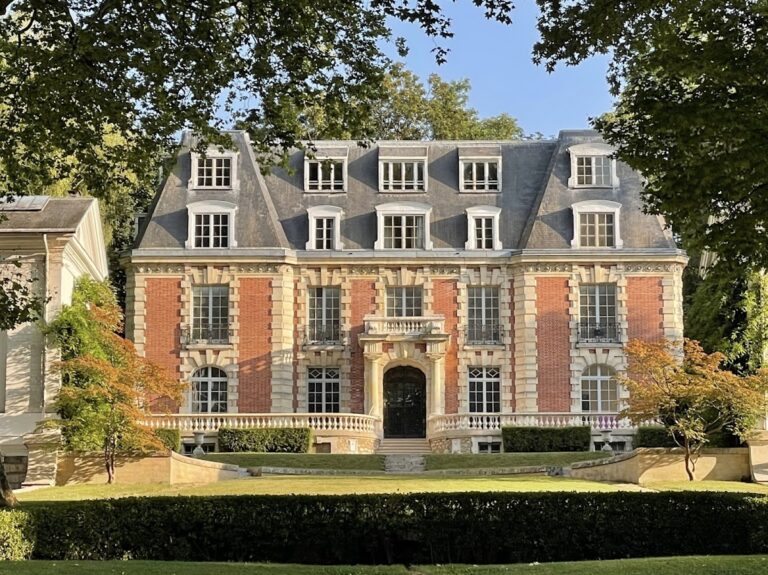
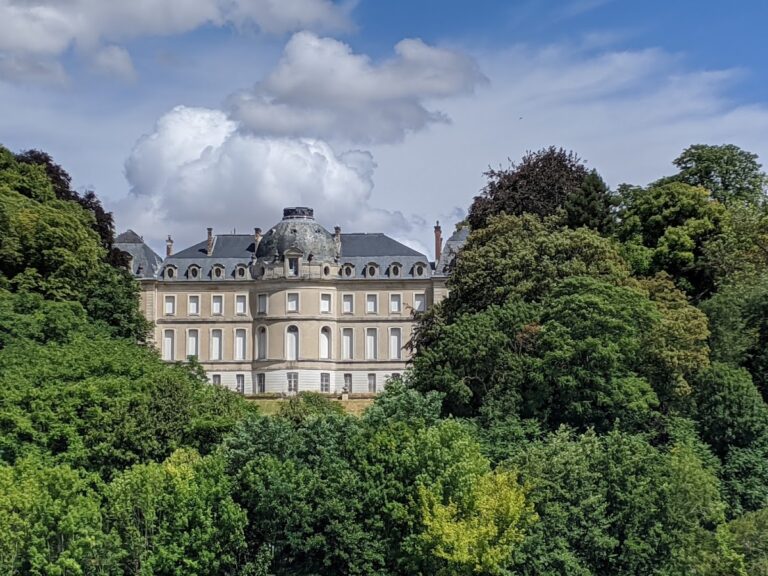
The château was laid out as a parallelogram flanked by two pavilions. Three large terraces descended toward the Seine, giving the residence a formal arrangement across the sloping ground. When the new château was built, the chapel was the only structure retained from the former priory buildings. The original function of the château was residential.
Gardens and approach
A description from 1757 records an approach through the woods along a forked avenue leading to a large esplanade, an outer courtyard, and an inner courtyard. A broad terrace extended across the garden front. From one side it led toward two bosquets, formal groves or enclosed plantings, while the other side led to a quincunx, a regular five-part or staggered arrangement of trees, above which stood an orangery for sheltering citrus trees.
The upper garden consisted of high forest crossed by paths. Opposite the château, a parterre, or formal ornamental garden area, descended from the terrace toward the river. These elements formed a sequence of wooded, formal, and descending garden spaces within the estate.
Later additions
A third pavilion was added beside the château after Louis XV’s visit. It contained a new dining room whose decoration was described as particularly elaborate. Two wings were later attached to the central building to accommodate numerous guests and a large household. Water from the Seine was raised to the château by a fire pump, and a ceremonial entrance grille was constructed with two small guard pavilions. The two lateral wings were demolished in 1807.
Seine-side pavilion
Sainte-Assise Pavilion
The Sainte-Assise Pavilion stands separately on the bank of the Seine as a dependency of the château estate. An earlier pavilion had been built for the Duke of Orléans, but the building that survives today was erected around 1800 by Philibert Rivière after the property passed through the hands of Charles Louis Cadet de Gassicourt and Dominique Beauregard.
The building’s later associations include Louis Marchand’s retirement there in 1822 and Alexandre Dumas fils’s occupation in 1855, when he wrote L’Affaire Clemenceau. Its later name, the Choiseul Pavilion, followed the residence of Count Horace de Choiseul-Praslin in 1876.
Radio installations
Antenna structures
The twentieth-century radio installation introduced gigantic antenna structures across the estate and substantially changed its appearance. The radio-electric center remains associated with naval communications using low-frequency transmission, which can travel effectively through seawater.
Nearby sites