Veleslavín Castle: A Baroque Estate and Sanatorium in Prague


Site at a Glance
- Rating
- 3.8
- Popularity
- Very Low
- Country
- Czechia
- Primary era
- Early Modern
- External website
- Open
- Eras represented
- Early Modern, Modern
- Civilizations
- Habsburg, Holy Roman Empire, Kingdom of Bohemia
- Site type
- Domestic
- Remains
- Castle
On this page8 sections
History
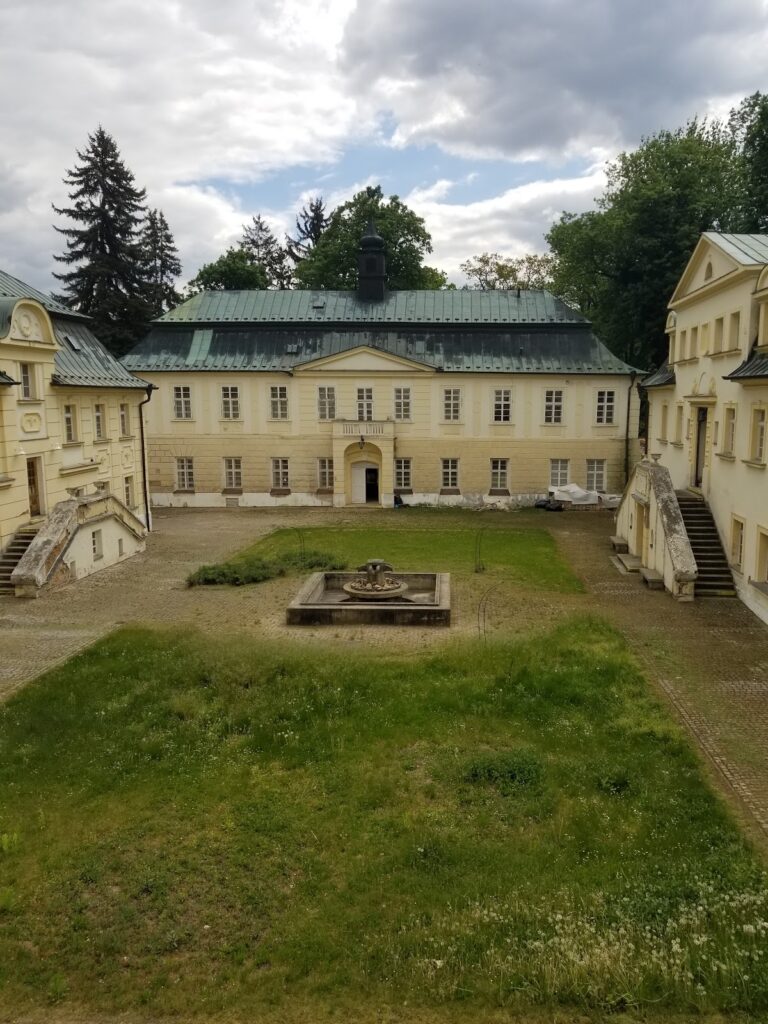
Veleslavín Castle is a Baroque castle in Czechia, located in Prague’s Veleslavín district. Its present building was constructed around 1730–50, probably to plans by Kilian Ignaz Dientzenhofer, a leading Bohemian Baroque architect and builder. The estate later became a sanatorium, a long-term institution for treatment and care, and remained connected with medical use until the site closed in 2000.
From monastic possession to eighteenth-century castle
The village of Veleslavín was first mentioned in 993 among the founding possessions of Břevnov Monastery, a Benedictine monastery in Prague traditionally regarded as the oldest Benedictine monastery in Bohemia. From the fifteenth century, the village belonged to Prague citizen families. During the sixteenth century it was associated with the Adam von Veleslavín family, and a manor or small castle already stood on the estate.
The earlier estate may have belonged in the eighteenth century to Empress Elisabeth of Austria, the mother of Maria Theresa, the Habsburg ruler of the Austrian hereditary lands from 1740 to 1780. A new Baroque castle was built around 1730–50. Field Marshal Keith, a senior eighteenth-century Prussian military commander, may have occupied it in 1757 during the Prussian siege of Prague.
The Rosenbaum and van Oestéren families
Emilie Rosenbaum, later known as Emilie van Oestéren, acquired the castle around 1877–84. She lived there with her three children and divided her time between Veleslavín and her home in Vienna. The young Rainer Maria Rilke, a major German-language poet and writer of the late nineteenth and early twentieth centuries, visited several times in 1896. He later wrote at least twelve letters to Emilie’s daughter, Laská van Oestéren.
Around 1899, Emilie’s son Friedrich Werner van Oestéren probably wrote parts of his first novel at the castle and continued to stay there frequently. After his lover died by suicide at the castle in 1907, Emilie van Oestéren put the property up for sale.
Medical institution and cultural memory
Psychiatrist Leo Kosák and his cousin Oskar Fischer sought to purchase the estate. The owner allegedly refused because they were Jewish. Jan Kolátor, the mayor of Břevnov, then acquired the property and sold it to the two men in 1908 for 100,000 crowns. They established a sanatorium for people with nervous and mental illnesses.
In 1917–18, the 21-year-old Milena Jesenská was forcibly confined there by her father in an effort to end her relationship with a man. Jesenská, later known as a Czech journalist, writer, and translator, described the forced isolation of Karl Přibram as well as her own disciplinary isolation after she continued to contact him.
Charlotte Garrigue Masaryková, the American-born wife of Tomáš Garrigue Masaryk, lived at the institution from 1918 while suffering from a nervous illness. Masaryk became the first president of Czechoslovakia that year and visited her frequently. He also had his own work and living room at the institution. Several patients died there under unexplained circumstances in 1922.
Confiscation, state medical use, and decline
In 1939, Oskar Fischer sold his share to his non-Jewish wife, but the property was nevertheless confiscated and transferred to the Emigration Fund for Bohemia and Moravia. This Nazi-era agency organized the confiscation of Jewish property in Bohemia and Moravia and used the proceeds to finance transports to concentration camps. Leo Kosák and Oskar Fischer were arrested in 1941 and later deported to camps, where they died in 1942 and 1944.
Leo Kosák’s son, Josef Kosák, unsuccessfully tried to recover the property in 1946. From 1947, the state-owned estate operated as a pneumological clinic, specializing in diseases of the lungs and respiratory system. It became a university hospital in 1990 and was later operated by Canadian Medical Care. The site ceased to be used in 2000 and subsequently deteriorated. Partial conservation was under way in 2022, including adaptation of parts of the site for architecture exhibitions.
Remains
The castle and later additions
The principal surviving structure is the Baroque castle built around 1730–50, probably according to plans by Kilian Ignaz Dientzenhofer. Its architectural character belongs to the European Baroque, a period that flourished mainly during the seventeenth and eighteenth centuries and favored elaborate forms and ornament. The main building was enlarged by additions around 1912, reflecting the estate’s continued adaptation before and during its medical use.
Estate buildings and park
The grounds contain several smaller buildings in addition to the main castle. They form part of a larger estate that also includes an extensive castle park. Together, the principal building, secondary structures, and park preserve the physical extent of Veleslavín as a historic landed property, while the partial conservation begun by 2022 addressed the surviving complex and its adaptation for architecture exhibitions.
Nearby sites