Schloss Ledenburg: A Moated Castle in Germany

Site at a Glance
- Rating
- 4.6
- Popularity
- Very Low
- Country
- Germany
- Primary era
- Early Modern
- External website
- Open
- Eras represented
- Medieval, Early Modern
- Civilizations
- Holy Roman Empire
- Site type
- Military
- Remains
- Castle
On this page6 sections
History
Schloss Ledenburg is a moated castle in Germany, near Bissendorf in the Osnabrück district of Lower Saxony. The present castle probably dates from the fifteenth century and was built as the successor to an earlier medieval stronghold. Its history continued through several noble families, a destructive fire, and the preservation of a valuable collection of literary and musical works.
From Holter Burg to Neue Burg Holte
The site was formerly occupied by Holter Burg, a castle associated with the Holte family that was destroyed in 1147. A first replacement castle was probably erected around 1350. The present successor was probably built in the fifteenth century under the name Neue Burg Holte.
The later name Schloss Ledenburg arose after the Leden family made the castle their residence. Its connection with the earlier Holte establishment was linked to the marriage of one of the last members of the Holte family into the von Langen family. After the Leden line died out, the estate passed among several noble families. The Enningloh family, also known as Pladiese, acquired it in 1557, and the von Hammerstein family held it for a period. From 1622 to 1776, Schloss Ledenburg belonged to the Grothaus family, after which it passed to the counts of Münster. Since 1951, it has been owned by the Homann family of Dissen.
Fire, rebuilding, and the Ledenburg Collection
A severe fire in 1618 damaged the castle and destroyed its archive, making much of its early history difficult to reconstruct. Rebuilding took place between 1618 and 1627. During this work, the earlier four-wing arrangement was reduced to two wings.
The estate also preserved the literary and musical interests of Eleonore von Grothaus, an eighteenth-century German poet and music lover. Known as the Ledenburg Collection, the material was deposited in the Lower Saxony State Archive in Osnabrück in 2000. It includes her poems and an eighteenth-century music collection. Research by the French musicologist François-Pierre Goy led to its rediscovery and scholarly examination in 2015. Among the recovered works were Georg Philipp Telemann’s Twelve Fantasias for Viola da Gamba Solo. The viola da gamba was a bowed string instrument held between the legs and widely used from the Renaissance to the eighteenth century. The collection also contains music by Carl Friedrich Abel, a prominent eighteenth-century viola da gamba player, and other German and Italian composers. Edition Güntersberg published most of the collection in 2016.
Remains
Schloss Ledenburg stands approximately 500 metres north-northeast of Nemden and about 500 metres south of the hamlet of Halle, southeast of the wooded Haller Berg. The castle occupies ground about 78 metres above sea level beside the Hüppelbruchgraben. This watercourse feeds the castle moat and a pond below the castle before flowing into the Hase. The wider estate includes 200 hectares of woodland, of which 30 hectares were damaged by Cyclone Kyrill in 2007.
Water defenses and outer buildings
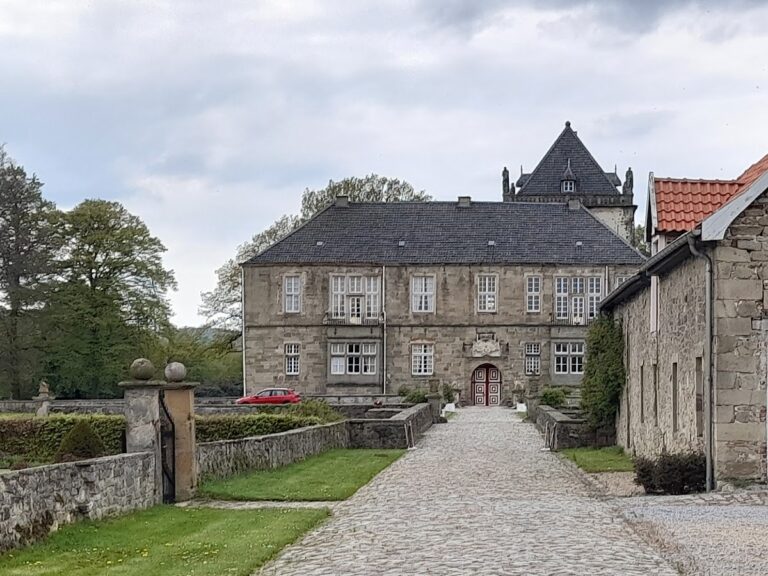
The main castle is enclosed by a moat about 15 metres wide. A second water-filled ditch, between approximately 5 and 10 metres wide, surrounds the entire complex and is reinforced by a retaining wall. West of the main building, a forecourt or outer bailey contains a gatehouse and ancillary buildings. Together, these water barriers and outer structures define the castle’s arrangement as a moated aristocratic residence.
Main castle
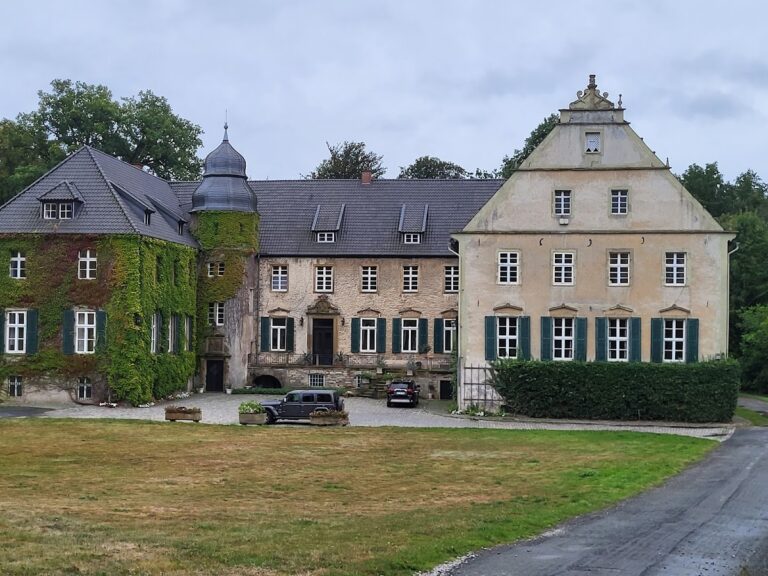
Schloss Ledenburg originally consisted of four wings, but the rebuilding after the 1618 fire left a two-wing main building with an attached or projecting tower. The exterior is sparsely decorated. A sandstone bay window rests on massive consoles and was probably intended to help monitor the entrance. The entrance itself is framed by pilasters. Inside the west wing is an elegant three-flight staircase, an early northern German example of a form that replaced the spiral staircases associated with Weser Renaissance architecture. The Weser Renaissance was a sixteenth- and early seventeenth-century style known for Renaissance forms and richly ornamented façades in the Weser region. The interior also contains a fireplace decorated with stone figures and several porcelain-tile stoves.
Nearby sites