Schloss Roseck: A Castle Complex and Estate in Germany


Site at a Glance
- Rating
- 3.3
- Popularity
- Very Low
- Country
- Germany
- Primary era
- Medieval
- Eras represented
- Medieval, Modern
- Civilizations
- German, Holy Roman Empire
- Site type
- Military
- Remains
- Castle
On this page8 sections
History
Schloss Roseck is a castle complex in Germany above the Ammertal near Unterjesingen, within the Tübingen area, probably built by the Counts Palatine of Tübingen during the Hohenstaufen period between 1138 and 1254. First mentioned in 1287, Roseck later became a monastic administrative center and court before passing through several private, religious, and institutional uses.
Medieval fortress and noble ownership
In 1287, Gottfried I, Count of Böblingen and Count Palatine of Tübingen, surrendered the fortress, recorded as castrum Rosseccke, to King Rudolf I. The transfer followed Rudolf’s suppression of resistance by several Swabian counts. By the middle of the fourteenth century, Roseck had passed to the Lords of Ow and later to Burkhart of Hönstein.
Burkhart sold the castle in 1408 to Hinz of Hailfingen. Two years later, on 28 October 1410, Hinz sold Roseck together with the entire village of Jesingen, now Unterjesingen, to Bebenhausen Abbey. The abbey established a monastic administrative office at Roseck, exercised lower court jurisdiction, and used the complex as an administrative center for villages in the Ammertal.
From monastic administration to private estate
The dissolution of Bebenhausen Abbey in 1535 and 1536 transferred its property to the Dukes of Württemberg. Roseck’s monastic administration became part of the Württemberg Bebenhausen monastic office at Lustnau and later moved into the Herrenberg district administration. In 1807, Roseck became a state-owned estate.
The state domain passed in 1824 to Karl Friedrich Sick, an economic councillor from Stuttgart. Rudolf Bernus of Frankfurt acquired it in 1826, and his foster son Leonhard Benz inherited the estate in 1850. Because of illness, Benz sold it in 1861 to Constantin Riedlinger of Rottenburg, born on 19 May 1821. In 1891, ownership passed to Alfred von Kaulla, a Stuttgart bank director.
During Riedlinger’s ownership, Guoth managed the estate. His son Heinrich Guoth, a trained agriculturalist, bought it in October 1898 and developed dairy farming and fruit cultivation. He entered the Stuttgart state parliament in 1900 as a member of the German Party. After his early death in 1909, his widow sold the castle estate in 1917 to Franz Öchsle, a soap manufacturer from Plochingen.
Religious use, fire, and changing care functions
Franz Öchsle donated Schloss Roseck in 1947 to the Franciscan Sisters of Schramberg-Heiligenbronn, a Catholic women’s religious community in the Franciscan tradition. The sisters moved into the castle, managed the associated estate, and built a convalescent home there in 1958.
In 1989, the sisters leased the castle to a Franciscan life center operated by the Little Servants of Jesus. The organization left after fourteen months when its director faced criminal proceedings for child abuse. The castle was then used to accommodate asylum seekers. On 9 August 1991, a fire deliberately started by a heavily intoxicated person with an addiction made the historic building uninhabitable. The sisters had the roof re-covered, but the interior was never rebuilt, leaving the structure as an empty shell.
Private ownership and future rehabilitation
Schloss Roseck returned to private ownership in 1993, when Oskar Eggenweiler of Sulz am Neckar acquired the estate for 5.3 million Deutsche Mark, equivalent to 2.71 million euros. His initial plans included a clinic for people with brain disorders in the old building. A care facility in the adjoining building was operated by Schloss Roseck Pflegegesellschaft, headed by Eggenweiler’s wife, Susanne.
The care facility had 21 beds and ten assisted-living apartments. It received patients referred by hospitals after strokes, traumatic brain injuries, and other illnesses, and also accommodated people with multiple sclerosis, severe neurological disorders, dementia, and Alzheimer’s disease. Markus Eggenweiler acquired the property and all its land in 2007, while Schloss Roseck GmbH remained the tenant of the grounds and planned extensive modernization and expansion.
On 16 March 2012, the Tübingen district authority revoked the care center’s operating permit because of various violations. The care operation ended in January 2014, and the castle was sold to a private buyer who initially intended to live there. Since the end of 2022, the property has belonged to COPRO Projektentwicklung of Berlin. In consultation with the municipality of Tübingen and the monument-protection authorities, COPRO and the Stuttgart architectural office Sindlinger + Vogt are preparing a rehabilitation and future-use concept for the complex.
Remains
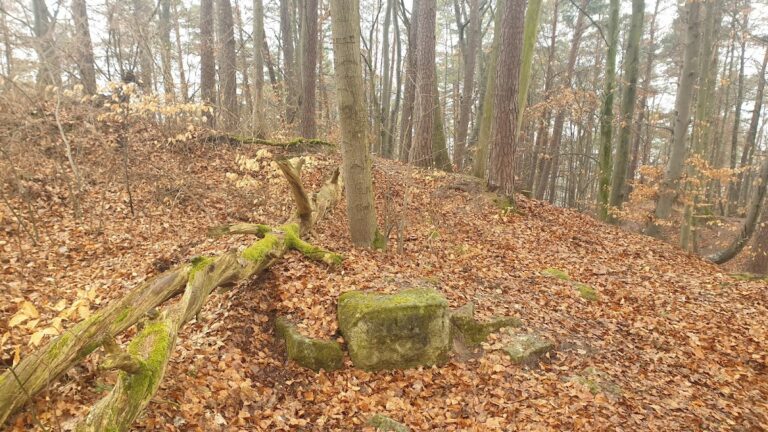
Schloss Roseck occupies a high position in the Schönbuch above the Ammertal, with the estate extending above the valley. The surviving property consists of the historic castle, an adjoining building constructed by the Franciscan Sisters, and associated agricultural land. The 1991 fire left the historic building with a re-covered roof but without a rebuilt interior.
Historic castle
The old building is the surviving historic core of the castle complex. Its interior remains unrestored after the fire, and the structure stands as an empty shell. The building was intended for a planned clinic for people with brain disorders after the estate entered private ownership in 1993. By January 2007, it was almost entirely vacant, with only one apartment rented.
Adjoining building and estate
The Franciscan Sisters constructed the adjoining building in 1959. It later housed the care facility, which contained 21 beds and ten apartments for assisted living. The castle and this later building form part of a property that also includes agricultural land, preserving the estate character of the complex alongside its historic and institutional structures.
Nearby sites