Hartmannsberg: A Former Water Castle in Bavaria


Site at a Glance
- Rating
- 4.6
- Popularity
- Very Low
- Country
- Germany
- Primary era
- Early Modern
- External website
- Open
- Eras represented
- Early Modern, Modern
- Civilizations
- Electorate of Bavaria, Holy Roman Empire
- Site type
- Domestic
- Remains
- Castle
On this page10 sections
History
Hartmannsberg is a former water castle in Germany, situated in Bad Endorf, whose present Baroque building dates to around 1685. The site first appears in the summer of 1166 as “Hademarsberch” in the Codex Falkensteinensis, a medieval record of the possessions and feudal holdings of the Counts of Falkenstein. Hartmannsberg was one of their four principal castles, together with Neuburg, Falkenstein, and Hernstein.
From Falkenstein to Wittelsbach control
After the death of Siboto VI, a member of the Falkenstein comital family, before 1245, the Counts of Wasserburg took control of Hartmannsberg. Following the fall of Wasserburg in 1248, the castle passed into ducal possession. Its lordship was then assigned to the Wittelsbach land court of Kling, part of the territorial administration of the major Bavarian ruling dynasty.
The Pinzenauer fief and rebuilding
In 1394 Hartmannsberg became a fief of the Pinzenauer family, a powerful noble family. The castle was largely destroyed during the Thirty Years’ War, the European conflict fought from 1618 to 1648 that brought extensive destruction across Central Europe. The Pinzenaus rebuilt it and retained Hartmannsberg until 1766.
Modern ownership and changing uses
Baron Maximilian von Crailsheim acquired Schloss Hartmannsberg at a state auction in 1839. During the Nazi period, the sculptor Josef Thorak used the castle. In 1948, under the American military government, the complex housed a displaced-persons camp for people uprooted by the Second World War and its aftermath.
Georg Schäfer, owner of the Schweinfurt-based Kugelfischer company, acquired the castle in 1957 and kept part of his art collection there. The collection included paintings associated with the Leibl Circle, a group linked to Wilhelm Leibl, and the Munich School, an influential artistic tradition centered in Munich. The Rosenheim district acquired Hartmannsberg in 1993, after which the complex served as a cultural center for exhibitions and concerts. It is protected as a listed architectural monument and is also designated as an archaeological monument for medieval and early-modern remains beneath the complex and its predecessor buildings.
Remains
Main castle complex
Baroque castle
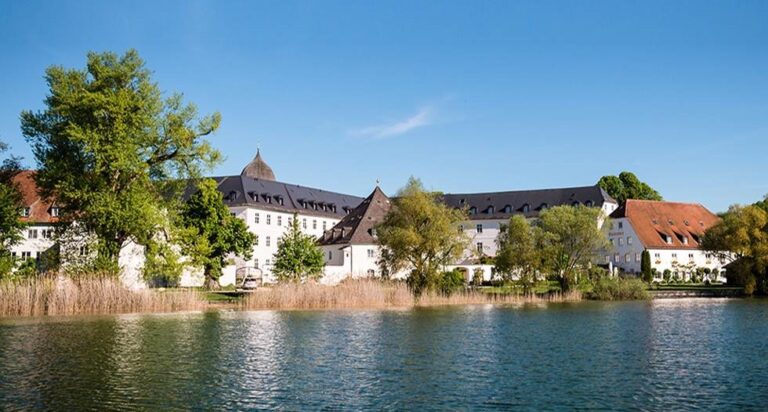
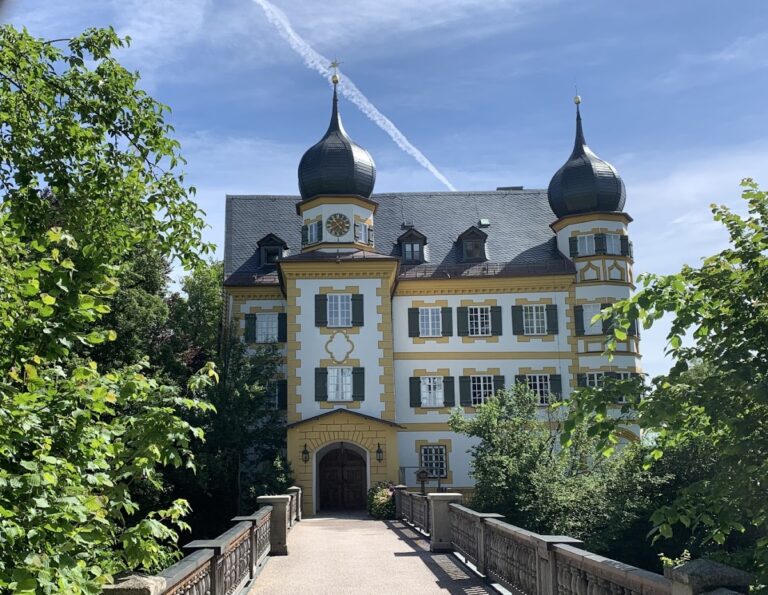
The preserved complex stands between Schloßsee and Langbürgner See in the Hartmannsberg district of Bad Endorf, at approximately 532 metres above sea level. The present castle, built around 1685, is a three-storey Baroque structure with a hipped roof, which slopes on all four sides, and plaster detailing. Its form represents the surviving principal building of the former water castle.
Castle chapel
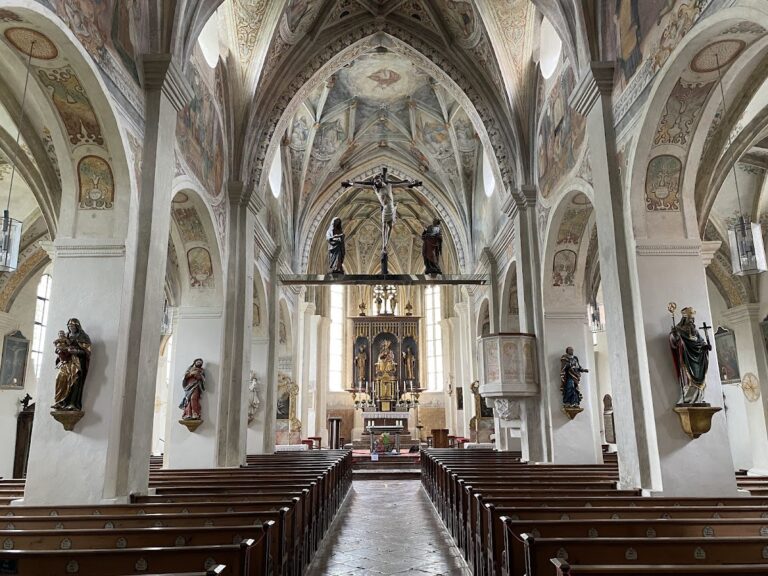
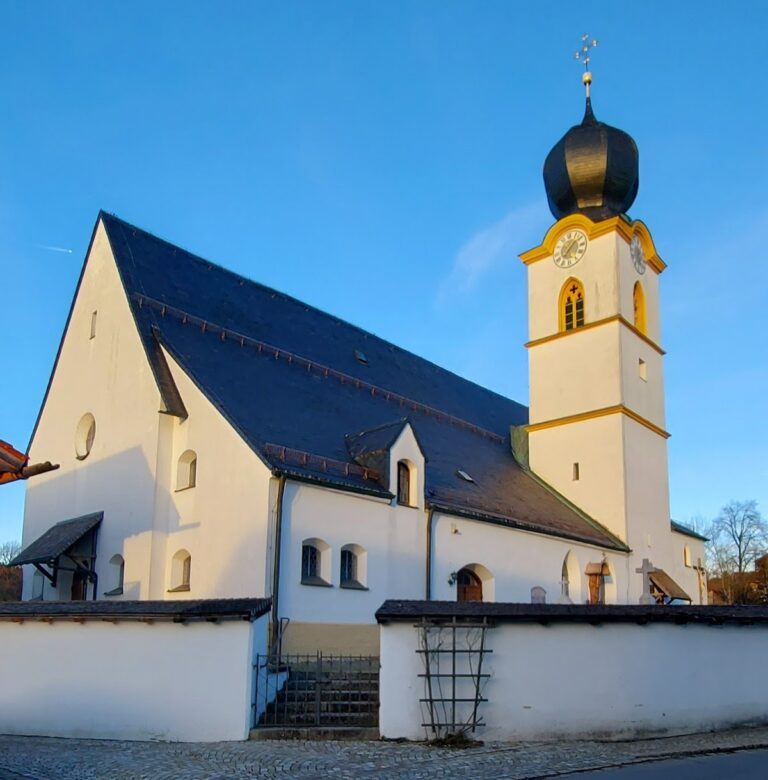
A chapel dating from 1737 is directly attached to the main building. It has a gabled roof with two sloping sides ending at a triangular gable, together with a tall roof turret capped by an onion dome. The chapel’s interior furnishings are also part of the surviving complex.
Service buildings and grounds
The service buildings and the Bundwerk barn belong to the nineteenth and early twentieth centuries. The barn is a traditional timber-framed agricultural building whose walls use a characteristic framework of wooden members and infill. The group includes a two-storey building with a gabled roof and partly Bundwerk framework walls. A park forms part of the complex.
Archaeological remains and related sites
Subsurface medieval and early-modern remains of Hartmannsberg and its predecessor buildings survive within the area of Schloss Hartmannsberg. The former Zickenburg stood 375 metres north-northwest of the castle, while the former Zinnenburg was located 575 metres north-northwest of it.