Klein Palace: A Neo-Renaissance Urban Palace in Brno
Site at a Glance
- Rating
- 4.7
- Popularity
- Very Low
- Country
- Czechia
- Primary era
- Modern
- Eras represented
- Modern
- Civilizations
- Habsburg
- Site type
- Domestic
- Remains
- Elite Residence
On this page8 sections
History
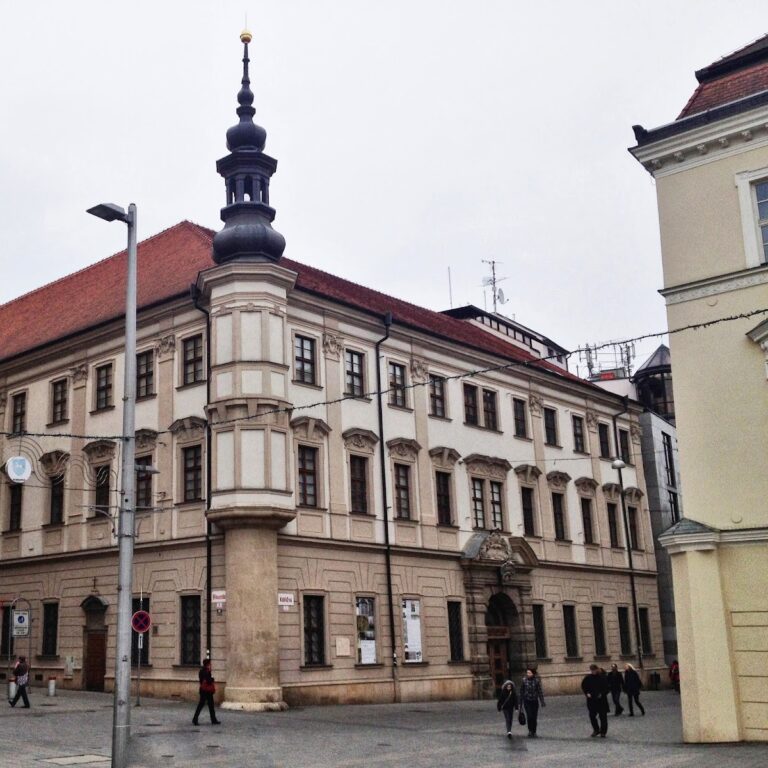
Klein Palace is a Neo-Renaissance urban palace in Brno, Czechia, built as a family residence in 1847–1848. The nineteenth-century Neo-Renaissance style revived forms and decoration associated with Renaissance buildings. The palace was designed for Franz Klein by Ludwig Förster and Theophil Hansen and has been protected as a cultural monument since 1958.
Construction and the Klein family
The site was formerly occupied by a house known as “U zlaté kule.” Franz Klein, an Austrian entrepreneur from the Klein family, purchased it in 1842 and later had it demolished. Between 1847 and 1848, he commissioned the new residence that became Klein Palace.
The Klein family owned an ironworks at Sobotín, and the palace’s extensive use of cast iron reflected the family’s main source of income. The family also worked in road and railway construction, including the Hodonín–Olomouc–Prague route, as well as river-regulation and fortification projects.
Changes of ownership
In 1880, Franz Klein II bequeathed the palace to his sister Maria Klein, who was married to the lawyer and politician Eduard Ulrich. Their son, the lawyer and politician Eduard Ulrich Jr., became a co-owner in 1885.
Following Eduard Ulrich Jr.’s suicide in 1904, his heirs sold the building to Karl Buchta, a manufacturer of musical instruments. Buchta’s descendants retained ownership until 1945. The City of Brno acquired the palace in 1949, after which it ceased to serve as a residence.
Decline and renovation
During the following decades, alterations made by various organizations damaged the building. Fire and water leaks added to its deterioration. Ownership passed to the Prague branch of Crédit Lyonnais in 1994, and the bank carried out a complete renovation between 1995 and 1997. The project was prepared by the K4 architectural office, and the palace reopened after the conservation work in 1997.
The renovation included a 90-year lease on part of the building. Crédit Lyonnais was acquired by Crédit Agricole in 2003; Crédit Agricole withdrew from the Czech banking market in 2012 and sold its rights to the palace premises. From 2011, the building housed the Serious Music Department of the Mahen Library, a public library institution in Brno, a Moravian branch of the Czech Bar Association, and a Crédit Lyonnais branch. In 2024, its occupants included several shops, the Jiří Mahen Library information centre, and the Brno branch of the Czech Bar Association.
Remains
Building and facade
Klein Palace is a Neo-Renaissance bourgeois townhouse, or urban palace, organized around a principal facade and an interior atrium. Its most distinctive external features are the cast-iron bay windows, windowed projections extending outward from the facade, especially on the first and second floors. The cast-iron elements were produced at the Klein family’s ironworks in Sobotín.
Entrance portal
The building includes a portal decorated with a mascaron, an ornamental representation of a face. Cast-iron decorative elements also form part of the palace’s architectural treatment, connecting its appearance with the industrial enterprise that financed the Klein family’s residence.
Atrium
The interior contains an atrium, an inner court or central open space, which is covered by a glass roof. The renovation added modern engineering systems and an elevator, while preserving the building’s principal architectural features. A lantern forms part of the atrium design.
Nearby sites