Haus Venauen: A Former Noble Residence in Rösrath, Germany


Site at a Glance
- Rating
- 4.4
- Popularity
- Very Low
- Country
- Germany
- Primary era
- Modern
- Eras represented
- Early Modern, Modern
- Civilizations
- German, Holy Roman Empire
- Site type
- Domestic
- Remains
- Manor House
On this page8 sections
History
Haus Venauen is a former noble residence in Rösrath, Germany, whose origins reach back to 1555, when Peter von Bellinghausen began a building at Finawen, later known as Venauen. The name “Finawen” means “marshy meadow.” The estate developed through several forms of aristocratic and bourgeois ownership before becoming a grand bourgeois villa in the early twentieth century.
From estate to noble residence
In 1596, Venauen was described as an allodial property, meaning that its owner held it independently rather than as a feudal fief. Between 1617 and 1638, it appeared in the knightly registers as a Landtagsfähiges Gut, an estate whose owner had the status required to participate in a regional assembly.
In 1669, ownership passed to the Bertolf von Belven family, descended from Aachen mayor Johann Bertolf and his wife, Nese Polleyn von Kettenis of the Belven estate. Around 1670, Johann Karl Bertolf von Belven remodelled the house. This work established the basic structural form that remained until the beginning of the twentieth century.
The von Francken period
Haus Venauen later came into the possession of the von Francken family. Its first lord of Venauen was Johann Werner von Francken, a major in Electoral Cologne, the ecclesiastical principality of the Holy Roman Empire ruled by an archbishop who held the rank of elector. He lived from 1706 to 1769. The family’s last lord of Venauen was Karl Philipp von Francken, who lived from 1784 to 1814.
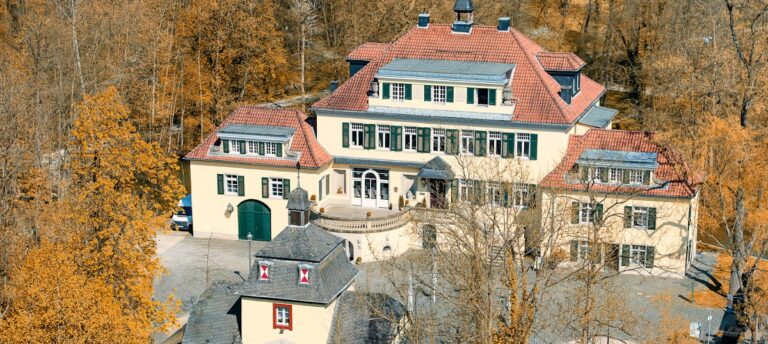
During the nineteenth century, ownership increasingly passed to bourgeois proprietors. Felix Mayer and his wife, Kathinka, née Neven DuMont, commissioned the Cologne architect Heinrich Müller-Erkelenz to remodel the house in 1907. The renovation transformed the estate into a grand bourgeois villa in the Heimatstil, a German architectural movement that used regional forms and materials to evoke local tradition. Mayer himself described the property as a knightly estate.
Twentieth-century institutions
From 1938 to 1945, Haus Venauen housed a regional school of the National Socialist People’s Welfare organization. This Nazi social-welfare institution also served the regime’s political and ideological purposes. The school’s ideological design included an eagle sculpture installed in 1938.
Beginning in 1950, the estate accommodated a Belgian boarding school and state secondary school, known in French as an Athénée Royal. The boys’ dormitories were located at Venauen, while the girls were initially housed at nearby Eulenbroich Castle. A French-speaking prefect directed the school until 1963. Belgium’s linguistic conflict affected the institution, and in 1963 the Flemish community demanded a separate Dutch-language section. By 1966, that section had been transferred entirely to Bensberg Castle.
Later reuse and protection
The Belgian occupants left in 2003. Plans then followed for a commercial site and an elderly-care facility. From 2004 to 2012, an ancillary building was occupied by the Martin Luther King School, a special-needs school of the Rheinisch-Bergisch district focused on emotional and social development.
The complex was completely renovated between 2012 and 2013 and converted into 17 privately owned apartments. Haus Venauen is protected as a listed monument and is recorded as architectural monument no. 23 in the City of Rösrath’s monument register. The eagle sculpture is also protected. Its survival provides a material reminder of the estate’s National Socialist past, and the Rösrath Historical Association proposed an information panel explaining its history.
Remains
Estate layout and setting
Haus Venauen stands approximately 150 metres from the Sülz River. The estate was designed for an agrarian form of landholding, and its two side wings contained exclusively agricultural utility rooms. The house retained the structural arrangement established by the remodelling around 1670 until the 1907 renovation, when Heinrich Müller-Erkelenz reshaped it as a grand bourgeois villa in the Heimatstil. The renovated complex now contains 17 privately owned apartments.
Courtyard sculpture
An eagle sculpture stands in the inner courtyard. It was erected for the inauguration of the National Socialist regional school in 1938 and remains a protected component of Haus Venauen. The sculpture connects the surviving physical fabric of the estate with its use by the Nazi regional training institution.